Key Findings
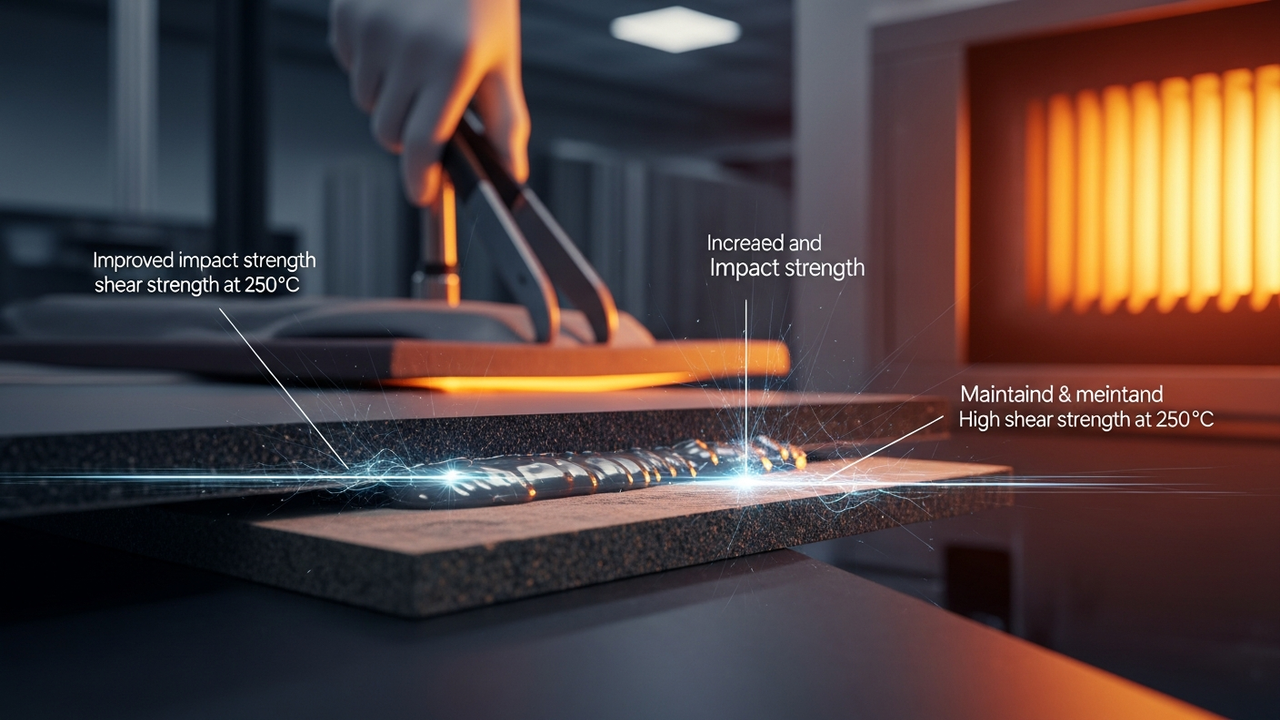
Groundbreaking research published in Industrial & Engineering Chemistry Research has unveiled a novel strategy for synergistically toughening solvent-free modified cyanate ester resins. An optimized formulation, designated CE2, exhibited an impressive 105.7% increase in impact strength, crucially without compromising its exceptionally high glass transition temperature (Tg) of 267 °C. When applied as a structural adhesive, this advanced material achieved a robust shear strength of 21.2 MPa at 25 °C and maintained a significant 13.5 MPa even at an elevated temperature of 250 °C, offering a practical and effective route to developing high-performance cyanate ester adhesives and composites for extreme thermal environments.
Technical / Clinical Details
The innovative toughening mechanism involves a precise combination of specific modifiers and curing agents that are integrated into the cyanate ester resin network. This approach enhances the resin’s ability to dissipate stress at a molecular level, translating into macroscopic improvements in toughness. The solvent-free nature of the formulation is a significant environmental and manufacturing advantage, reducing volatile organic compound (VOC) emissions and simplifying processing. The high Tg ensures excellent thermal stability and mechanical property retention at elevated temperatures, making it suitable for demanding applications in aerospace, automotive, and advanced electronics. The sustained shear strength at 250 °C is particularly noteworthy, indicating superior bond line integrity under severe thermal stress.
Background & Context
Cyanate ester resins are highly valued in high-performance applications due to their superior thermal resistance, low dielectric loss, and excellent mechanical properties. However, their inherent brittleness has historically limited their use in applications requiring high impact resistance or exposure to thermal cycling. Traditional toughening methods often come at the cost of reduced thermal performance or other mechanical properties. This new synergistic toughening strategy addresses these limitations by offering a method to simultaneously enhance toughness and maintain or improve other critical characteristics, representing a significant advancement in polymer material science.
Strategic Significance & Outlook
The development of this solvent-free, highly toughened cyanate ester resin holds profound implications for the design of next-generation high-temperature adhesives and composites. Potential applications span critical sectors such as lightweight structures in aerospace, encapsulants for high-power electronics, and components in high-temperature automotive areas, all of which demand exceptional reliability under extreme conditions. This research not only provides new insights into the fundamental principles of high-performance polymer design but also paves the way for the creation of more robust, efficient, and environmentally sustainable material solutions that can meet future engineering challenges.
Get our weekly technology intelligence — free
Receive an infographic that lets you judge at a glance whether each field’s analysis report is worth reading.
Subscribe Free — Weekly Tech Intelligence
By subscribing, you’ll receive Troy-Technical’s weekly technology intelligence newsletter.
- Your email and selected fields are used only to deliver the newsletter.
- We never share your information with third parties.
- You can unsubscribe anytime via the link in each email.
See our Privacy Policy for details.
Takes about a minute · Unsubscribe anytime