Background
mRNA therapeutics hold transformative promise across a spectrum of diseases, from infectious disease vaccines to cancer immunotherapies and treatments for genetic disorders. However, the inherent instability of mRNA and its challenge in intracellular delivery underscore the critical need for efficient and safe delivery systems. Lipid nanoparticles (LNPs) have emerged as the most successful platform for mRNA delivery, unequivocally demonstrating their efficacy in COVID-19 vaccines. Despite this success, a major hurdle remains: the predominant accumulation of most LNPs in the liver, making targeted delivery to extra-hepatic organs and specific cell types a formidable challenge. This groundbreaking research aims to provide a profound understanding of LNP composition and function, paving the way for the rational design of more precise, next-generation mRNA delivery systems tailored for specific organs and cells. Such advancements are crucial for overcoming current LNP limitations and broadening the therapeutic applicability of mRNA to a wider range of conditions.
Key Findings
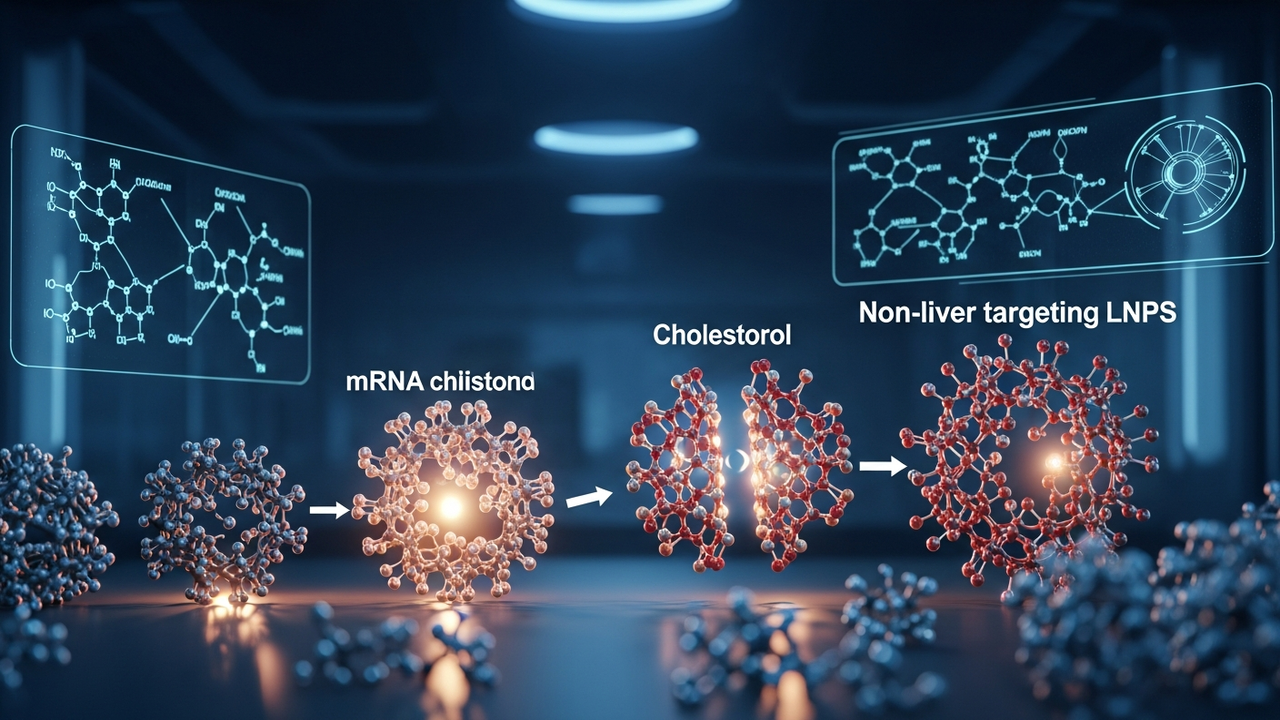
A groundbreaking investigation into the fundamental components of mRNA lipid nanoparticles (LNPs) has meticulously unraveled the distinct functional roles each lipid plays in gene delivery efficacy and organ targeting. This research marks a significant leap forward in the rational design of LNPs, most notably by demonstrating that cholesterol is not required for successful non-hepatic targeted delivery.
The study employed a systematic modulation of the four primary lipid components within LNPs: ionizable lipid, cholesterol, helper lipid, and PEG-lipid, thoroughly assessing their individual and combinatorial impacts. Key findings reaffirmed the critical role of ionizable lipids in mRNA encapsulation and efficient intracellular release, cementing their status as indispensable for delivery. More remarkably, while cholesterol proved vital for LNP stability and specific targeting to the liver, it was found to be entirely dispensable for mRNA delivery to extra-hepatic tissues like the spleen and lungs. This pivotal discovery suggests the viability of designing cholesterol-free LNPs for therapies aimed at targets beyond the liver.
Furthermore, PEG-lipids were identified as decisive determinants of LNP particle size, systemic circulation time, and overall in vivo organ biodistribution. Intriguingly, LNPs formulated without PEG-lipids exhibited a pronounced tropism for the spleen, thereby opening new avenues for developing highly specialized LNP designs for spleen-specific therapeutic interventions.
Outlook and Implications
The profound insights garnered from this research establish a crucial foundation for accelerating the optimization of LNPs in the ongoing development of mRNA therapeutics. The newfound ability to precisely tailor LNP compositions, for instance, enables the design of formulations specifically targeting extra-hepatic diseases like those of the spleen or lungs. This specificity promises not only enhanced therapeutic efficacy but also a significant reduction in systemic side effects, thereby improving patient safety and outcomes. Furthermore, this granular understanding of individual lipid component roles will bolster the accuracy of in silico design approaches leveraging artificial intelligence (AI) and computational science, potentially dramatically shortening drug development timelines.
Looking ahead, the critical next steps involve rigorously validating the in vivo safety and efficacy of these innovative LNP designs. The scientific and medical communities eagerly await to see how these advancements will translate into the practical realization of precisely targeted mRNA therapeutics for a broad spectrum of currently underserved diseases, heralding a new era of precision medicine.
Source: https://pubs.acs.org/ancac3/article/20/31/22008/5232330/Decoding-the-Functional-Roles-of-Individual
Get our weekly technology intelligence — free
Receive an infographic that lets you judge at a glance whether each field’s analysis report is worth reading.
Subscribe Free — Weekly Tech Intelligence
By subscribing, you’ll receive Troy-Technical’s weekly technology intelligence newsletter.
- Your email and selected fields are used only to deliver the newsletter.
- We never share your information with third parties.
- You can unsubscribe anytime via the link in each email.
See our Privacy Policy for details.
Takes about a minute · Unsubscribe anytime