Key Findings
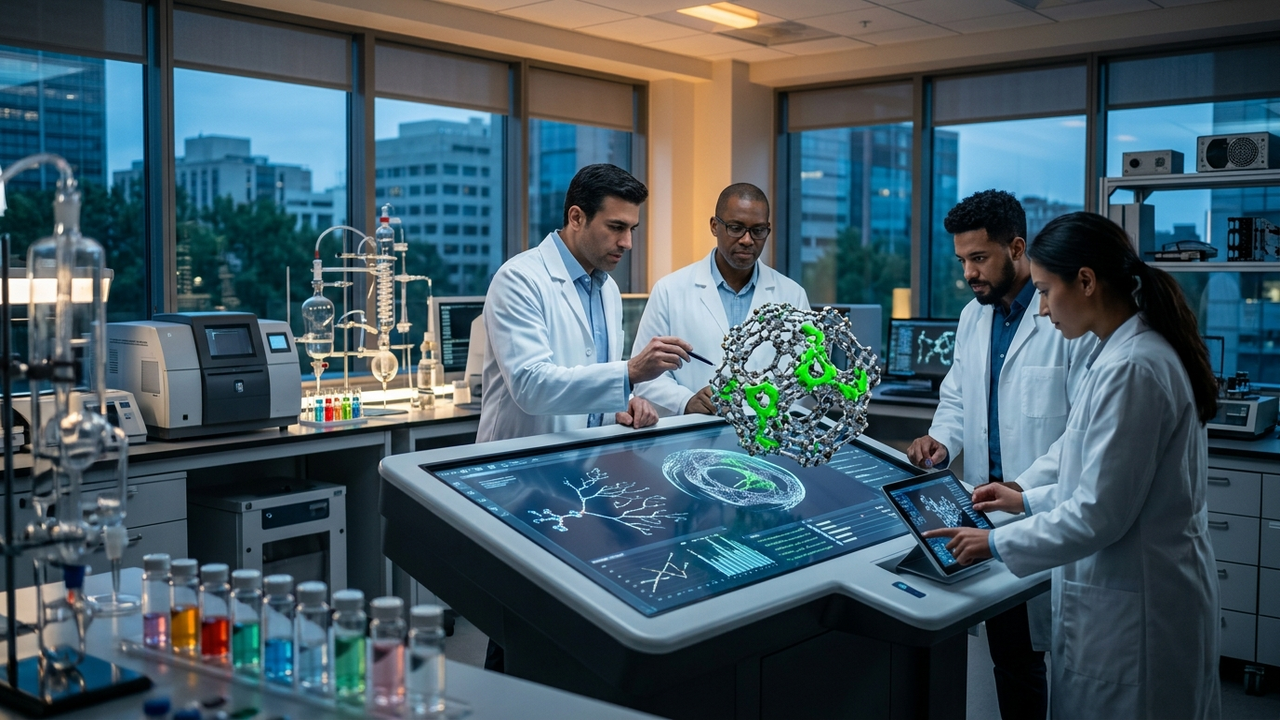
A research laboratory at the Pritzker School of Molecular Engineering (PME) at the University of Chicago has developed a machine learning (ML)-driven, end-to-end workflow designed to efficiently transition materials discovery from academic ideas to manufacturable realities. Applying this innovative process, the research team successfully created two novel zinc-based Metal-Organic Frameworks (MOFs), ‘UCHI-1’ and ‘UCHI-2,’ specifically tailored for methane separation. This achievement overcomes significant bottlenecks in computational materials discovery, enabling the rapid development of high-performance materials essential for climate change mitigation.
Technical / Clinical Details
The developed ML-driven workflow integrates multiple computational and experimental stages. Initially, machine learning models predict MOF candidates with specific functionalities (in this case, methane separation capabilities) based on vast material databases and physical principles. Subsequently, detailed first-principles calculations and molecular simulations are performed on these candidates to evaluate their performance and stability. Crucially, the workflow is also designed to consider manufacturability aspects, such as ease of physical synthesis and cost-effectiveness. UCHI-1 and UCHI-2 were predicted by simulations to exhibit superior methane separation properties and were subsequently synthesized and characterized. These MOFs demonstrated significantly improved methane separation efficiency compared to conventional MOFs, presenting a potential practical solution for reducing greenhouse gas emissions.
Background & Context
Methane is a potent greenhouse gas, and its emission reduction is an urgent challenge in combating climate change. Efficient separation and capture of methane from industrial processes and natural gas production are critically important for mitigating global warming. However, existing methane separation technologies often suffer from high energy consumption and insufficient efficiency. MOFs, with their high porosity and tunable structures, are attracting attention as next-generation materials for gas separation, but the discovery of MOFs with desired properties has been time-consuming. This ML-driven workflow provides a powerful tool to overcome these challenges and accelerate innovation in climate change mitigation technologies.Strategic Significance & Outlook
This achievement by the University of Chicago PME lab further strengthens the role of AI in materials science. The end-to-end workflow is applicable not only to methane-separating MOFs but also to the discovery of new materials for various other applications, including other gas separations, catalysis, and energy storage. In the future, it is highly possible that such ML-driven frameworks will integrate with autonomous laboratories to realize fully automated material discovery platforms with minimal human intervention. This is expected to bring innovative materials, essential for a sustainable society, to market at unprecedented speeds.
Get our weekly technology intelligence — free
Receive an infographic that lets you judge at a glance whether each field’s analysis report is worth reading.
Subscribe Free — Weekly Tech Intelligence
By subscribing, you’ll receive Troy-Technical’s weekly technology intelligence newsletter.
- Your email and selected fields are used only to deliver the newsletter.
- We never share your information with third parties.
- You can unsubscribe anytime via the link in each email.
See our Privacy Policy for details.
Takes about a minute · Unsubscribe anytime