Key Findings
The integration of Artificial Intelligence (AI), particularly DeepMind’s GNoME model, with ‘self-driving labs’ has demonstrated a dramatic reduction in the time required for new materials discovery, compressing processes from months to just days. This breakthrough showcases how AI-powered lab automation systems can autonomously design, synthesize, and characterize new materials by harnessing robotics and machine learning algorithms. This significantly enhances the efficiency of materials science research and is expected to accelerate innovation across various industries.
Technical / Clinical Details
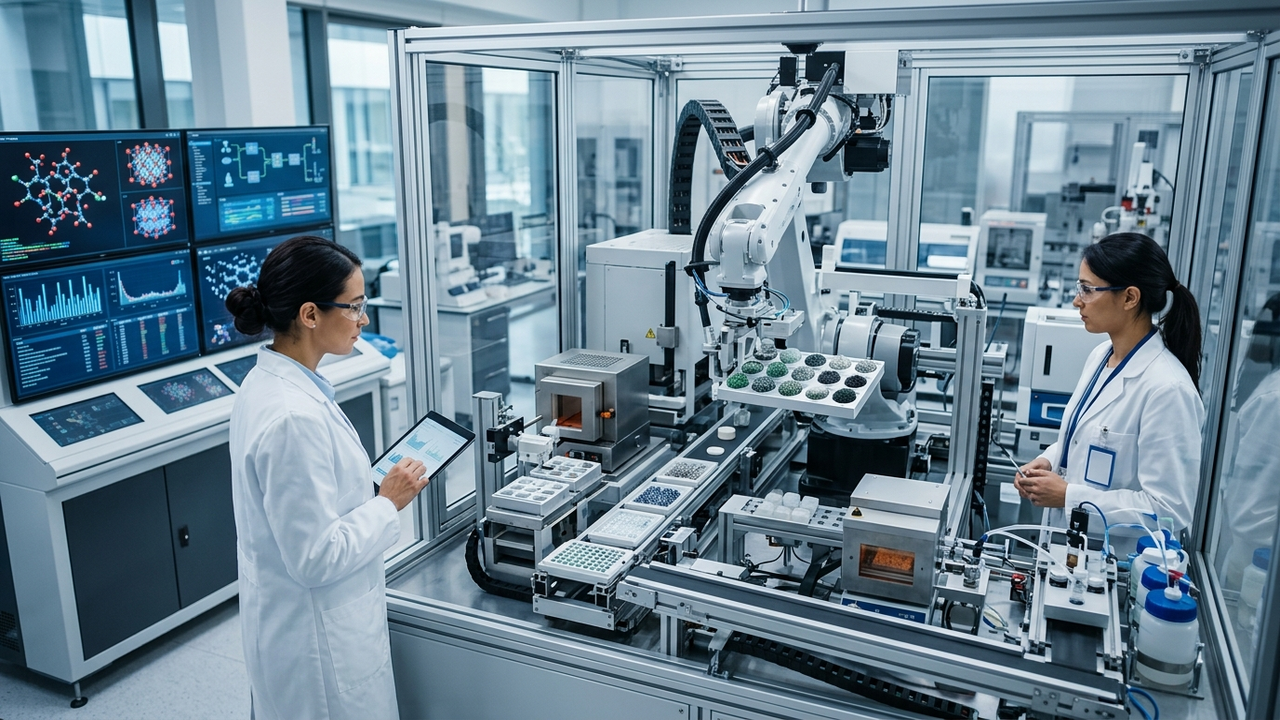
GNoME (Graph Networks for Materials Exploration) is a powerful AI model capable of predicting stable, novel material candidates after learning from millions of crystal structure data points. Materials candidates proposed by GNoME are then sent to advanced analytical facilities, such as the Advanced Photon Source (APS), or autonomous laboratories (self-driving labs). Autonomous labs are integrated platforms that combine robotic arms, automated dispensing systems, and real-time sensor data analysis. AI adjusts experimental parameters, while robots synthesize, test, and analyze the materials. In this closed-loop system, AI continuously learns from new experimental data, iteratively optimizing the material design process. For example, one such autonomous lab synthesized and evaluated 36 different materials in 17 days, overwhelmingly surpassing the speed and efficiency of traditional human-led labs. This automated approach enables breakthroughs in a wide range of fields, including solar energy materials, high-performance batteries, and efficient catalysts.
Background & Context
Historically, materials discovery and development have been time-consuming and costly processes, representing a major bottleneck for technological innovation. High-performance materials are indispensable for the advancement of cutting-edge industries such as clean energy, advanced electronics, and space exploration. The progress in AI and robotics is fundamentally transforming this traditional approach, paving the way for the ‘fifth paradigm’ of scientific discovery. This enables researchers to rapidly identify, synthesize, and evaluate materials with desired properties from a vast number of candidates, accelerating technological development towards solving global challenges.
Strategic Significance & Outlook
The integration of AI and autonomous labs is poised to redefine the future of materials science. As this technology matures, humans will be able to focus on higher-level research questions and strategic decision-making, while AI and robots handle routine tasks. In the future, it is plausible that systems will emerge where, given only specific functional requirements, AI autonomously designs, synthesizes, tests, and ultimately identifies optimal materials. This is expected not only to further shorten material development cycles and reduce costs but also to enable the creation of entirely new types of materials never before discovered, bringing immeasurable benefits to human society.
Get our weekly technology intelligence — free
Receive an infographic that lets you judge at a glance whether each field’s analysis report is worth reading.
Subscribe Free — Weekly Tech Intelligence
By subscribing, you’ll receive Troy-Technical’s weekly technology intelligence newsletter.
- Your email and selected fields are used only to deliver the newsletter.
- We never share your information with third parties.
- You can unsubscribe anytime via the link in each email.
See our Privacy Policy for details.
Takes about a minute · Unsubscribe anytime