Key Findings
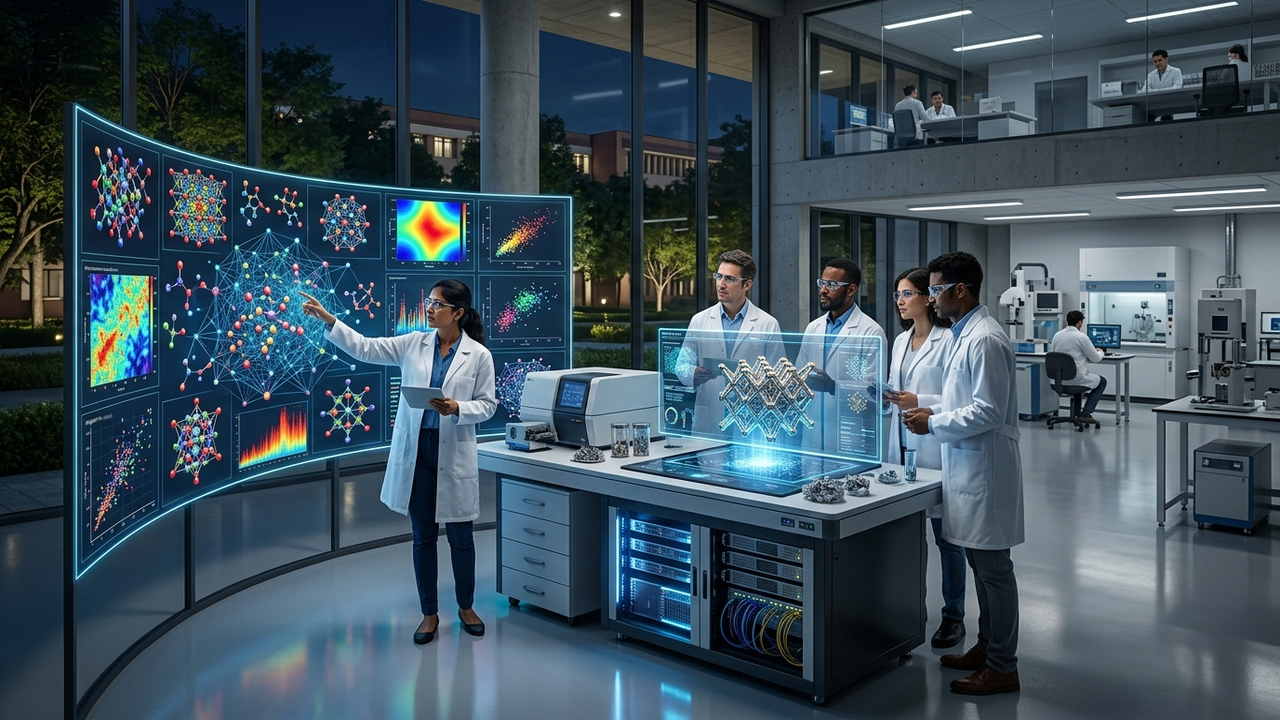
The Indian Institute of Technology Madras (IIT Madras) has developed the world’s largest open database of advanced alloys, driven by an AI-powered prediction system, to advance sustainable materials research. This groundbreaking database is poised to revolutionize the exploration and understanding of High-Entropy Alloys (HEAs) in particular.
Technical / Clinical Details
The developed database integrates millions of data points related to alloy compositions, crystal structures, thermodynamic stabilities, and mechanical properties. AI models learn complex patterns and correlations from this vast dataset, enabling them to predict the properties of novel, as-yet unsynthesized alloys with high accuracy. High-Entropy Alloys, specifically, hold promise for exhibiting superior properties (e.g., high strength, ductility, corrosion resistance, high-temperature stability) not found in conventional alloys, due to the mixing of multiple elements in near-equimolar ratios. However, their vast design space has made traditional exploration challenging. IIT Madras’s AI-driven system efficiently navigates this immense design space, allowing for rapid identification of promising HEA candidates. This significantly shortens the cycle of experimental synthesis and evaluation, reducing development costs. The database is open-access, making it available to researchers worldwide.
Background & Context
Modern society demands more high-performance and durable materials across various sectors, including aerospace, energy, automotive, and biomedicine. Materials combining properties such as lightweight, high heat resistance, and corrosion resistance are key to technological innovation. However, traditional alloy development has been slow, relying on trial-and-error heuristics and limited experimental data. The fusion of AI and materials informatics is gaining global attention as a powerful approach to address this challenge, with leading research institutions in the US and Europe also pursuing similar initiatives. IIT Madras’s achievement demonstrates leadership in AI-driven materials science research in the South Asian region.
Strategic Significance & Outlook
The release of this world’s largest open database of advanced alloys by IIT Madras will open new frontiers for sustainable materials research. In the aerospace sector, it will accelerate the development of lighter, more heat-resistant engine components and structural materials, contributing to improved fuel efficiency and reduced CO2 emissions. In the energy sector, it will aid in the discovery of high-efficiency power generation turbines and materials for fusion reactors. In manufacturing, it could lead to extended tool life and improved component durability. This database and the AI-driven prediction capabilities are expected to help researchers discover groundbreaking alloys more rapidly and efficiently, drastically reducing the time it takes for these materials to be implemented in society, thereby contributing to both economic growth and environmental sustainability.
Get our weekly technology intelligence — free
Receive an infographic that lets you judge at a glance whether each field’s analysis report is worth reading.
Subscribe Free — Weekly Tech Intelligence
By subscribing, you’ll receive Troy-Technical’s weekly technology intelligence newsletter.
- Your email and selected fields are used only to deliver the newsletter.
- We never share your information with third parties.
- You can unsubscribe anytime via the link in each email.
See our Privacy Policy for details.
Takes about a minute · Unsubscribe anytime





Comments