
Key Findings
At its 2026 Annual Meeting, the Molecular Foundry at Lawrence Berkeley National Laboratory outlined crucial directions for the future of computational materials science. Highlights included a keynote on the quantum accuracy scale transition from Density Functional Theory (DFT) to Machine Learning Interatomic Potentials (MLIP), and the announcement of plans for two new autonomous laboratories: the ‘Materials Foundry’ for automated powder synthesis and ‘NanoBio MDS’ for metalloprotein discovery. These initiatives are poised to significantly accelerate discoveries in both materials and biosciences.
Technical / Clinical Details
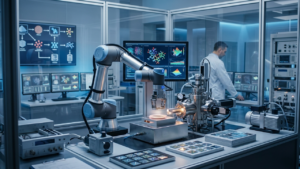
The conference focused on the potential of MLIPs to maintain the high accuracy offered by ab initio calculations like DFT, while drastically reducing computational costs. MLIPs enable extensive simulations and high-throughput screening, dramatically boosting the efficiency of new material exploration. The two announced autonomous labs aim to automate research processes and minimize human intervention. The Materials Foundry will integrate robotic arms, automated analytical instruments, and AI algorithms to autonomously explore and optimize inorganic powder synthesis conditions. This could shorten synthesis processes that traditionally took months or years to just days or weeks. Concurrently, NanoBio MDS (Materials Discovery System) will automate the synthesis, characterization, and functional analysis of complex biomaterials like metalloproteins, targeting applications in new drug development and biosensing.
Background & Context
Modern scientific research demands vast experimental data and computational power for understanding complex phenomena and creating new technologies. Particularly in materials science and biotechnology, accelerating the pace of discovery is key to industrial competitiveness and solving societal challenges. Lawrence Berkeley National Laboratory, a leading institution under the U.S. Department of Energy (DOE), has historically driven advanced scientific research. This announcement further strengthens its leadership by integrating AI and automation technologies. The concept of autonomous labs is gaining traction among major research institutions worldwide, symbolizing a paradigm shift in research and development.
Strategic Significance & Outlook
These new initiatives will have immeasurable impacts on the fields of materials science and biosciences. The transition from DFT to MLIP will enable simulations of larger and more complex material systems, accelerating the development of high-performance batteries, catalysts, and semiconductors. The Materials Foundry and NanoBio MDS will fundamentally transform the discovery processes for inorganic and biological materials, respectively, significantly reducing the lead time for bringing new functional materials and pharmaceuticals to market. In the future, these autonomous labs are expected to collaborate and drive interdisciplinary research, contributing to the realization of ‘smart labs’ where humans and AI work synergistically to dramatically improve the efficiency and speed of scientific discovery. This will accelerate technological innovations essential for addressing global energy and health challenges.
Source: https://foundry.lbl.gov/2026/08/24/aum2026recap/
Get our weekly technology intelligence — free
Receive an infographic that lets you judge at a glance whether each field’s analysis report is worth reading.
Subscribe Free — Weekly Tech Intelligence
By subscribing, you’ll receive Troy-Technical’s weekly technology intelligence newsletter.
- Your email and selected fields are used only to deliver the newsletter.
- We never share your information with third parties.
- You can unsubscribe anytime via the link in each email.
See our Privacy Policy for details.
Takes about a minute · Unsubscribe anytime





Comments