Key Findings
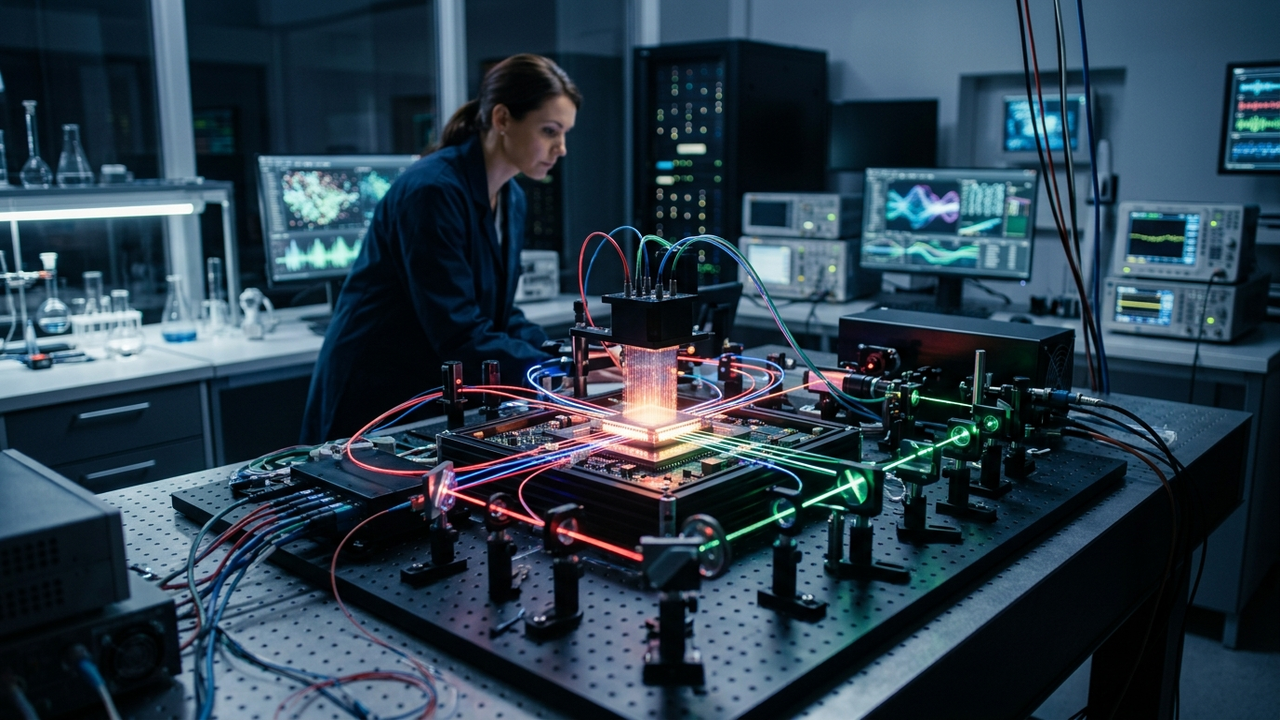
Optalysys has successfully demonstrated a novel photonic hardware that performs computations directly while data is in transit between storage and processors. This pioneering ‘compute-in-transit’ paradigm offers a fundamental solution to the pervasive data movement bottleneck plaguing modern computing systems, particularly for AI and cryptographic workloads. This approach is expected to dramatically reduce processing latency, bandwidth constraints, and energy consumption, potentially revolutionizing demanding applications such as AI and fully homomorphic encryption (FHE).
Technical / Clinical Details
- Principle of Compute-in-Transit: Optalysys’s technology leverages the physical properties of light to perform computations as data signals propagate. This involves passing light signals through specific optical elements that execute mathematical operations during transmission. In contrast, traditional electronic computing requires data to be moved from memory to CPU/GPU, computed, and then moved back, a process that consumes vast amounts of energy and time.
- Advantages of Photonic Hardware: Light propagates faster than electrons and can carry information with lower energy. Additionally, multiple light signals can pass through the same spatial medium without interfering, allowing for high parallelism. Optalysys’s photonic hardware maximizes these characteristics to efficiently perform calculations commonly used in AI and cryptography, such as vector-matrix multiplications.
- Target Workloads: The technology is specifically aimed at computationally intensive applications like AI model inference and training, and fully homomorphic encryption (FHE), which demands high security. FHE, allowing computations on encrypted data for privacy preservation, has been hampered by high computational costs. Compute-in-transit holds the potential to address this challenge.
Background & Context
Modern data centers and AI systems are increasingly grappling with issues known as the ‘memory wall’ and ‘data movement bottleneck.’ This problem arises because the increase in processor speed far outpaces the improvements in data transfer rates and memory bandwidth, limiting overall system performance. This bottleneck leads to increased power consumption and reduced processing speeds, particularly for large-scale AI models and complex cryptographic algorithms. Optical computing is recognized as one of the most promising technologies globally for overcoming this critical bottleneck.
Strategic Significance & Outlook
Optalysys’s compute-in-transit technology has the potential to revolutionize the fields of AI and cybersecurity. By fusing data movement and computation, AI model training and inference can be conducted faster and more energy-efficiently, opening new pathways for real-time AI applications. Moreover, a substantial reduction in FHE computational costs could accelerate the adoption of privacy-preserving computing across all sectors handling sensitive data, including finance, healthcare, and government. This technology represents a groundbreaking advancement capable of transforming data center design philosophies and redefining the future of computing.
Source: https://quantumzeitgeist.com/compute-data-travels-optalysys-aims/
Get our weekly technology intelligence — free
Receive an infographic that lets you judge at a glance whether each field’s analysis report is worth reading.
Subscribe Free — Weekly Tech Intelligence
By subscribing, you’ll receive Troy-Technical’s weekly technology intelligence newsletter.
- Your email and selected fields are used only to deliver the newsletter.
- We never share your information with third parties.
- You can unsubscribe anytime via the link in each email.
See our Privacy Policy for details.
Takes about a minute · Unsubscribe anytime





Comments