
Key Findings
Periodic Labs, a venture-backed startup, was established in 2025 by former senior researchers from OpenAI and Google DeepMind. The company has set an ambitious mission: to accelerate scientific discovery, particularly in the field of materials science, by harnessing the cutting-edge capabilities of artificial intelligence (AI).
Technical / Clinical Details
Periodic Labs applies AI technologies such as deep learning, reinforcement learning, and generative models to vast datasets in materials science. This enables high-precision and high-speed molecular structure design, material property prediction, and synthesis pathway optimization. At its core, the company utilizes technologies like GNNs (Graph Neural Networks) and MLPs (Machine Learning Interatomic Potentials), adopting a data-driven approach that integrates ab initio calculations with experimental data. This paradigm shifts traditional trial-and-error dependent materials development processes towards efficient, rational AI-driven exploration, significantly shortening development cycles. The company’s technology focuses on developing new catalysts, high-performance battery materials, semiconductors, and sustainable composites.
Background & Context
Advancements in materials science form the bedrock of almost all modern technological innovations, yet the discovery and development of new materials are notoriously time-consuming and costly. The integration of AI is seen as a powerful tool to address these challenges, with major tech companies and research institutions increasingly focusing on the convergence of AI and materials science. Periodic Labs, by bringing together experts with frontline experience in AI research, aims to carve out a unique strength in this emerging frontier. The venture capital backing signifies strong confidence in their technology and business model, positioning them as a potential catalyst for accelerating innovation across the industry.
Strategic Significance & Outlook
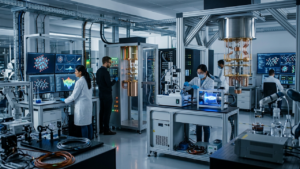
Periodic Labs aims to dramatically enhance the pace of discovery in materials science and drive innovation across diverse industries, including pharmaceuticals, energy, electronics, and automotive, by leveraging the power of AI. Their goal is to build autonomous laboratory systems that can efficiently synthesize and evaluate AI-designed materials. This is expected to realize a ‘closed-loop’ materials development cycle where AI explores and generates optimal materials for human-defined objectives, followed by physical experimental validation. This approach promises to reduce materials development lead times from years to months, playing a crucial role in accelerating the creation of new materials necessary for a sustainable future.
Source: #
Get our weekly technology intelligence — free
Receive an infographic that lets you judge at a glance whether each field’s analysis report is worth reading.
Subscribe Free — Weekly Tech Intelligence
By subscribing, you’ll receive Troy-Technical’s weekly technology intelligence newsletter.
- Your email and selected fields are used only to deliver the newsletter.
- We never share your information with third parties.
- You can unsubscribe anytime via the link in each email.
See our Privacy Policy for details.
Takes about a minute · Unsubscribe anytime








Comments