Key Findings
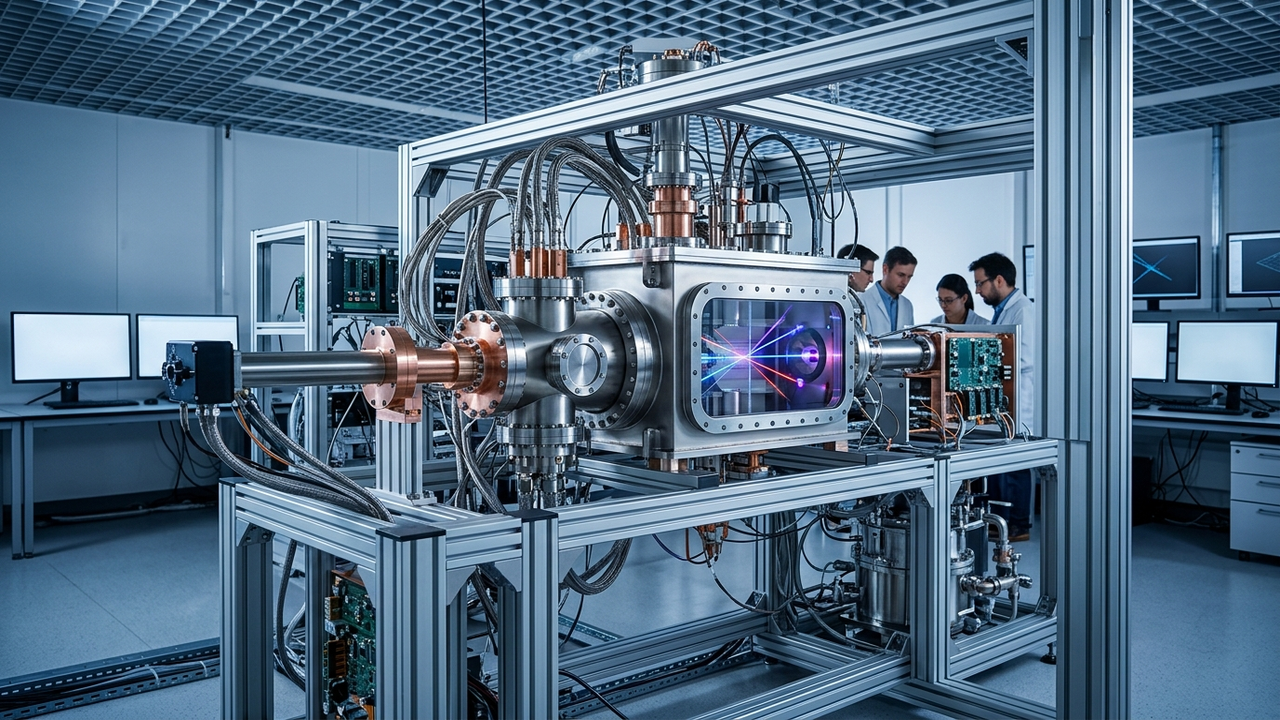
Quantinuum has unveiled “Helios,” a 98-qubit trapped-ion quantum computer, marking it as the world’s largest system of its kind. This breakthrough demonstrates a significant step towards large-scale quantum computation, performing random benchmark tests that exceed the capabilities of classical simulations.
Technical/Clinical Details
- 98-Qubit HQS: Helios is the latest iteration in Quantinuum’s H-series, based on its quantum volume architecture, featuring 98 physical qubits. This positions it as the current global leader among trapped-ion systems in terms of qubit count.
- QCCD Architecture: The system utilizes a Quantum Charge-Coupled Device (QCCD) architecture, which separates regions for storing and processing quantum information. This design allows for enhanced control and stability of individual qubits while improving the overall scalability of the system.
- Beyond Classical Simulation: Helios has successfully executed specific random benchmark tests that surpass the simulation capabilities of existing classical supercomputers. This suggests a distinct advantage for quantum computers in certain types of complex calculations.
- Path to Practicality: Despite the impressive feat, the article points out that practical, commercially valuable quantum computations will require even larger and more error-resilient systems, specifically mentioning the need for approximately one million qubits to achieve broad real-world impact.
Background & Context
The quantum computing landscape is driven by the dual challenges of increasing qubit counts and reducing error rates. Trapped-ion quantum computers are highly regarded for their high qubit fidelity and connectivity, with Quantinuum (formed from the merger of Honeywell Quantum Solutions and Cambridge Quantum) at the forefront of this technology. The introduction of Helios represents a crucial milestone in the transition from the Noisy Intermediate-Scale Quantum (NISQ) era towards developing larger, fault-tolerant quantum computers.
Strategic Significance & Outlook
The advent of Quantinuum’s Helios reinforces the potential for quantum computers to succeed supercomputers. Future progress will hinge on further qubit scaling and advancements in quantum error correction. The demonstrated efficacy of the QCCD architecture in Helios is expected to form a vital foundation for constructing systems with millions of qubits, paving the way for revolutionary applications in pharmaceuticals, materials science, finance, and optimization problems.
Get our weekly technology intelligence — free
Receive an infographic that lets you judge at a glance whether each field’s analysis report is worth reading.
Subscribe Free — Weekly Tech Intelligence
By subscribing, you’ll receive Troy-Technical’s weekly technology intelligence newsletter.
- Your email and selected fields are used only to deliver the newsletter.
- We never share your information with third parties.
- You can unsubscribe anytime via the link in each email.
See our Privacy Policy for details.
Takes about a minute · Unsubscribe anytime







Comments