Key Findings
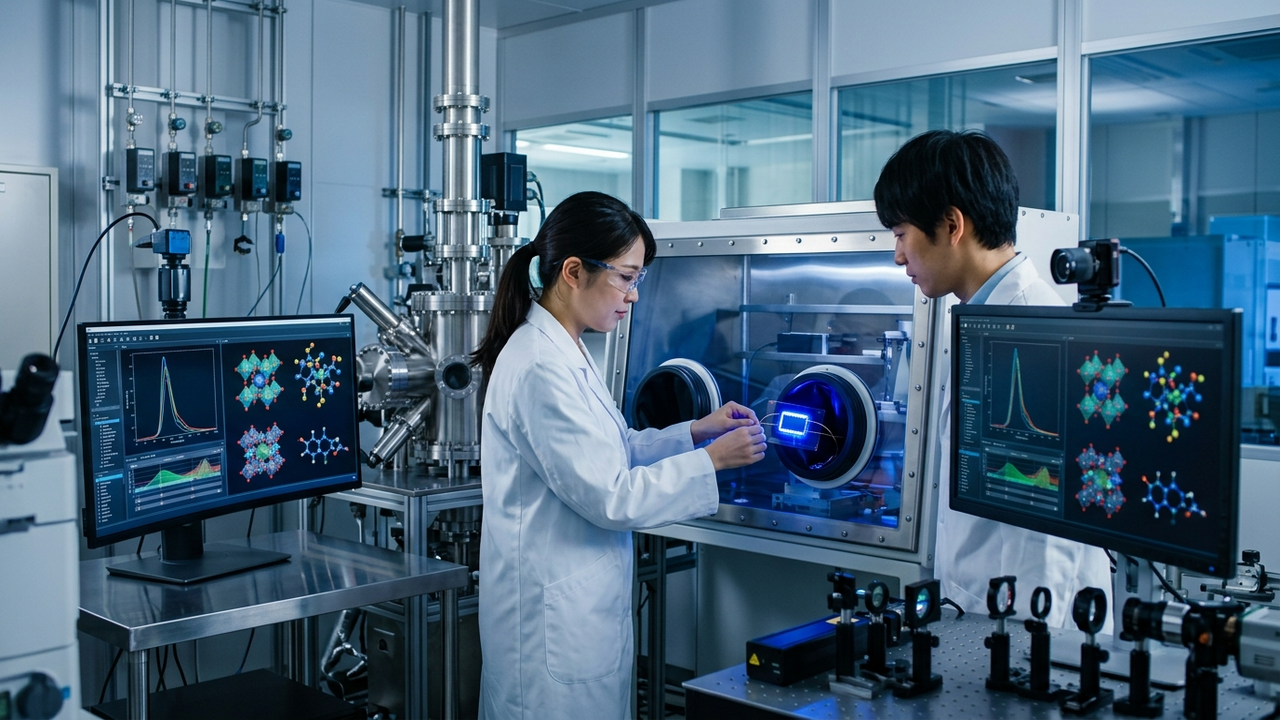
A breakthrough in research significantly improving the performance of deep-blue perovskite light-emitting diodes (PeLEDs) has been reported. In this study, a novel “dynamic modulation strategy” employing indium chloride (InCl) as a functional dopant was introduced, successfully and dramatically enhancing both the efficiency and spectral stability of PeLEDs. This innovative approach optimized the crystallization process of mixed-halide perovskites, suppressed non-radiative recombination losses, and effectively eliminated halide segregation, a major factor affecting the operational lifetime of PeLEDs. As a result, deep-blue PeLEDs with a high external quantum efficiency (EQE) of 5.2% at 460 nm and excellent operational spectral stability were realized.
Technical & Clinical Details
Achieving deep-blue PeLEDs has been challenging due to inherent material instability, particularly halide segregation in mixed-halides (e.g., lead bromide and lead iodide). This phenomenon causes halide ions to migrate during device operation, forming phases with different bandgaps, which leads to a shift in the emission spectrum and degradation of color purity. The dynamic modulation strategy employed here deeply involves the InCl dopant in the crystallization process of the perovskite precursor solution. InCl delays crystal growth kinetics, promoting the formation of more uniform and high-quality mixed-halide perovskite films. This reduces defect density within the film, thereby decreasing non-radiative recombination centers, allowing more charge carriers to contribute to light emission and improving EQE. More importantly, InCl physically and chemically suppresses halide ion migration, effectively preventing phase segregation during device operation and dramatically improving the stability of the emission spectrum. This technology significantly surpasses the performance of conventional deep-blue PeLEDs, opening the path for commercial applications.
Background & Context
Perovskite light-emitting diodes (PeLEDs) possess attractive properties such as high color purity, low-cost manufacturing, and adaptability to flexible devices, making them highly anticipated for next-generation display and lighting technologies. Among the primary colors for displays—red, green, and blue—achieving high efficiency and stability for deep-blue PeLEDs has been one of the most difficult challenges. This is because perovskite materials emitting blue light tend to have wider bandgaps and lower stability compared to other colors. The success of this dynamic modulation strategy using InCl doping presents a groundbreaking solution to this longstanding problem, marking a crucial step for PeLED technology to genuinely compete with, or even surpass, organic light-emitting diode (OLED) technology. This will accelerate technological innovation in the display industry and drive the emergence of more high-performance and energy-efficient products.
Strategic Significance & Outlook
The dynamic modulation strategy for deep-blue PeLEDs using InCl dopant holds immense potential to revolutionize next-generation display technology. An EQE of 5.2% at 460 nm and significantly enhanced spectral stability make the adoption of perovskite QLED displays a reality for a wide range of consumer products, including smartphones, televisions, and wearable devices. Future outlooks will focus on optimizing the InCl dopant, further increasing EQE, and validating long-term operational lifetimes. Development of manufacturing processes to enhance scalability for mass production is also critical. If this technology is commercialized, it will introduce brighter, higher color purity, and longer-lasting display products to the market, offering consumers new visual experiences and potentially reshaping the competitive landscape of the display industry. This is a strategic achievement that contributes to the realization of energy-efficient lighting and displays, while accelerating the transition to a sustainable society.
Get our weekly technology intelligence — free
Receive an infographic that lets you judge at a glance whether each field’s analysis report is worth reading.
Subscribe Free — Weekly Tech Intelligence
By subscribing, you’ll receive Troy-Technical’s weekly technology intelligence newsletter.
- Your email and selected fields are used only to deliver the newsletter.
- We never share your information with third parties.
- You can unsubscribe anytime via the link in each email.
See our Privacy Policy for details.
Takes about a minute · Unsubscribe anytime

Comments