Key Findings
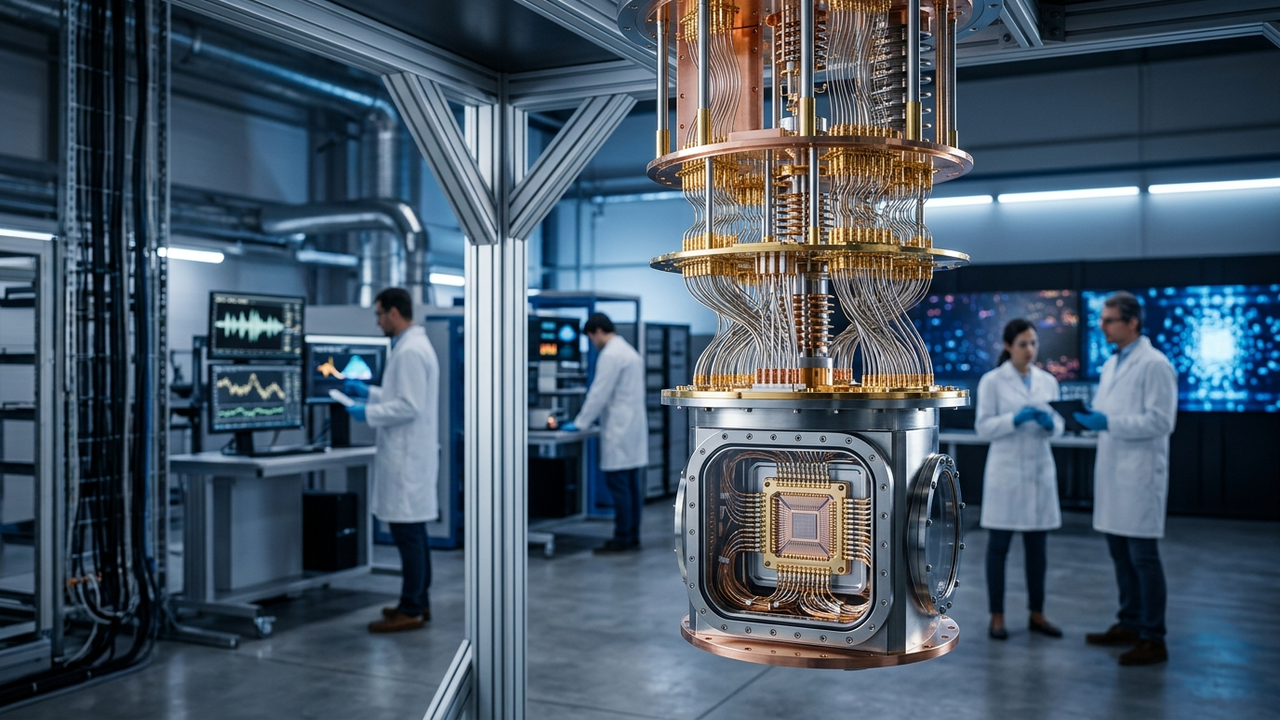
Google, utilizing its latest 105-qubit superconducting processor ‘Willow,’ has experimentally demonstrated sub-threshold quantum error correction for surface codes. This pioneering achievement illustrates that the logical error rate indeed decreases exponentially with an increasing number of constituent physical qubits, thereby reaching a crucial scientific milestone towards the realization of fault-tolerant quantum computing.
Technical Details
The Willow processor employs an advanced array of superconducting qubits to implement a two-dimensional surface code architecture. In the experiments, logical qubits were formed by grouping different numbers of physical qubits, and their logical error rates were measured. The results confirmed that, under conditions where the physical qubit error rate was below the surface code threshold, the logical error rate consistently decreased as the number of physical qubits increased. For instance, a logical qubit constructed using a 7×7 array of physical qubits demonstrated an error rate reduced by several orders of magnitude compared to a single physical qubit. This demonstration unequivocally shows that quantum error correction is not merely a theoretical concept but is experimentally achievable.
Background & Context
One of the biggest challenges in quantum computing is that qubits are highly sensitive to environmental noise and prone to errors. Quantum error correction is considered an indispensable technique for overcoming these errors and constructing large-scale, reliable quantum computers. While Google has previously demonstrated quantum supremacy, the demonstration of error correction has been viewed as the next critical step towards building more practical quantum computers. This latest achievement with the Willow processor reaffirms Google’s leadership in this field, comparable to efforts by other major quantum computing companies such such as IBM and Quantinuum.
Strategic Significance & Outlook
The experimental demonstration of sub-threshold error correction for surface codes by Google’s Willow processor is a decisive advancement in the roadmap towards building fault-tolerant quantum computers. The fact that the logical error rate decreases dependent on the number of physical qubits provides a practical pathway for constructing larger and more reliable logical qubits. This will accelerate the development of highly reliable quantum algorithms for complex problems currently intractable for classical computers, spanning drug discovery, materials science, financial modeling, and artificial intelligence. This research opens wide the door to practical applications of quantum computing.
Get our weekly technology intelligence — free
Receive an infographic that lets you judge at a glance whether each field’s analysis report is worth reading.
Subscribe Free — Weekly Tech Intelligence
By subscribing, you’ll receive Troy-Technical’s weekly technology intelligence newsletter.
- Your email and selected fields are used only to deliver the newsletter.
- We never share your information with third parties.
- You can unsubscribe anytime via the link in each email.
See our Privacy Policy for details.
Takes about a minute · Unsubscribe anytime






Comments