Key Findings
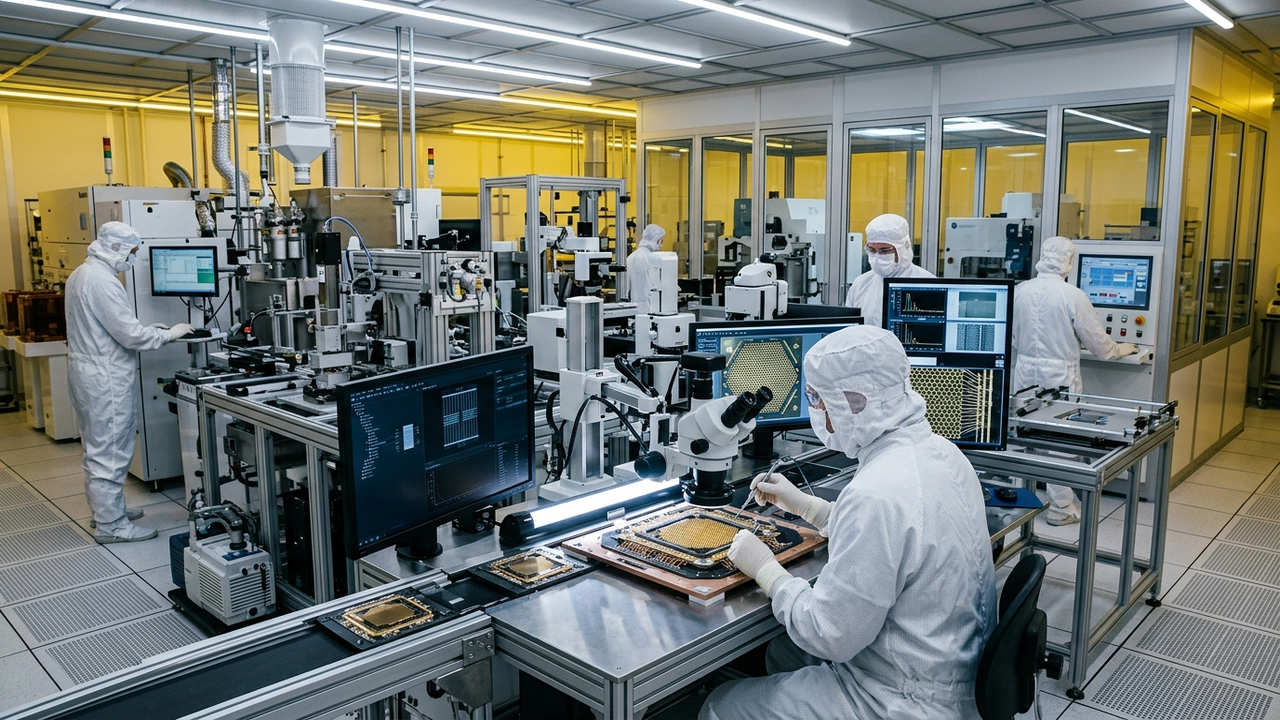
IonQ has initiated the fabrication of its first fully integrated 256-qubit quantum processing units (QPUs) at its subsidiary, SkyWater, marking a significant transition towards scalable manufacturing of quantum computers. The new Superion 256 platform is designed for mass production, with the ambition to build hundreds of these units rather than individual prototypes, which is projected to drastically reduce the cost per qubit.
Technical / Clinical Details
The Superion 256 platform leverages cutting-edge technology, including the integration of Oxford Ionics’ Electronic Qubit Control (EQC) technology. EQC enables precise and efficient manipulation of qubits, enhancing overall performance and fidelity. By collaborating with SkyWater, a leader in semiconductor manufacturing, IonQ is adopting a fabrication approach akin to traditional chip production. This strategy is expected to compress design cycles and boost the delivery of wafer lots, addressing critical bottlenecks in previous quantum hardware development. The high-volume manufacturing capability is a crucial step towards building larger, more complex quantum systems with greater reliability and lower cost.
Background & Context
Historically, quantum computer processors have been custom-built in research laboratories, limiting their scalability and commercial viability. The move by IonQ to industrial-scale manufacturing through its partnership with SkyWater represents a strategic effort to overcome these limitations. This approach is fundamental to accelerating the development and deployment of fault-tolerant quantum computers, making them accessible for a wider range of applications and users. The adoption of semiconductor manufacturing techniques for quantum hardware is a testament to the industry’s maturation and its ambition to bridge the gap between theoretical breakthroughs and practical applications.
Strategic Significance & Outlook
The mass production of the Superion 256 platform is a critical milestone for IonQ, aligning with its roadmap towards developing commercially viable, fault-tolerant quantum computers. The reduction in manufacturing costs and increase in production capacity are essential for scaling quantum systems to thousands, and eventually millions, of qubits. This advancement is anticipated to accelerate progress in diverse fields such as quantum chemistry, materials science, drug discovery, and financial modeling by providing more robust and accessible quantum computing resources. IonQ’s commitment to industrial-scale manufacturing positions it at the forefront of driving quantum computing towards widespread commercial adoption.
Source: https://quantumzeitgeist.com/ionq-superion-256/
Get our weekly technology intelligence — free
Receive an infographic that lets you judge at a glance whether each field’s analysis report is worth reading.
Subscribe Free — Weekly Tech Intelligence
By subscribing, you’ll receive Troy-Technical’s weekly technology intelligence newsletter.
- Your email and selected fields are used only to deliver the newsletter.
- We never share your information with third parties.
- You can unsubscribe anytime via the link in each email.
See our Privacy Policy for details.
Takes about a minute · Unsubscribe anytime









Comments