Key Findings
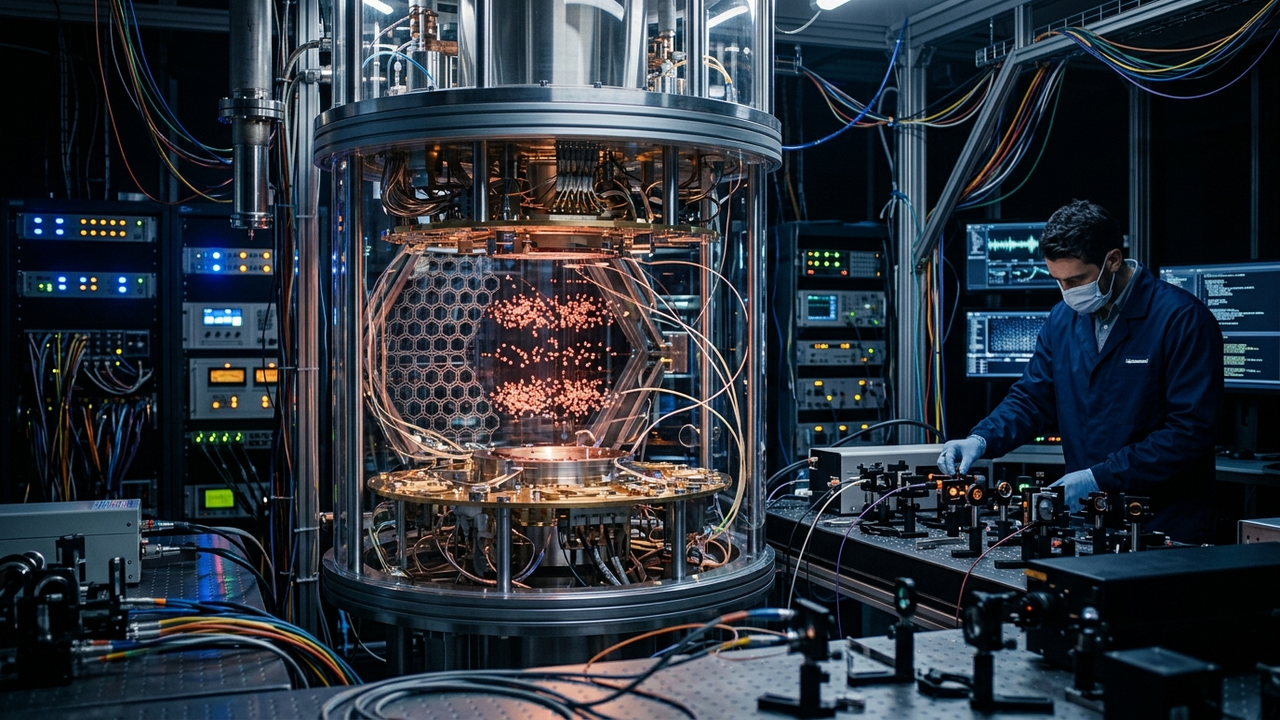
Significant advancements in quantum error correction (QEC) techniques are accelerating the realization of Cryptographically Relevant Quantum Computers (CRQCs), which possess the capability to break existing cryptographic schemes. Notably, a recent paper from Caltech proposes a neutral atom-based quantum computer (QC) architecture that incorporates qLDPC (quantum Low-Density Parity Check) based error correction. This architecture demonstrates the potential to decrypt major cryptographic standards like ECC-256 and RSA-2048 using substantially fewer physical qubits than previously thought possible.
Technical / Clinical Details
Central to this progress is the application of classical LDPC code design theory to quantum computing. A paper by Kasai, accepted in August 2026, and subsequent work by researchers from Harvard, MIT, and QuEra Computing, adapted this classical theory for reconfigurable neutral-atom quantum computers, now referred to as ‘Kasai codes.’ These codes emphasize regular structures well-suited for atomic movements, enabling efficient quantum error correction. Furthermore, Google has achieved ‘below threshold’ performance with surface code QEC, and Iceberg Quantum’s Pinnacle architecture has reduced the physical qubit requirements for RSA-2028 decryption. These methods aim to increase the ratio of logical to physical qubits, thereby overcoming a major bottleneck in building fault-tolerant quantum computers.
Background & Context
Building practical quantum computers necessitates robust error correction mechanisms to overcome qubit decoherence and high error rates, which cause quantum bits to lose information due to external noise. However, existing error correction methods require an immense number of physical qubits, posing scalability challenges. LDPC codes have demonstrated high efficiency in classical communication error correction, and their adaptation to the quantum domain opens possibilities for achieving high-reliability quantum computation with fewer physical resources. Neutral-atom platforms are considered particularly suitable for implementing such error correction codes due to their inherent scalability and long coherence times.
Strategic Significance & Outlook
These advancements in quantum error correction place the realization of CRQCs on a more realistic timeline, potentially having a devastating impact on information security, particularly public-key cryptographic systems. The substantial reduction in physical qubit requirements will accelerate the construction of large-scale quantum computers, contributing to the demonstration of quantum advantage across diverse fields, including computational chemistry, materials science, and financial modeling. The combination of neutral-atom-based architectures and LDPC-based error correction is emerging as a critical direction for next-generation fault-tolerant quantum computer development, further hastening the potential arrival of ‘Q-day.’
Source: https://www.eurekalert.org/news-releases/1142982
Get our weekly technology intelligence — free
Receive an infographic that lets you judge at a glance whether each field’s analysis report is worth reading.
Subscribe Free — Weekly Tech Intelligence
By subscribing, you’ll receive Troy-Technical’s weekly technology intelligence newsletter.
- Your email and selected fields are used only to deliver the newsletter.
- We never share your information with third parties.
- You can unsubscribe anytime via the link in each email.
See our Privacy Policy for details.
Takes about a minute · Unsubscribe anytime








Comments