
Key Findings
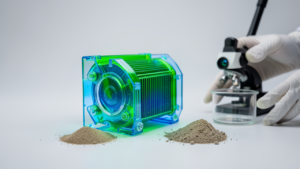
Researchers at Penn State University have reported a significant breakthrough in perovskite thin-film technology, specifically optimized for indoor lighting conditions. The team achieved an astonishing 36.2% power conversion efficiency (PCE) from a device with an aperture area of just 0.093 square centimeters. This advancement successfully enhances both the indoor light absorption capability and the stability of the device under high light intensity.
Technical / Clinical Details
This high efficiency was enabled by a series of technical innovations. Firstly, the research team precisely tuned the ratio of bromine to iodine, thereby optimizing the perovskite’s bandgap to match the narrow spectrum of indoor illumination, allowing for more efficient absorption of limited indoor light energy. Secondly, using dichlorobenzene as an antisolvent facilitated the formation of a more compact and uniform perovskite crystalline film, which contributed to improved device performance and stability. Furthermore, by incorporating a passivation layer of phenethylammonium bromide (PEABr) on top of the perovskite layer, surface defects were effectively suppressed, reducing non-radiative recombination and thus achieving both high PCE and robust stability.
Background & Context
The proliferation of Internet of Things (IoT) devices has created a rapidly growing demand for self-sustaining power sources that can operate reliably in low-light environments. Conventional solar cells are typically optimized for strong outdoor sunlight, leading to a significant drop in efficiency under weak indoor illumination. Perovskite materials, with their inherent flexibility in bandgap tuning, hold immense potential for indoor light harvesting applications. Penn State’s achievement represents a world-leading efficiency in this domain, marking a crucial step towards eliminating battery changes and fostering a more sustainable IoT ecosystem.
Strategic Significance & Outlook
The success of this indoor light-harvesting perovskite thin film has the potential to revolutionize power supply for a wide range of IoT applications, including wireless sensors, smart home devices, and wearables. Further research to enhance device stability and manufacturing scalability could soon make a battery-free future for these devices a reality. This technology holds profound implications for sustainable living and could fundamentally transform how technology integrates into our daily lives.
Get our weekly technology intelligence — free
Receive an infographic that lets you judge at a glance whether each field’s analysis report is worth reading.
Subscribe Free — Weekly Tech Intelligence
By subscribing, you’ll receive Troy-Technical’s weekly technology intelligence newsletter.
- Your email and selected fields are used only to deliver the newsletter.
- We never share your information with third parties.
- You can unsubscribe anytime via the link in each email.
See our Privacy Policy for details.
Takes about a minute · Unsubscribe anytime





Comments