
Key Findings
A consortium of leading industry players, including Volvo Group, Daimler Truck, Toyota Motor, Bosch, Air Liquide, and TotalEnergies, has announced a comprehensive plan to expand the entire hydrogen mobility value chain in Europe. This multi-faceted collaboration aims to accelerate the decarbonization of long-haul truck transport by addressing critical challenges in both hydrogen refueling infrastructure and vehicle deployment.
Technical / Clinical Details
This extensive partnership focuses on removing bottlenecks for hydrogen adoption in the commercial vehicle sector, where long range, high payload capacity, and rapid refueling capabilities are essential. Key initiatives include:
- Synchronized Funding for Infrastructure and Vehicles: Coordinating funding schemes to ensure the simultaneous development of hydrogen refueling stations and the procurement of hydrogen fuel cell trucks, thereby resolving the ‘chicken and egg’ problem.
- Harmonization of Renewable Fuel Credit Mechanisms: Standardizing national renewable fuel credit systems across Europe to enhance economic incentives for hydrogen fuel, thus improving its cost competitiveness.
- Risk Reduction Across the Value Chain: Jointly identifying and mitigating technical and economic risks throughout the entire hydrogen supply chain, from production, transport, and storage to refueling.
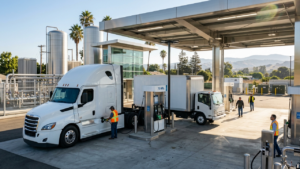
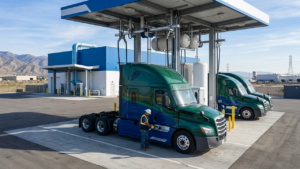
- Development of High-Capacity Refueling Stations: A target to establish large-scale hydrogen refueling stations across Europe, capable of fueling up to 100 trucks per day.
Through these strategies, the partners aim to enhance the convenience of hydrogen refueling and reduce the total cost of ownership (TCO) to be competitive with diesel vehicles, thereby facilitating the transition for commercial vehicle operators to hydrogen trucks.
Background & Context
Europe is confronting the urgent challenge of decarbonizing its transport sector to meet its 2050 carbon neutrality goals. Long-haul truck transport, in particular, poses significant hurdles for battery electric vehicles due to limitations in range and charging time, making hydrogen fuel cells a crucial alternative. However, the lack of hydrogen infrastructure and high operational costs have historically hindered widespread adoption. This collaborative effort by industry leaders is essential for overcoming these challenges and accelerating the full-scale establishment of a hydrogen economy.
Strategic Significance & Outlook
This broad cooperative framework holds the potential to dramatically accelerate the introduction of hydrogen mobility in Europe. As infrastructure development progresses and costs are optimized, hydrogen fuel cell trucks are expected to become a mainstream solution for long-haul transport. This will drive the decarbonization of Europe’s logistics industry and significantly contribute to achieving climate change targets. The initiative is poised to serve as an international model for building a sustainable, hydrogen-based transport system.
Get our weekly technology intelligence — free
Receive an infographic that lets you judge at a glance whether each field’s analysis report is worth reading.
Subscribe Free — Weekly Tech Intelligence
By subscribing, you’ll receive Troy-Technical’s weekly technology intelligence newsletter.
- Your email and selected fields are used only to deliver the newsletter.
- We never share your information with third parties.
- You can unsubscribe anytime via the link in each email.
See our Privacy Policy for details.
Takes about a minute · Unsubscribe anytime







Comments