Key Findings
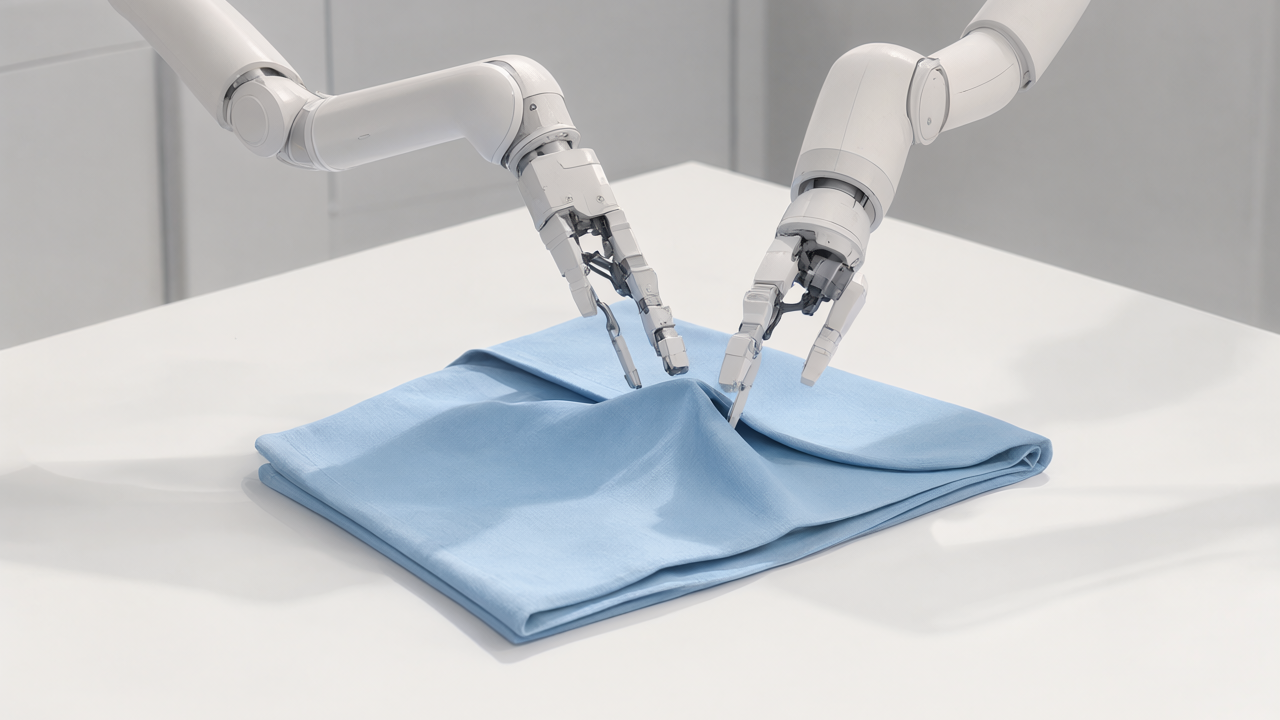
A report published on arXiv on September 30, 2026, introduces ‘Rho,’ a family of open-weight, 5-billion-parameter models specifically designed for bimanual robot manipulation, emphasizing data-efficient environmental and task adaptation. This model offers an efficient approach for robots to rapidly learn new tasks.
Technical / Clinical Details
The central premise of the Rho model is that for physical AI models to adapt quickly to new tasks, they must first deeply acquire specific aspects of the robot’s Vision, Language, and Control (VLA) that are expected to perform the task. This ‘VLA model’ possesses an enormous 5 billion parameters, comprehensively learning visual data from diverse environments, linguistic data for instructions and feedback, and control data for operating the robot’s physical body. As a result, Rho establishes a foundation for general-purpose robotic intelligence, enabling efficient skill transfer and adaptation even from small amounts of new task data. By integrating Rho into existing robotic systems, it is expected that robots will be able to respond to new actions and environmental changes without extensive retraining.
Background & Context
One of the major challenges in the field of robotics has been that robots are often designed for specific tasks or environments, lacking versatility and adaptability to new situations. In particular, manual data collection and individualized programming have been factors driving up the cost and time of robot deployment. Inspired by the success of Large Language Models (LLMs), research and development of ‘robot foundation models’ that give robots general learning capabilities have become active. The Rho model, in this context, is designed with a particular emphasis on data efficiency and task adaptability. Its ability to learn quickly from limited data is crucial for accelerating the industrial adoption of robots.
Strategic Significance & Outlook
The Rho model family paves the way for a future where bimanual robots can more efficiently and autonomously perform complex assembly tasks, precise manipulations, or logistics operations involving diverse objects, which were previously human-executed. Its data-efficient learning capabilities have the potential to lower the barrier for small and medium-sized enterprises and research institutions to adopt and operate advanced robotic systems, promoting the democratization of robotics. In the future, foundation models like Rho are expected to provide innovative solutions across a wide range of fields, including flexible manufacturing, remote surgery assistance in healthcare, and enhanced field adaptability for disaster response robots. This technology represents a significant step towards general-purpose intelligent robots operating effectively in the real world.
Source: https://arxiv.org/html/2609.38164v1
Get our weekly technology intelligence — free
Receive an infographic that lets you judge at a glance whether each field’s analysis report is worth reading.
Subscribe Free — Weekly Tech Intelligence
By subscribing, you’ll receive Troy-Technical’s weekly technology intelligence newsletter.
- Your email and selected fields are used only to deliver the newsletter.
- We never share your information with third parties.
- You can unsubscribe anytime via the link in each email.
See our Privacy Policy for details.
Takes about a minute · Unsubscribe anytime