

Key Findings
Quandela underscores new research indicating that foundry-compatible III–V quantum-dot devices are capable of delivering the essential light–matter interaction capabilities for scalable hybrid photonic quantum computing. This marks a pivotal transition from merely demonstrating the viability of spin–photon interfaces to focusing on their system-scale optimization and integration, crucial for achieving fault-tolerant quantum computing.
Technical / Clinical Details
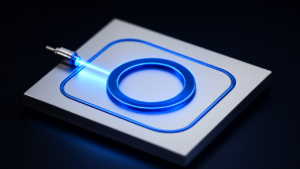
At the heart of this research is the efficient interfacing of spins and photons via quantum dots. The spin–photon interface performs several critical functions: serving as local quantum memory for storing quantum information, acting as an on-demand photon source to generate photons when needed, and establishing optical links to connect different elements within a quantum system. III–V semiconductors are particularly well-suited for quantum dot fabrication due to their high luminescence efficiency and superior control over electronic and photonic properties. Foundry compatibility implies that these devices can be integrated into existing semiconductor manufacturing processes, opening avenues for mass production and cost reduction.
Background & Context
Quantum computing promises to vastly outperform classical computers in solving specific complex problems but faces significant challenges in scalability and fault tolerance. Photonic quantum computing is a promising approach due to the high speed and low interaction of photons, but it requires efficient mechanisms to manipulate and connect qubit states. The spin–photon interface is a key enabling technology for this challenge. Hybrid systems using quantum dots aim to combine the advantages of both photons and solid-state systems to build robust and scalable quantum computers.
Strategic Significance & Outlook
The system-scale optimization and integration of spin–photon interfaces represent a critical step toward realizing fault-tolerant quantum computers. This will enable the execution of more complex quantum algorithms, leading to transformative applications in drug discovery, materials science, and cryptography. Foundry-compatible devices will accelerate the industrialization and broader adoption of quantum computers, laying the groundwork for expanding the impact of quantum technology on society. This progress suggests that quantum computing is rapidly approaching a phase of ‘practical realization’ for both scientific research and industrial applications.
Source: https://www.quandela.com/resources/blog/spin-photon-interfaces-hybrid-photonic-quantum-computing/
Get our weekly technology intelligence — free
Receive an infographic that lets you judge at a glance whether each field’s analysis report is worth reading.
Subscribe Free — Weekly Tech Intelligence
By subscribing, you’ll receive Troy-Technical’s weekly technology intelligence newsletter.
- Your email and selected fields are used only to deliver the newsletter.
- We never share your information with third parties.
- You can unsubscribe anytime via the link in each email.
See our Privacy Policy for details.
Takes about a minute · Unsubscribe anytime