Key Findings
A research team at the University of Hamburg has identified and characterized a novel enzyme, BhEstB, from soil bacteria that efficiently converts the soluble intermediates—bis(2-hydroxyethyl) terephthalate (BHET) and mono(2-hydroxyethyl) terephthalate (MHET)—produced during the partial degradation of PET plastic, directly into terephthalic acid. This discovery holds significant promise for resolving a major bottleneck in enzymatic PET recycling, thereby paving the way for a truly circular plastic economy.
Technical / Clinical Details
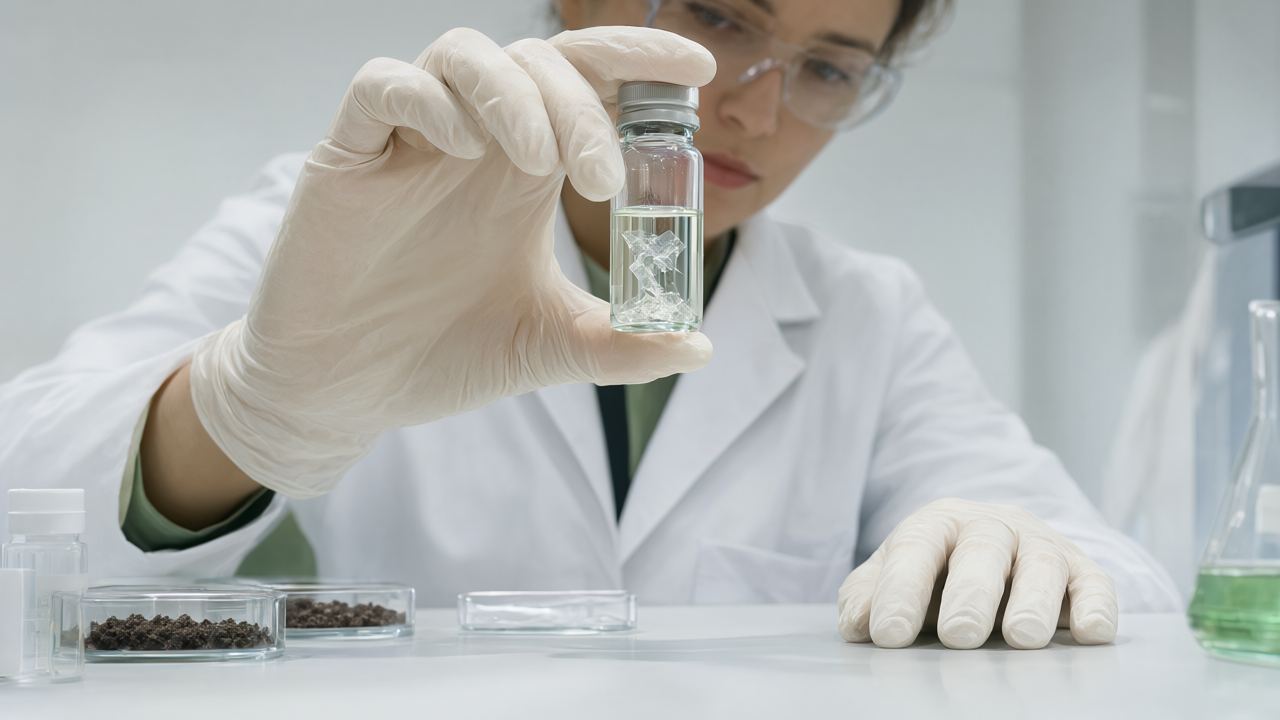
Enzymatic recycling of polyethylene terephthalate (PET) is garnering considerable attention as an environmentally friendly method for plastic decomposition, bypassing harsh heat or chemicals. However, a common challenge with many existing PET-degrading enzymes is their diminished efficiency in the intermediate stages, where PET is first broken down into BHET and MHET, rather than directly into its constituent monomers, terephthalic acid (TPA) and ethylene glycol (EG). Through metagenomic analysis of soil bacteria, the Hamburg research team discovered BhEstB, a new esterase enzyme capable of efficiently hydrolyzing these water-soluble intermediates to TPA. Experimental results confirmed that BhEstB exhibits excellent catalytic activity against both BHET and MHET, demonstrating particularly high efficiency in MHET degradation. This significantly improves the overall efficiency of the final stages of enzymatic PET recycling, facilitating the recovery of high-purity TPA. The high purity of the recovered monomers implies they can be re-polymerized to produce virgin-quality PET.
Background & Context
The global plastic waste crisis, particularly the widespread pollution from PET bottles and textiles, is a severe environmental concern, making the development of sustainable recycling technologies an urgent priority. Traditional mechanical recycling methods often lead to a gradual degradation of PET quality, limiting its reuse in applications demanding virgin-like properties. Enzymatic recycling, with its greener profile and potential to recover high-purity monomers from diverse PET waste streams, has emerged as a promising alternative. However, efficient intermediate degradation has consistently been a challenge, impacting the overall process speed and cost. The discovery of BhEstB offers a potential solution to this ‘intermediate barrier,’ representing a significant step forward for the commercialization of enzymatic PET recycling, contributing to ongoing efforts by companies in Japan and France developing similar technologies.
Strategic Significance & Outlook
The identification of BhEstB has the potential to dramatically advance enzymatic PET plastic recycling technology. Future research will likely focus on further optimizing this enzyme, scaling up its production, and integrating it into industrial processes. For example, combining BhEstB with existing PETase enzymes could lead to hybrid systems that achieve faster and more complete PET degradation. If this technology is established on a commercial scale, it could enable true circularity for PET waste, substantially contributing to reducing plastic pollution, decreasing reliance on fossil resources, and fostering a more sustainable society. This would bring closer a future where PET is utilized as an ‘eternal resource’ rather than an ‘eternal waste product.’
Get our weekly technology intelligence — free
Receive an infographic that lets you judge at a glance whether each field’s analysis report is worth reading.
Subscribe Free — Weekly Tech Intelligence
By subscribing, you’ll receive Troy-Technical’s weekly technology intelligence newsletter.
- Your email and selected fields are used only to deliver the newsletter.
- We never share your information with third parties.
- You can unsubscribe anytime via the link in each email.
See our Privacy Policy for details.
Takes about a minute · Unsubscribe anytime