Key Findings
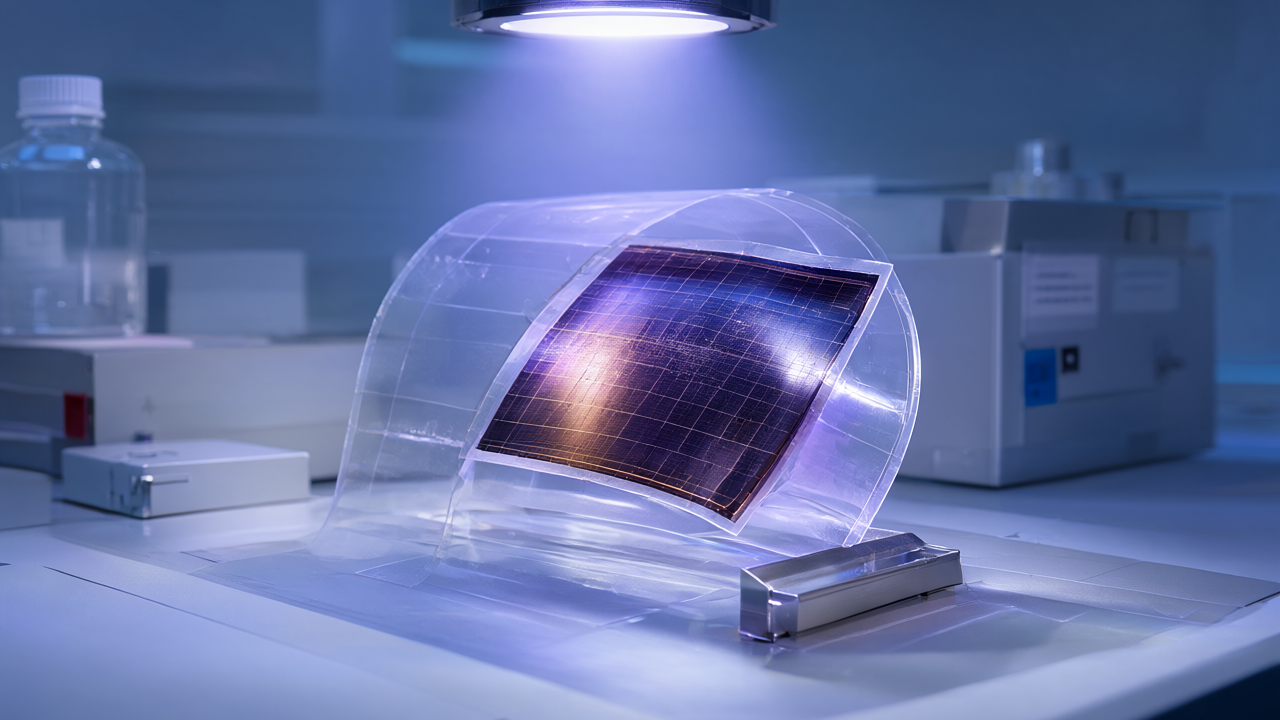
A research team at CEA–INES (French Alternative Energies and Atomic Energy Commission’s National Institute for Solar Energy) has established a new world record internal conversion efficiency of 21.2% for flexible perovskite solar cells. This breakthrough was achieved on a polyethylene terephthalate (PET) substrate, significantly advancing the performance benchmark for flexible photovoltaic technology.
Technical / Clinical Details
- Efficiency Boost: The 21.2% efficiency represents a 2-percentage-point increase over CEA–INES’s prior record of 19.2%. This improvement was primarily realized through the strategic integration of an anti-reflective coating and a comprehensive redesign of the electrical connections, effectively minimizing energy losses within the cell structure.
- Substrate Material: The use of a highly flexible PET (polyethylene terephthalate) substrate is critical, endowing these solar cells with bendable properties suitable for diverse applications. This inherent flexibility is vital for emerging markets such as wearable devices, smart textiles, and building-integrated photovoltaics (BIPV).
- Active Area: While the current device features an active area of 0.28 cm², achieving such high efficiency at this scale is a promising indicator for future upscaling and commercialization efforts.
Background & Context
Perovskite solar cells have garnered substantial attention as a next-generation photovoltaic technology due to their high power conversion efficiency and potential for low-cost manufacturing. Flexible perovskite cells, in particular, offer unique advantages of lightweight design and adaptability to various surfaces, potentially opening up niche markets and novel applications where rigid silicon-based cells are impractical. However, the simultaneous achievement of high efficiency and long-term stability on flexible substrates has remained a significant technical challenge. CEA–INES’s latest achievement signifies a major technological breakthrough in this domain.
Strategic Significance & Outlook
Moving forward, CEA–INES intends to focus on further optimizing the cell layers and developing more heat-resistant flexible substrates. These efforts aim to enhance durability for use in harsher environments and increase manufacturing process flexibility. Should this technology reach commercialization, it would significantly boost the competitiveness of perovskite solar cells in the renewable energy market, accelerating their adoption in sectors demanding flexibility, such as portable power solutions, IoT devices, and smart building applications.
Source: https://taiyangnews.info/technology/ceaines-raises-flexible-perovskite-cell-efficiency-to-212
Get our weekly technology intelligence — free
Receive an infographic that lets you judge at a glance whether each field’s analysis report is worth reading.
Subscribe Free — Weekly Tech Intelligence
By subscribing, you’ll receive Troy-Technical’s weekly technology intelligence newsletter.
- Your email and selected fields are used only to deliver the newsletter.
- We never share your information with third parties.
- You can unsubscribe anytime via the link in each email.
See our Privacy Policy for details.
Takes about a minute · Unsubscribe anytime