Key Findings
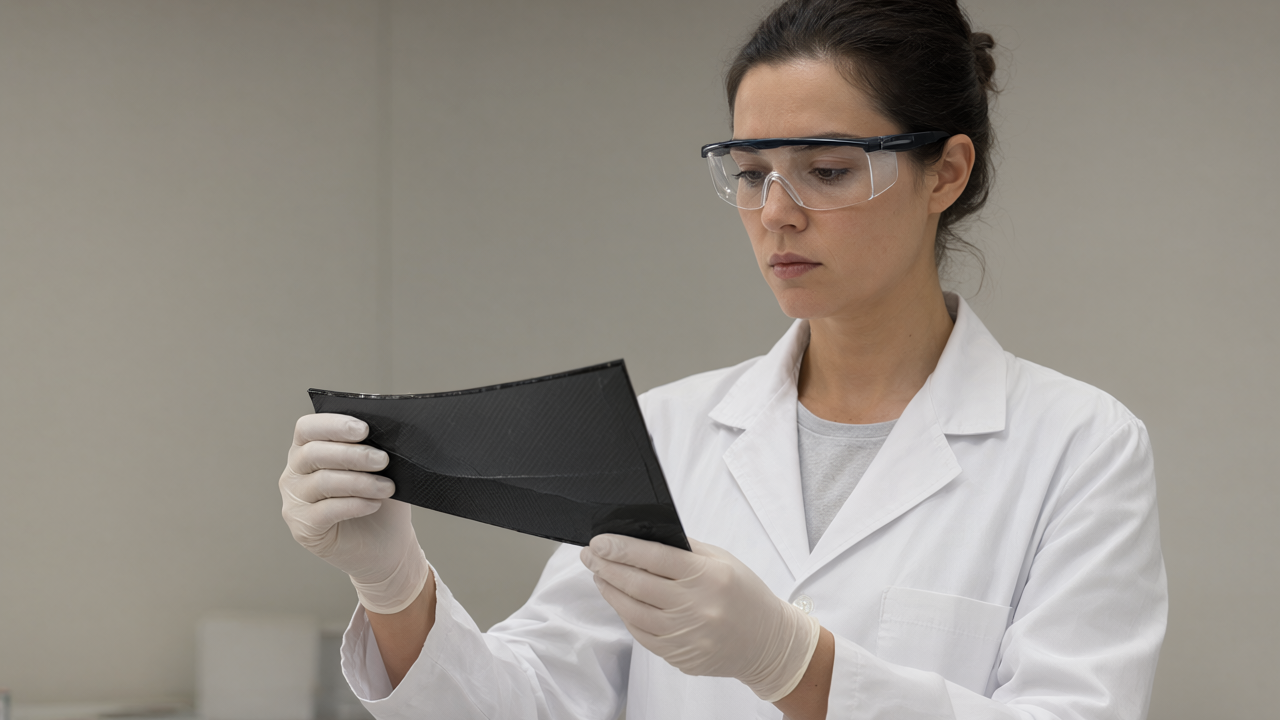
A research team at the Indian Institute of Science (IISc), Bangalore, has successfully developed a self-healing and recyclable carbon fiber composite material that promises to fundamentally transform material circularity within the aerospace industry. This groundbreaking composite addresses long-standing challenges associated with conventional thermoset epoxy composites, namely their inability to heal cracks, their irreversible shape, and the extreme difficulty in recycling them.
Technical / Clinical Details
The new composite material developed by the IISc team is based on a **vitrimer epoxy matrix**, distinguished by its incorporation of a **’dual dynamic network’** that combines **associative disulfide bonds** and **silyl ether bonds**. This dual dynamic network imparts two critical, innovative properties to the material:
- Self-Healing Capability: Should microscopic cracks appear in the material, the dynamic bonds can re-associate under mild external stimuli (e.g., gentle heat), enabling the material to autonomously heal its damage. This preserves structural integrity and significantly extends component lifespan, a stark contrast to traditional thermoset epoxies where crack repair is exceptionally challenging.
- Recyclability: At the end of the composite’s service life, the matrix resin can be disassembled, allowing for the recovery and reuse of expensive carbon fibers. This is facilitated by the vitrimer’s inherent reprocessability upon heating and the reversible nature of its dynamic bonds. Conventional thermoset composites are notoriously difficult to recycle, with the valuable carbon fibers often ending up in landfills or incinerated because the matrix cannot be easily separated without degradation.
The dual dynamic network is particularly ingenious as it allows for different dynamic responses under varying temperatures or environmental conditions, enabling multifunctional material design. For instance, bonds active at lower temperatures could facilitate self-healing, while those active at higher temperatures could promote decomposition during the recycling process.
Background & Context
Carbon fiber composites are indispensable in the aerospace industry due to their exceptional strength-to-weight ratio, which is crucial for fuel efficiency and performance. However, while contributing significantly to aircraft lightweighting, the environmental impact of manufacturing waste and end-of-life disposal has become a growing concern. The thermoset epoxies traditionally used in these composites form irreversible cross-linked networks upon curing, making them impossible to melt, re-dissolve, or reshape. This renders recycling extremely difficult, leading to the landfilling or incineration of valuable carbon fibers and contributing to resource depletion and environmental burden. The aerospace sector, driven by increasing sustainability demands, has been actively seeking innovative solutions to these challenges.
Strategic Significance & Outlook
The IISc research holds immense potential to dramatically enhance the sustainability across the entire lifecycle of aerospace materials. The self-healing property promises reduced maintenance costs and improved safety for aircraft, while the recyclability promotes the reuse of costly carbon fibers, boosting resource efficiency. If commercialized, this technology could find widespread applications not only in aerospace but also in other industries heavily reliant on carbon fiber composites, such as automotive, wind energy (blades), and high-performance sports equipment. This represents a significant step towards waste reduction and the realization of a circular economy, contributing profoundly to a sustainable future.
Get our weekly technology intelligence — free
Receive an infographic that lets you judge at a glance whether each field’s analysis report is worth reading.
Subscribe Free — Weekly Tech Intelligence
By subscribing, you’ll receive Troy-Technical’s weekly technology intelligence newsletter.
- Your email and selected fields are used only to deliver the newsletter.
- We never share your information with third parties.
- You can unsubscribe anytime via the link in each email.
See our Privacy Policy for details.
Takes about a minute · Unsubscribe anytime