Key Findings
A research team from ETH Zurich, the University of California, Berkeley, and the University of Texas at Austin has unveiled “TacEx,” a new framework designed to dramatically improve the efficiency of tactile information gathering for robot exploration and learning. TacEx enables robots to acquire skills more intentionally and through contact-rich experiences by treating uncertainty in tactile sensor data as a primary learning objective.
Technical / Clinical Details
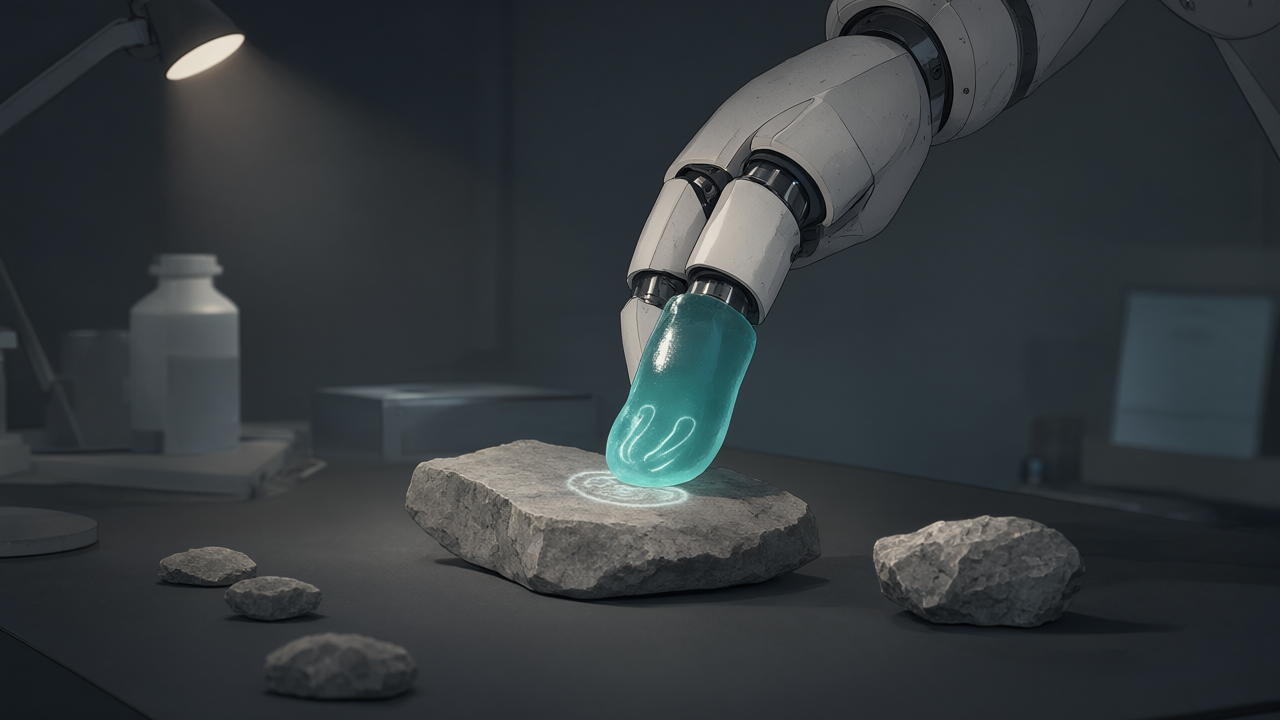
The TacEx framework introduces the concept of “Tactile Curiosity,” which utilizes the “tactile uncertainty” a robot experiences when touching unknown objects or environments as a key incentive for exploratory behavior. Specifically, it decomposes model uncertainty across different sensing modalities—such as vision, touch, and proprioception—and rewards states with high tactile uncertainty. This mechanism encourages the robot to actively explore objects through touch rather than merely performing random explorations within its environment.
A significant advantage of this approach is its data efficiency. Traditional reinforcement learning often requires robots to explore vast state spaces, demanding an immense number of trials and data, especially for learning delicate manipulation tasks involving contact. TacEx, by focusing on the acquisition of tactile information, reduces unnecessary transitions away from objects and collects more relevant contact experience data efficiently. This allows robots to learn intricate manipulation skills, such as folding laundry, assembling components, or interacting with humans, which are inherently contact-dependent, with fewer trials.
Background & Context
For robots to function effectively in complex physical worlds, tactile information is as crucial as visual input. However, progress in acquiring tactile data has lagged behind visual data due to physical sensor limitations and the difficulty of modeling diverse contact states. Particularly in robot manipulation using deep reinforcement learning, the sim-to-real transfer remains a significant challenge. TacEx, by centering tactile information in the learning process, helps bridge this sim-to-real gap, fostering the development of more robust and versatile robot manipulation skills. This foundational technology could accelerate robot deployment across various sectors, including manufacturing, healthcare, and service robotics.
Strategic Significance & Outlook
The TacEx framework is expected to play a crucial role in future robot learning. The research team aims to apply this tactile-curiosity-based exploration strategy to more complex multi-fingered robot hands and humanoid robots, striving to develop advanced manipulation skills and adaptability to unknown environments. In the future, much like humans understand and manipulate the world through touch, robots could autonomously learn by leveraging tactile information, paving the way for closer collaboration within human society.
Source: https://roboskin.ai/news/tacex-tactile-curiosity-robot-exploration
Get our weekly technology intelligence — free
Receive an infographic that lets you judge at a glance whether each field’s analysis report is worth reading.
Subscribe Free — Weekly Tech Intelligence
By subscribing, you’ll receive Troy-Technical’s weekly technology intelligence newsletter.
- Your email and selected fields are used only to deliver the newsletter.
- We never share your information with third parties.
- You can unsubscribe anytime via the link in each email.
See our Privacy Policy for details.
Takes about a minute · Unsubscribe anytime