Key Findings
A research paper, “TacOT,” published on arXiv, introduces a groundbreaking framework designed to enable robots to efficiently learn contact-rich, dexterous manipulation tasks from human demonstrations. This technology promises to significantly simplify the robot skill acquisition process and broaden its applicability to more complex real-world tasks.
Technical / Clinical Details
The TacOT (Tactile-Guided Optimal Transport) framework addresses the key challenges in human-to-robot skill transfer, specifically the difficulty of ensuring demonstration consistency and correspondence. Central to this framework is the utilization of “Dynamic Time Warping (DTW)” combined with two distinct modalities: action (motion) information and tactile information. TacOT employs this DTW to identify similarities and consistency in action and tactile patterns along the temporal axis between human and robot manipulation demonstrations.
Specifically, the robot records not only the human’s movements during object manipulation but also simultaneous tactile information such as applied force, pressure, and friction. Subsequently, this data is analyzed to automatically derive correspondences that reflect consistent interaction dynamics between both demonstrations. These correspondences are then used to guide a “soft optimal transport alignment” within a shared policy representation space. The primary advantage of this approach is the elimination of the need for rigid, frame-level pre-pairing of human and robot demonstrations, a requirement often present in conventional methods. This simplification significantly streamlines the collection and preprocessing of demonstration data, enabling learning from more diverse and richer datasets.
Background & Context
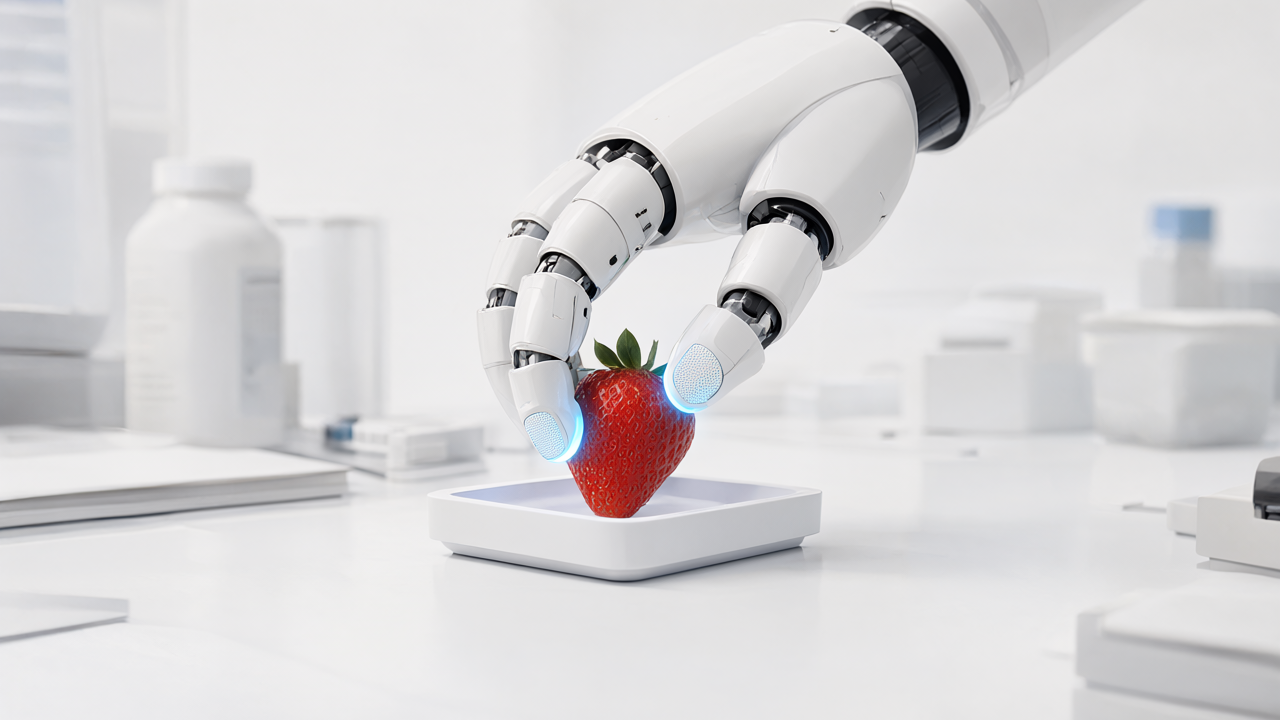
Learning from Demonstration (LfD) is a powerful paradigm for robots to acquire skills from humans, but it has always faced challenges, particularly in contact-rich dexterous manipulation, due to variations, noise, and physical discrepancies between human and robot bodies. Traditional LfD methods often heavily rely on visual information or struggle with accurate tactile data matching, limiting robust skill acquisition in the real world. TacOT overcomes these limitations by centering tactile information in the learning process, allowing robots to understand manipulation nuances more deeply through “feeling.” This is critically important for accelerating robot adoption in fields requiring high dexterity, such as precision assembly in manufacturing, surgical procedures in medicine, and delicate object handling by service robots.
Strategic Significance & Outlook
The advent of TacOT represents a significant advancement in improving the data efficiency and versatility of dexterous robot manipulation learning. Future research is expected to apply this framework to more complex multi-fingered robot hands and humanoid robots, verifying its adaptability to a broader range of tasks. Furthermore, as the quality and quantity of tactile data collected and analyzed by TacOT improve, it will contribute to advancements in tactile-based reinforcement learning and simulation environments. Ultimately, TacOT is poised to contribute to a future where robots autonomously acquire intuitive and dexterous manipulation skills, similar to those performed naturally by humans, enabling more seamless collaboration in human society.
Source: https://arxiv.org/abs/2610.04363
Get our weekly technology intelligence — free
Receive an infographic that lets you judge at a glance whether each field’s analysis report is worth reading.
Subscribe Free — Weekly Tech Intelligence
By subscribing, you’ll receive Troy-Technical’s weekly technology intelligence newsletter.
- Your email and selected fields are used only to deliver the newsletter.
- We never share your information with third parties.
- You can unsubscribe anytime via the link in each email.
See our Privacy Policy for details.
Takes about a minute · Unsubscribe anytime