


Key Findings
A research team led by Yulin Xie, Sayaka Sekida, and Goro Miyamoto at Tohoku University’s Institute for Materials Research (IMR), in collaboration with Tadashi Furuhara of the National Institute for Materials Science (NIMS) and TsubameLab, has successfully automated the experimental workflow for bulk structural metals. The system achieves mechanical property evaluation accuracy comparable to manual measurements while increasing the speed of the experimental sequence by more than ten times.
Technical Details
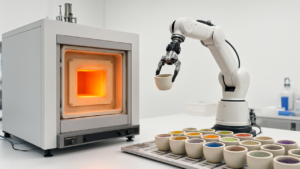
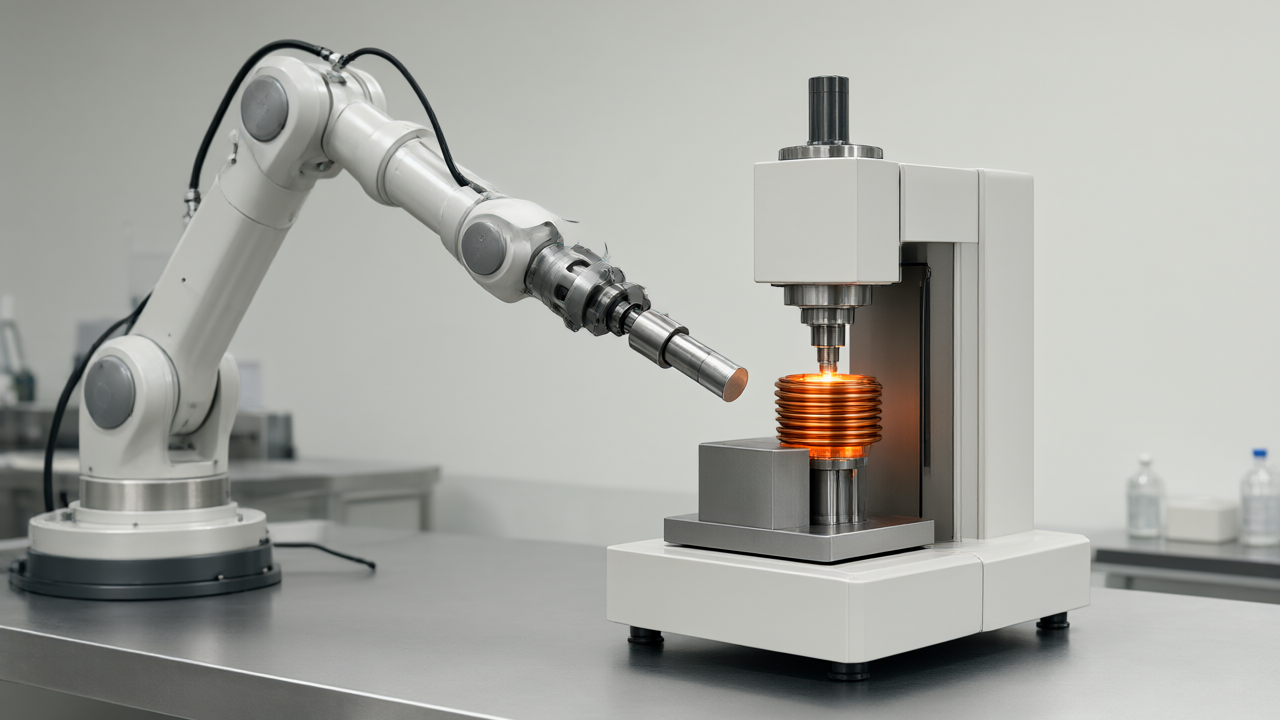
The platform utilizes a robotic arm to automatically transfer specimens between three primary instruments: an induction heating furnace, an X-ray diffractometer (XRD), and a micro-impact testing machine. To overcome the challenges of handling solid specimens—which are more difficult to automate than liquids or powders—the team developed dedicated specimen-handling tools and unified computer control. Using commercial JIS SCM435H low-alloy steel for demonstration, the team showed that the sequence of handling, XRD measurement, mechanical testing, and recovery takes approximately 800 seconds per sample, excluding the heat-treatment time.
Background & Context
Developing high-strength structural metals requires exploring vast processing conditions, as heat treatment significantly alters microstructure and mechanical properties. Traditionally, automating bulk metallic experiments has been difficult due to the need to transport and position solid specimens across specialized equipment. To address this, the researchers integrated an AI optimization tool within the NIMS Orchestration System (NIMO) to automate the control of furnace parameters.
Significance & Outlook
The system creates a continuous stream of process-structure-property data, which is essential for training artificial intelligence in materials development. The researchers envision a future closed-loop autonomous system where AI analyzes experimental results and proposes the next heat-treatment conditions, which the platform then executes automatically. This approach is expected to accelerate the discovery of innovative processing routes and advanced structural metallic materials by efficiently narrowing down promising conditions from an enormous range of possibilities.
Source: https://www.tohoku.ac.jp/en/press/fully_automated_metal_experiments_pave_way_for_ai_exploration.html
Get our weekly technology intelligence — free
Receive an infographic that lets you judge at a glance whether each field’s analysis report is worth reading.
Subscribe Free — Weekly Tech Intelligence
By subscribing, you’ll receive Troy-Technical’s weekly technology intelligence newsletter.
- Your email and selected fields are used only to deliver the newsletter.
- We never share your information with third parties.
- You can unsubscribe anytime via the link in each email.
See our Privacy Policy for details.
Takes about a minute · Unsubscribe anytime