Key Findings
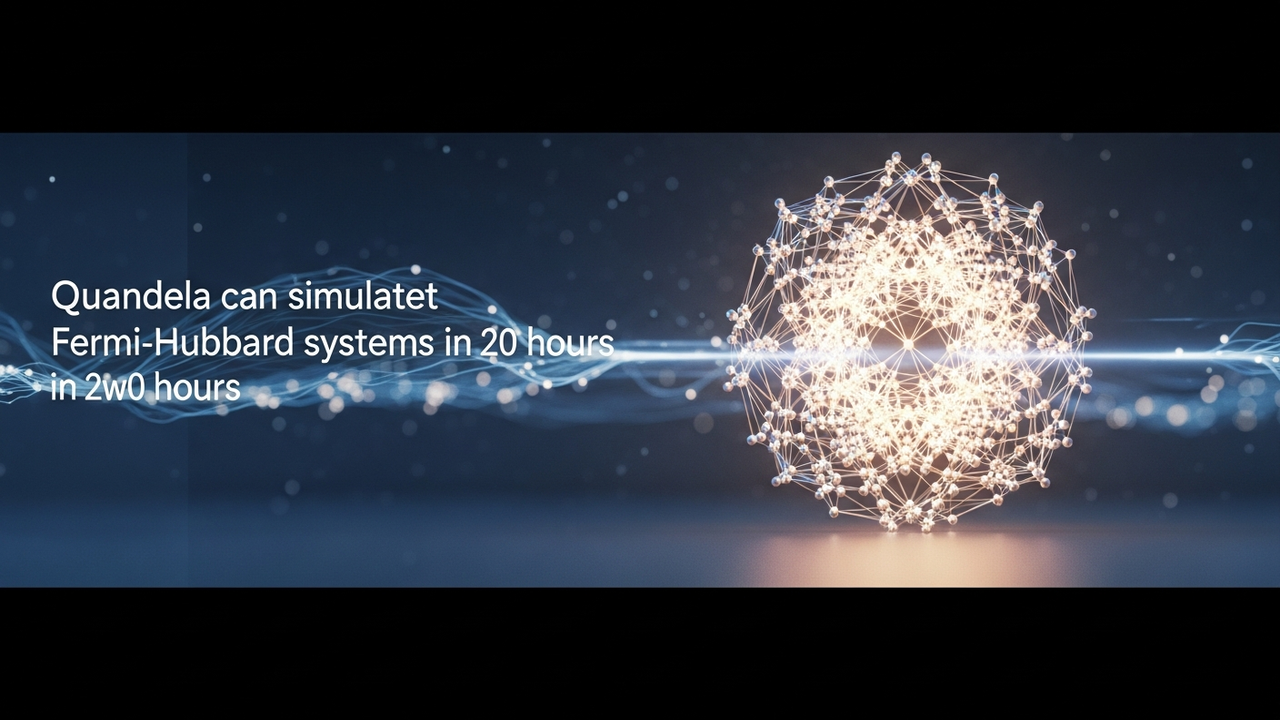
French quantum computing companies Quandela and Walrus Computing have announced detailed resource estimations regarding the impressive performance of fault-tolerant spin-optical quantum computers. According to their research, this technology can simulate commercially relevant Fermi–Hubbard systems—one of the most critical challenges in materials science—in approximately two hours. This achievement strongly suggests that quantum computing can become a practical tool for elucidating the behavior of complex quantum materials, such as high-temperature superconductors and quantum magnets, and contribute to the design of groundbreaking new materials.
Technical / Clinical Details
The Fermi–Hubbard model is a quantum many-body model that describes electron interactions and serves as a fundamental framework for understanding phenomena like high-temperature superconductivity and quantum magnetism. Accurately simulating this model has been extremely challenging for classical computers due to the exponential increase in computational resources required. The research by Quandela and Walrus Computing demonstrates that ‘spin-optical quantum computing,’ which utilizes photons as qubits, can overcome this computational barrier. Fault-tolerant quantum computers possess the ability to correct qubit errors, maintaining high reliability even during long computations. Their resource estimation quantitatively analyzed the necessary number of qubits, gate operations, and the overhead required for error correction, showing that a simulation of a specific scale Fermi–Hubbard model can be completed within a realistic timeframe (approximately 2 hours). This presents not just a proof of concept, but a practical roadmap with concrete computational resources.
Background & Context
Quantum materials, particularly high-temperature superconductors and topological materials, hold promise for applications in energy-efficient devices, quantum devices, and next-generation electronics. However, the fundamental physical phenomena of these materials are determined by extremely complex quantum many-body interactions, and their theoretical understanding remains incomplete. The limitations of classical computer simulations have hindered progress in this field. Quantum computing, by its nature, can solve these quantum problems, making it an anticipated ultimate tool for ‘quantum simulation.’ Quandela’s announcement suggests that quantum computing is progressing beyond academic curiosity to a stage where it can directly contribute to solving industrially significant materials science problems, potentially having a major impact on accelerating R&D and creating new industries.
Strategic Significance & Outlook
This achievement highlights that spin-optical quantum computers are a promising platform for solving complex quantum problems in materials science. Moving forward, Quandela and Walrus Computing will likely advance their technology to further scale up the size of simulatable Fermi–Hubbard systems and apply it to a wider range of quantum material problems. Furthermore, strengthening the collaboration between laboratory quantum material synthesis and theoretical predictions from quantum computers is expected to accelerate the entire material discovery cycle. This technology has the potential to enable breakthroughs in various fields, including clean energy, healthcare, and information and communication technology, playing a crucial role in building the foundation for next-generation technologies vital for the sustainable development of human society.
Source: #
Get our weekly technology intelligence — free
Receive an infographic that lets you judge at a glance whether each field’s analysis report is worth reading.
Subscribe Free — Weekly Tech Intelligence
By subscribing, you’ll receive Troy-Technical’s weekly technology intelligence newsletter.
- Your email and selected fields are used only to deliver the newsletter.
- We never share your information with third parties.
- You can unsubscribe anytime via the link in each email.
See our Privacy Policy for details.
Takes about a minute · Unsubscribe anytime







Comments