


Key Findings
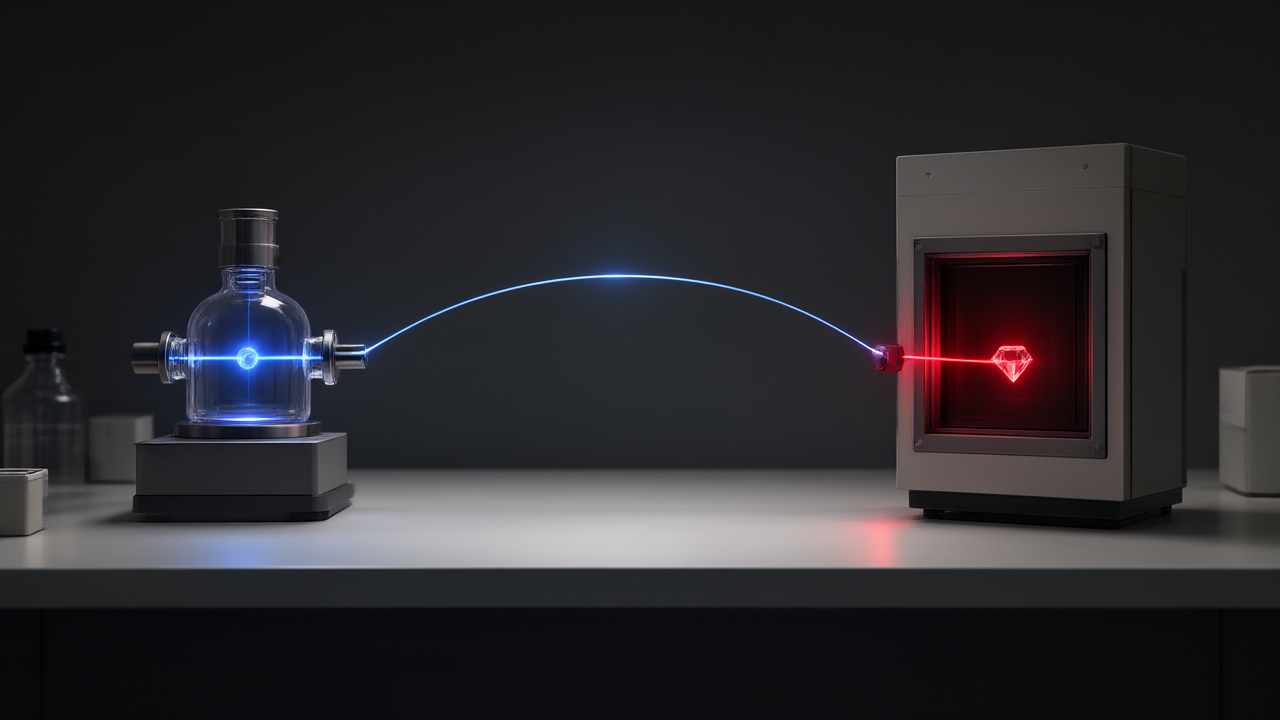
A hybrid quantum architecture has demonstrated the generation of entanglement between a trapped 138 Ba + ion and a silicon-vacancy (SiV – ) center in a diamond nanophotonic cavity. The system produces ion–SiV- Bell pairs at an average rate of 1.03(1) kHz with a fidelity of 87.9(7)%. This performance represents a significant increase over existing photonic links between trapped ions, which have previously reached rates of 250 Bell pairs per second.
Technical Details
The system utilizes a single-photon heralding scheme to overcome photon loss and efficiency limitations. The process involves the following steps:
- A photon is emitted by the trapped ion and collected via a conventional imaging system located outside the vacuum chamber.
- The photon undergoes wavelength and encoding conversion.
- The photon is reflected from the SiV – –cavity system and detected; a single detected photon heralds the entanglement.
By using a reflective quantum memory, the architecture avoids the need for two-photon interference and allows the emitter to be excited with near-unit probability. The SiV – centers in the diamond nanophotonic cavity provide an electron–nuclear spin register with nuclear-controlled gate fidelities reaching 99.9%.
Background & Context
Modular quantum computing requires high-fidelity entanglement between separate processor modules to implement fault-tolerant operations. Current estimates suggest that continuous logical operations between modules require entanglement rates between 10 and 100 kHz. While photonic links are a viable path to multiplexing, they are probabilistic and often limited by radiative lifetimes or photon extraction efficiencies. Previous attempts to increase efficiency using cavities near qubits have been hindered by dielectric surfaces that degrade coherence and gate fidelities.
Significance & Outlook
This heterogeneous approach combines the high emission rate of atomic qubits with the high interaction efficiency of solid-state memories. By achieving a rate of one Bell pair per millisecond, this system matches the cycle time of planned trapped-ion processors, providing a scalable path toward large-scale distributed quantum computing.
Source: https://arxiv.org/html/2610.10705v2
Get our weekly technology intelligence — free
Receive an infographic that lets you judge at a glance whether each field’s analysis report is worth reading.
Subscribe Free — Weekly Tech Intelligence
By subscribing, you’ll receive Troy-Technical’s weekly technology intelligence newsletter.
- Your email and selected fields are used only to deliver the newsletter.
- We never share your information with third parties.
- You can unsubscribe anytime via the link in each email.
See our Privacy Policy for details.
Takes about a minute · Unsubscribe anytime