


Key Findings
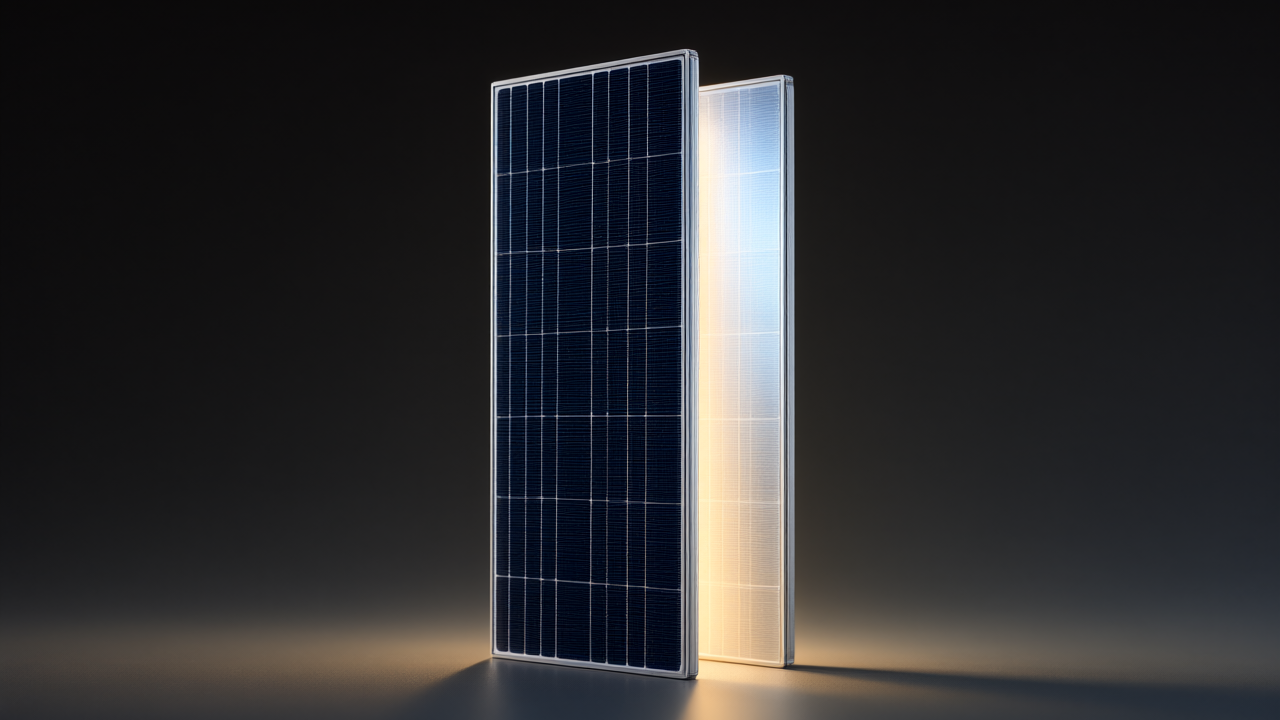
A study published in Nature Energy on 29 October 2026 demonstrates that higher perovskite lattice compliance enhances the stability of bifacial perovskite/silicon tandem solar cells. Under illumination equivalent to a ground albedo of 0.20, the fabricated monolithic tandem devices achieved a power-generation density of 36.2 milliwatts per square centimetre. In ISOS-L-2 ageing tests, which involve one-sun illumination at 65 degrees Celsius, the cells maintained 90 percent of their initial efficiency for over 1,000 hours of operation.
Technical Details
The research team focused on perovskite absorbers with a bandgap of approximately 1.55 electronvolt. This specific composition reduces the use of bromide, which mitigates light-induced halide segregation and shifts the stability focus toward the intrinsic photothermal resilience of bromide-lean absorbers. The study found that higher lattice compliance improves stability through several mechanisms:
- Suppression of thermally induced microstrain accumulation.
- Shifting of deep-level defects toward shallower states.
- Reduction of disorder in band-edge energetics.
Background & Context
Bifacial tandem solar cells are designed to capture light from both sides to deliver more power per unit area than conventional panels. However, maintaining the stability of the perovskite layer under real operating conditions has been a primary obstacle. The work, led by Fuzong Xu, Jiang Liu, and Xuechun Zhang, along with colleagues including Stefaan De Wolf, establishes lattice compliance as a physically testable framework. This allows researchers to evaluate the mechanical response of the lattice and its link to defect energetics directly.
Significance & Outlook
By providing a measurable criterion for screening materials, this design principle moves the field away from trial-and-error stability testing. While the reported efficiency and stability figures were achieved under controlled laboratory conditions, the authors note that translating the lattice-compliance principle into commercially manufactured bifacial tandem modules will require further validation at scale.
Source: https://bioengineer.org/softer-perovskite-lattices-yield-stable-bifacial-tandem-solar-cells/
Get our weekly technology intelligence — free
Receive an infographic that lets you judge at a glance whether each field’s analysis report is worth reading.
Subscribe Free — Weekly Tech Intelligence
By subscribing, you’ll receive Troy-Technical’s weekly technology intelligence newsletter.
- Your email and selected fields are used only to deliver the newsletter.
- We never share your information with third parties.
- You can unsubscribe anytime via the link in each email.
See our Privacy Policy for details.
Takes about a minute · Unsubscribe anytime