


Key Findings
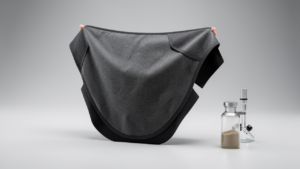
The GriFIPS sensor demonstrates a sensitivity of 175.9 kPa⁻¹ and a linear detection upper limit of approximately 360kPa, with a coefficient of determination R²=0.997. It can detect pressures as low as 2.1Pa (roughly the weight of a ladybug) with a response time of 25ms and a recovery time of 50ms. In material recognition tests across 14 different substances, the system achieved an accuracy rate of 99.86%.
Technical Details
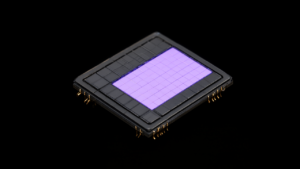
The team moved away from modifying core functional materials, instead adding a gradient grid interlayer between the electrode and the ionic gel. This layer, made of Dragon Skin 20 silicone via direct-write printing, consists of three concentric rings (diameters of 4mm, 8mm, and 12mm) with a line width and thickness of 100μm. This structure ensures a progressive contact mechanism where the center responds first, and the contact area expands radially as pressure increases.
To prevent signal saturation, the sensor utilizes a liquid metal composite electrode made of gallium-indium and PDMS. Ultrasonic sintering creates a conductive path with micron-scale surface roughness, which maintains capacitance changes over a wider pressure range compared to smooth copper electrodes.
Background & Context
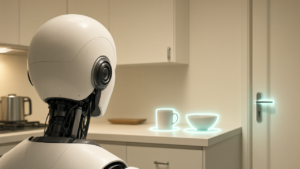
Current humanoid robots struggle with “blind spots” in vision, such as self-occlusion or the inability to distinguish between visually identical but mechanically different elastomers. While iontronic sensors offer high sensitivity, they typically suffer from rapid signal saturation. Previous solutions involving complex microstructures or multi-layer stacking were often too cumbersome for large-scale array production.
Significance & Outlook
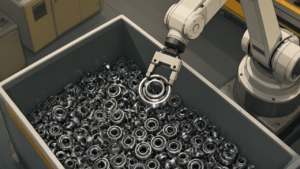
The “decoupled” design allows researchers to adjust sensing characteristics by modifying grid printing parameters rather than redesigning materials. Integration into robotic fingertips enabled 99.72% accuracy in classifying 12 types of fabrics and successful execution of blind-hole assembly and weight-sensing tasks. Future challenges include optimizing the full parameter space of the grid, adapting the planar structure to curved surfaces, and improving wiring for large-scale arrays.
Source: https://www.sohu.com/a/1095026980_489960
Get our weekly technology intelligence — free
Receive an infographic that lets you judge at a glance whether each field’s analysis report is worth reading.
Subscribe Free — Weekly Tech Intelligence
By subscribing, you’ll receive Troy-Technical’s weekly technology intelligence newsletter.
- Your email and selected fields are used only to deliver the newsletter.
- We never share your information with third parties.
- You can unsubscribe anytime via the link in each email.
See our Privacy Policy for details.
Takes about a minute · Unsubscribe anytime