Key Findings
A new semi-solid slurry strategy has achieved a 409% increase in specific capacity compared to MnSO₄-based electrolyte benchmarks. Using a 4 M MnO₂ slurry, the researchers reached a soluble manganese species concentration of 3.76 M and a specific capacity of 156.2 Ah L⁻¹. Notably, the system maintains high performance at a current density of 30 mA cm⁻², where it retains a specific capacity above 151 Ah L⁻¹ and an energy efficiency exceeding 71%.
Technical Details
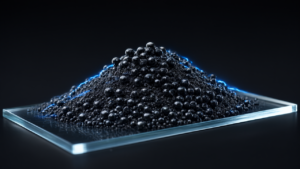
The system overcomes the common-ion effect in conventional sulfuric acid electrolytes, which typically limits MnSO₄ solubility. By introducing solid MnO₂ particles, the battery accesses more active material as the solid MnO₂ is electrochemically converted into soluble Mn²⁺ during discharge. The slurry operates without additional conductive carbon additives while maintaining low viscosity.
The study identified a shift in the electrochemical reaction mechanism:
- Initial cycles rely on a slower solid-phase MnO₂/Mn²⁺ reaction.
- Subsequent charging creates a more disordered MnO₂ with a larger specific surface area.
- This new structure favors a reverse disproportionation reaction with Mn²⁺, shifting the dominant process to a faster solution-phase Mn³⁺/Mn²⁺ reaction.
This transition improves reaction kinetics and discharge voltage, allowing for higher current densities.
Background & Context
Manganese-based redox flow batteries are attractive for large-scale storage due to the abundance and low cost of manganese. However, conventional systems are limited by solubility, and previous semi-solid attempts suffered from slow reaction kinetics that restricted operating current densities.
Significance & Outlook
With an estimated electrolyte energy cost of US$33 kWh⁻¹, this method provides a significant economic advantage. While a 1 M MnO₂ slurry demonstrated 99% Coulombic efficiency and 76% energy efficiency over 100 cycles at 30 mA cm⁻², capacity retention remains a challenge at higher concentrations due to manganese crossover and particle accumulation. Future optimization of membranes and electrolytes is required to improve cycling stability for renewable energy storage applications.
Source: https://www.miragenews.com/mno-slurry-electrolytes-boost-manganese-flow-1772361/
Get our weekly technology intelligence — free
Receive an infographic that lets you judge at a glance whether each field’s analysis report is worth reading.
Subscribe Free — Weekly Tech Intelligence
By subscribing, you’ll receive Troy-Technical’s weekly technology intelligence newsletter.
- Your email and selected fields are used only to deliver the newsletter.
- We never share your information with third parties.
- You can unsubscribe anytime via the link in each email.
See our Privacy Policy for details.
Takes about a minute · Unsubscribe anytime