


Key Findings
A research team led by Professor Jung-Yong Kim at Sungkyunkwan University has developed a world-first technology to freely control the color (energy) and vibration direction (polarization) of infrared light. By stacking two atomic-layer semiconductors and adjusting the twist angle, the team successfully generated stable interlayer exciton light in the infrared spectrum across various rotation angles.
Technical Details
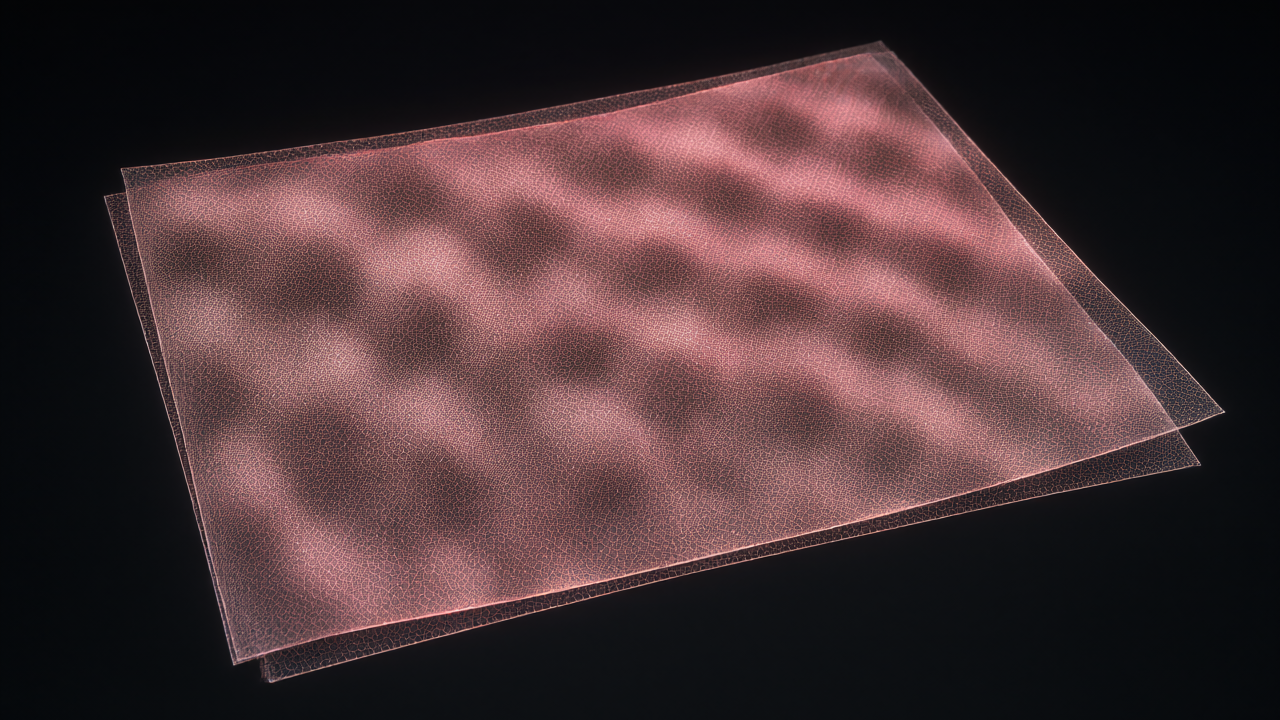
The researchers utilized anisotropic semiconductor materials, specifically rhenium disulfide (ReS2) and rhenium diselenide (ReSe2). By twisting the layers at angles ranging from 1 to 88 degrees, they created “Moiré patterns” within the atomic lattices, similar to the patterns formed by overlapping mosquito nets.
- Energy Control: By combining the twist angle and the number of layers, the team achieved a light energy control range of approximately 100 meV, which is described as a world-leading level for 2D semiconductors.
- Intensity and Polarization: Increasing the number of layers enhanced light brightness by more than 10 times and enabled the precise control of the polarization direction.
Background & Context
When light hits a semiconductor, electrons (negative charge) and holes (positive vacancies) pair to form “excitons.” In “interlayer excitons,” where the electron and hole reside in different layers, the lifespan is dozens of times longer than standard excitons, making them easier to manipulate via external voltage. Previously, 2D semiconductors were limited to specific angles (0 or 60 degrees) for light emission or polarization changes, restricting their practical application.
Significance & Outlook
This technology overcomes the structural limitations of existing 2D materials by providing a single nano-semiconductor platform that simultaneously controls light energy and polarization. Potential applications include LiDAR for autonomous vehicles, night vision surveillance equipment, and high-precision biosensors. The research was supported by the National Research Foundation of Korea (NRF) and published in ACS Nano.
Source: https://www.usline.kr/news/articleView.html?idxno=35298
Get our weekly technology intelligence — free
Receive an infographic that lets you judge at a glance whether each field’s analysis report is worth reading.
Subscribe Free — Weekly Tech Intelligence
By subscribing, you’ll receive Troy-Technical’s weekly technology intelligence newsletter.
- Your email and selected fields are used only to deliver the newsletter.
- We never share your information with third parties.
- You can unsubscribe anytime via the link in each email.
See our Privacy Policy for details.
Takes about a minute · Unsubscribe anytime