


Key Findings
A research team led by Professor Junseok Noh of POSTECH, in collaboration with Samsung Research, has developed an ultra-thin augmented reality (AR) lens with a total thickness of 1.5mm. The technology achieves a diagonal field of view (FOV) of 30 degrees and an eye box of 8mm by 8mm at a distance of 15mm from the waveguide. Performance tests showed a white light luminance efficiency averaging 1938 nits/lm, with a maximum of 4225 nits/lm.
Technical Details
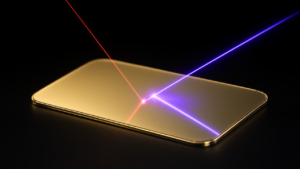
The system utilizes metasurface waveguides to address light loss and color distortion common in traditional AR optics. The team implemented the following technical specifications:
- Nanostructure Design: Nano-structures smaller than the wavelength of light were placed on the waveguide surface, with shapes and intervals adjusted based on position.
- Layered Architecture: To achieve full-color imagery, the team combined two layers—one primarily for blue and green light, and another for red and green light.
- Material: The metasurfaces were fabricated using silicon nitride (SiNx), with 29 different nano-structure regions designed per layer.
- Luminance Efficiency: Average luminance efficiency was measured at 1897 nits/lm for red, 1977 nits/lm for green, and 2170 nits/lm for blue.
Background & Context
Conventional AR glasses often struggle to balance thickness, brightness, and the viewing range. Light typically leaks out as it changes direction within the waveguide, leading to dim images, especially when expanding the range of eye movement. This research, published in Nature on November 12, 2026, uses ray tracing and electromagnetic analysis to ensure more light reaches the eye.
Significance & Outlook
This development enables the use of AR glasses in bright outdoor settings and reduces display power consumption by increasing light delivery efficiency. Future goals include reducing the two-layer waveguide to a single layer, establishing mass-production processes, and eliminating “rainbow” blurring effects caused by external light. The technology is expected to be applied to AI-based smart glasses and daily-use AR devices for navigation and work information.
Get our weekly technology intelligence — free
Receive an infographic that lets you judge at a glance whether each field’s analysis report is worth reading.
Subscribe Free — Weekly Tech Intelligence
By subscribing, you’ll receive Troy-Technical’s weekly technology intelligence newsletter.
- Your email and selected fields are used only to deliver the newsletter.
- We never share your information with third parties.
- You can unsubscribe anytime via the link in each email.
See our Privacy Policy for details.
Takes about a minute · Unsubscribe anytime