

Key Findings
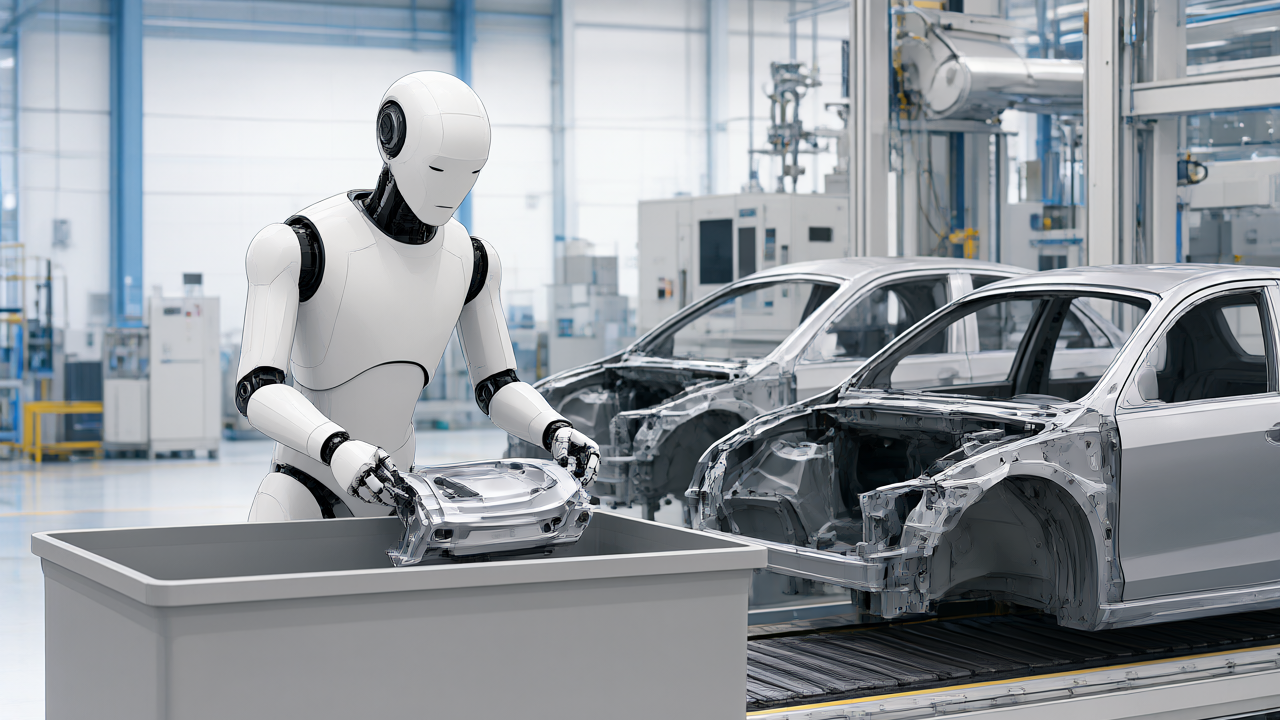
Gemini Robotics 2.5 achieved a 96% success rate during automotive kitting tests at Mercedes-Benz factories in Sindelfingen, Germany, and Kecskemét, Hungary. In these tests, Apptronik’s Apollo 2 humanoid robots sorted metal automotive brackets from bulk containers into sequencing trays. Across more than 200 evaluated tasks, the model performed 20% to 30% faster and showed success rates 30% to 100% higher than previous baselines.
Technical Details
The deployment utilized a dual-model architecture: Gemini Robotics ER managed the overall workflow, while Gemini Robotics 2.5 controlled the physical movements of the arms and hands. The model is compatible with various platforms, including the Franka Duo system and the Apollo 2, which features a five-fingered SharpaWave hand with 22 degrees of freedom.
Significant improvements in dexterity were recorded compared to Gemini Robotics 2:
- Packing pastries with tongs: 5% to 100% success rate.
- Closing a toolbox lid: 0% to 93% success rate.
- Untying ribbon bows: 0% to 70% success rate.
- Hanging a cardigan: 0% to 62% success rate.
- Sweeping trash into a dustpan: 0% to 52% success rate.
Safety was enhanced through reasoning-based movement adjustments, increasing safe task completion by 33% around obstacles and 43% near people.
Background & Context
Google DeepMind introduced ASIMOV-Jailbreak, an open-source benchmark to test resistance to unsafe instructions. The Gemini 4 Argon model achieved a 99.5% resistance rate, compared to 82% for the Gemini Robotics ER 2 model. Furthermore, Gemini 4 Argon accelerated the development of Gemini Robotics 2.5 by generating thousands of simulated training environments from real-world camera scenes and analyzing failure videos to suggest improvements.
Significance & Outlook
The model is currently being rolled out to robotics partners, including Boston Dynamics, Agile Robots, and Apptronik. According to Apptronik CEO Jeff Cardenas, the ability of the models to improve rapidly through post-training and transfer to production lines with minimal drop-off provides a foundation for scaling humanoid robots in industrial settings.
Get our weekly technology intelligence — free
Receive an infographic that lets you judge at a glance whether each field’s analysis report is worth reading.
Subscribe Free — Weekly Tech Intelligence
By subscribing, you’ll receive Troy-Technical’s weekly technology intelligence newsletter.
- Your email and selected fields are used only to deliver the newsletter.
- We never share your information with third parties.
- You can unsubscribe anytime via the link in each email.
See our Privacy Policy for details.
Takes about a minute · Unsubscribe anytime