


Key Findings
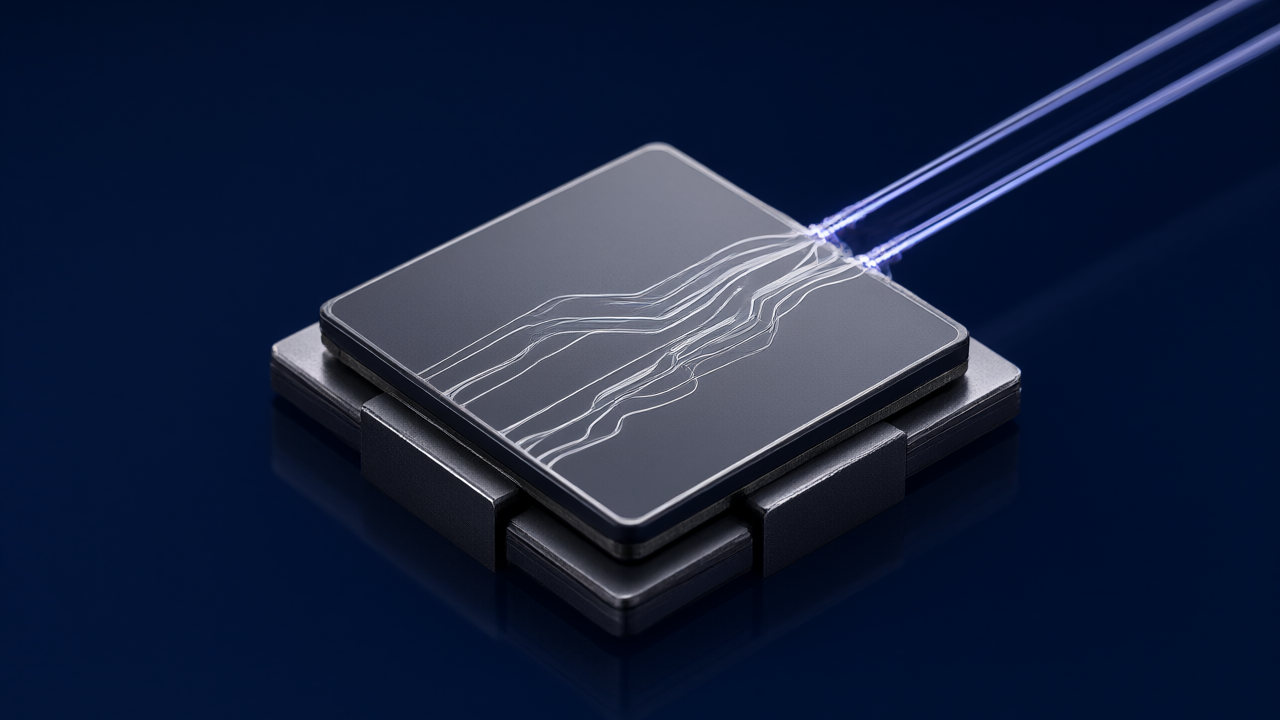
NTT has successfully demonstrated a programmable optical circuit capable of reducing signal temporal spread from approximately 27ns to approximately 10ns over a transmission distance of 1331.2km. This represents a reduction of about 60%, which corresponds to a potential reduction in the processing load of the receiver-side digital signal processing (DSP) by 60% or more.
Technical Details
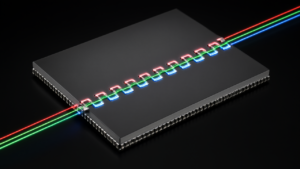
The developed circuit utilizes Planar Lightwave Circuit (PLC) technology based on silica waveguides. It features an array of Mach-Zehnder interferometers, where the phase of each interferometer is adjusted to control the mixing of multiple optical signals. The prototype achieved the following specifications:
- Insertion loss: 2.1dB
- Operating bandwidth: 40nm
- Control fidelity: Over 96%
- Input/output ports: 8
- Polarization independence
To optimize the circuit, NTT treated the entire transmission path as a deep neural network (DNN). Using the backpropagation method typically used in DNN training, the system adjusts the phase of each interferometer to minimize signal spread.
Background and Context
The demand for increased transmission capacity is rising due to the proliferation of cloud services and generative AI. Specifically, Space Division Multiplexing (SDM) technology, which uses multiple spatial modes in a single fiber, suffers from signal spreading caused by propagation speed differences and mode mixing. Traditionally, this required massive DSP at the receiver end, leading to increased power consumption and processing delays.
Significance and Outlook
While the experiment did not directly measure a 60% reduction in DSP power consumption, it demonstrated a reduction in the required calculation and memory volume by shortening the time range of the signal that needs compensation. NTT intends to expand this technology to handle more spatial modes, integrate it with optical switching functions, and implement real-time control. The goal is to deploy these circuits in networks ranging from data center interconnects to transcontinental submarine cables.
Source: https://optronics-media.com/news/20261113/114030/
Get our weekly technology intelligence — free
Receive an infographic that lets you judge at a glance whether each field’s analysis report is worth reading.
Subscribe Free — Weekly Tech Intelligence
By subscribing, you’ll receive Troy-Technical’s weekly technology intelligence newsletter.
- Your email and selected fields are used only to deliver the newsletter.
- We never share your information with third parties.
- You can unsubscribe anytime via the link in each email.
See our Privacy Policy for details.
Takes about a minute · Unsubscribe anytime