


Key Findings
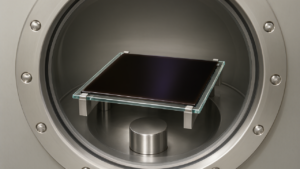
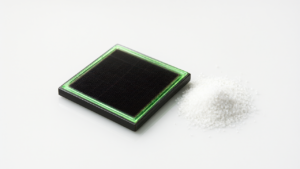
A research team led by Professor Yang Dong from the Dalian Institute of Chemical Physics (CAS) and Dalian Maritime University has developed a method to produce high-efficiency perovskite solar modules under ambient conditions. The team achieved a peak PCE of 22.70% for a module with an active area of 54.80 cm², consisting of 14 series-connected cells. For comparison, small-area cells produced using the same method reached a maximum efficiency of 26.16%.
Technical Details
To overcome the volatility and thermal instability of methylammonium (MA), the researchers used a FAxCs1-xPbI3 system. To prevent phase separation and ensure film uniformity during slot-die coating, they introduced two additives: formamidinium thiocyanate (FASCN, 2 mg/mL) and rubidium thiocyanate (RbSCN, 5 mg/mL). These additives expanded the “processing window” (the time between coating and annealing) to over 100 seconds.
- FASCN: Promotes nucleation and crystal growth during vacuum flash processing.
- RbSCN: Suppresses the non-photoactive yellow phase (δ-phase) and stabilizes the photoactive black phase (α-phase).
- Mechanism: DFT calculations suggest Rb+ ions reduce the activation energy for the δ-to-α phase transition from 0.68 eV to 0.64 eV.
Stability and Durability
Unencapsulated devices were tested under various conditions. In a nitrogen atmosphere at 65°C under continuous illumination (ISOS-L-3I), the additive-enhanced cells maintained 97.76% of their initial efficiency after 1,300 hours. In dark heat tests at 85°C (nitrogen), they maintained over 96% efficiency after 1,000 hours. In ambient air (30–50% humidity) without operation, they retained over 97% efficiency after 1,600 hours.
Significance and Outlook
The research demonstrates that increasing the tolerance of the crystallization process reduces film variance; efficiency deviations on 10 cm x 10 cm substrates dropped to less than ±0.48 compared to ±1.16 for additive-free films. Future milestones include third-party certification of the 22.70% efficiency, long-term lifetime evaluations of encapsulated modules in real-world environments, and validation on continuous roll-to-roll production lines.
Source: https://xenospectrum.com/perovskite-module-slot-die-high-efficiency/
Get our weekly technology intelligence — free
Receive an infographic that lets you judge at a glance whether each field’s analysis report is worth reading.
Subscribe Free — Weekly Tech Intelligence
By subscribing, you’ll receive Troy-Technical’s weekly technology intelligence newsletter.
- Your email and selected fields are used only to deliver the newsletter.
- We never share your information with third parties.
- You can unsubscribe anytime via the link in each email.
See our Privacy Policy for details.
Takes about a minute · Unsubscribe anytime