Key Findings
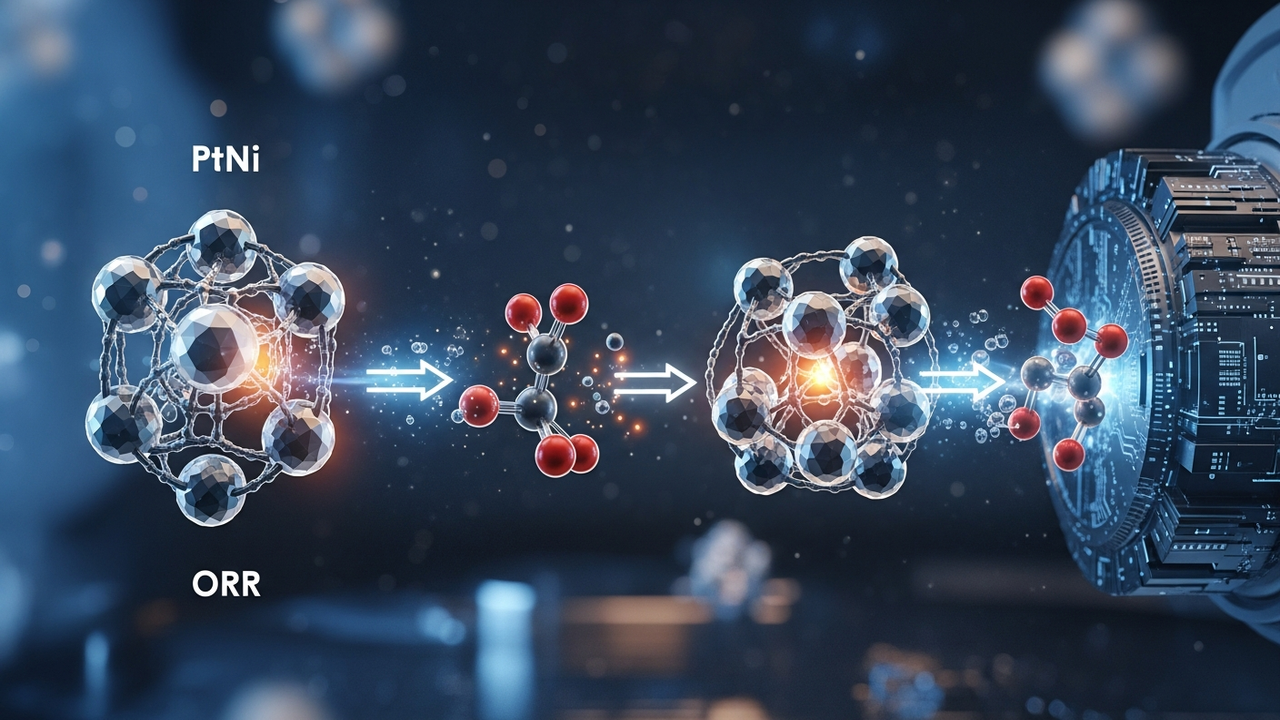
It has been discovered that local coordination asymmetry at the atomic level within platinum-nickel (PtNi) nanocrystals dramatically enhances catalytic performance for both the oxygen reduction reaction (ORR) and the ethylene glycol oxidation reaction (EGOR), which play crucial roles in fuel cells and chemical synthesis, respectively. These PtNi nanocrystals exhibited exceptionally high mass activities—6.73 times greater for ORR and 3.86 times greater for EGOR compared to commercial platinum-carbon (Pt/C) catalysts—opening new avenues for improving the efficiency of precious metal catalysts.
Technical Details
The research team synthesized PtNi nanocrystals with specific heterogeneous coordination environments of Pt and Ni atoms using a controlled synthesis method. Density Functional Theory (DFT) calculations demonstrated that this local coordination asymmetry optimizes the electronic state of Pt atoms, particularly leading to an up-shift in the d-band center. This up-shift in the d-band center enhances the adsorption of both oxygen molecules (O2) and ethylene glycol (EG) molecules onto the catalyst surface, promoting stronger interaction between reactants and the catalyst. Detailed analysis via in situ electrochemical infrared spectroscopy further supported this mechanism, revealing that the formation of crucial oxygenated intermediates is accelerated. Consequently, the 4-electron reduction pathway for oxygen is favored in ORR, and EG is more efficiently oxidized in EGOR, leading to a significant increase in current density. These results provide design principles for next-generation catalysts that can achieve high performance while reducing the amount of precious metal used.
Background & Context
Fuel cell technology holds great promise for clean energy conversion, but its performance and cost heavily depend on precious metal catalysts, particularly platinum. Since platinum is expensive and has limited supply, the development of “low-Pt” or “Pt-free” catalysts that maintain or improve performance while reducing platinum usage is at the forefront of research and development. Ethylene glycol is also a promising candidate for liquid fuel cells and a valuable chemical feedstock, making its efficient electrochemical oxidation important for both energy conversion efficiency and the production of value-added chemicals. PtNi alloy nanocrystals have shown potential to improve catalytic performance by tuning the electronic structure of platinum-group metals, but a deeper understanding of their underlying mechanisms was needed.
Strategic Significance & Outlook
The discovery of enhanced catalytic performance due to local coordination asymmetry in PtNi nanocrystals will have a significant impact on the design of a wide range of electrochemical devices, including fuel cells, metal-air batteries, and electrochemical synthesis. Moving forward, this design principle is expected to be extended to other multi-metallic nanocatalyst systems, leading to the development of even higher-performing and more cost-effective catalysts. In particular, it has the potential to contribute to reducing the cost and improving the long-term stability of precious metal catalysts, which are major challenges for the commercialization of fuel cells. The research team will aim for practical application by further precisely controlling the catalyst’s composition, size, shape, and defect structures. This study represents a significant step towards the development of sustainable energy technologies and more efficient utilization of precious metal resources.
Source: https://pubs.acs.org/doi/10.1021/acs.applyengmaterials.6b00196
Get our weekly technology intelligence — free
Receive an infographic that lets you judge at a glance whether each field’s analysis report is worth reading.
Subscribe Free — Weekly Tech Intelligence
By subscribing, you’ll receive Troy-Technical’s weekly technology intelligence newsletter.
- Your email and selected fields are used only to deliver the newsletter.
- We never share your information with third parties.
- You can unsubscribe anytime via the link in each email.
See our Privacy Policy for details.
Takes about a minute · Unsubscribe anytime






Comments