Background: The Promise of Quantum Dots and Their Environmental Challenges
Quantum dots (QDs), owing to their superior optical properties—including wide excitation spectra, tunable emission, narrow full-width at half-maximum (FWHM), and high photoluminescence quantum yields (PLQY)—hold immense promise for transformative applications in next-generation displays, lighting, solar cells, and bioimaging. Perovskite quantum dots (PQDs), in particular, have garnered significant attention for their exceptional luminescent performance. However, many current QD formulations often contain toxic heavy metals like lead and cadmium, raising severe environmental and human health concerns. These toxicity issues, coupled with the inherent instability of traditional QDs in ambient conditions, have presented substantial barriers to their widespread commercialization.
Key Findings / Results: Breakthrough in Lead-Free CsMnBr3 QD Glass
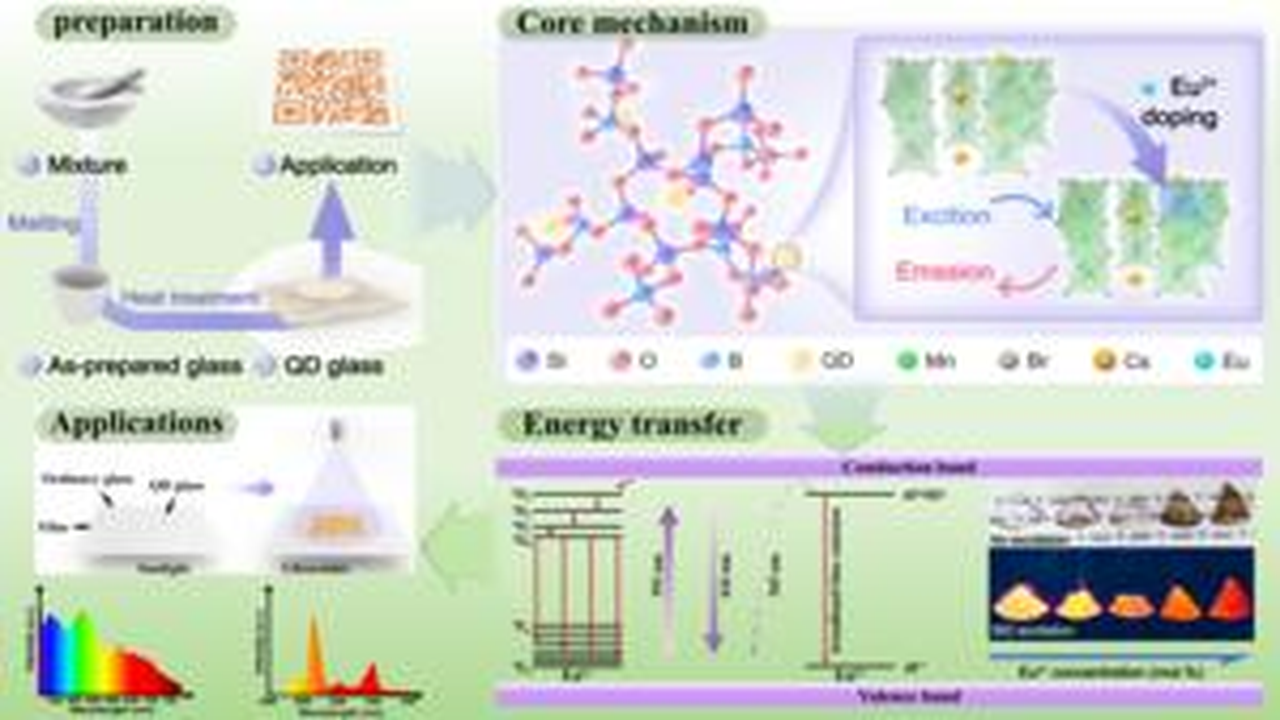
A research team from China Jiliang University has made a significant breakthrough by developing stable and eco-friendly lead-free quantum dot glass, effectively addressing the aforementioned challenges. This innovative research offers a compelling, environmentally conscious alternative to conventional lead halide perovskite QDs.
The key technical features of the developed lead-free QD glass are:
- Lead-Free Composition: The material is based on safer cesium manganese bromide (CsMnBr3) quantum dots, entirely free from toxic lead or cadmium. This aligns with increasingly stringent environmental regulations and contributes to sustainable technological development.
- Emission Control via Eu3+ Doping: The co-introduction of europium ions (Eu3+) into the CsMnBr3 QD system enables precise control over luminescence properties and significantly enhances stability. Eu3+ ions play a crucial role in tuning specific emission wavelengths and boosting overall luminescent efficiency. For example, the incorporation of Eu3+ can shift and narrow the emission spectrum, leading to higher color purity.
- Superior Stability: The innovative “QD-in-glass” structure, where QDs are embedded within a robust glass matrix, dramatically improves the QDs’ stability against moisture, oxygen, and heat in ambient air. This encapsulation ensures long-term performance retention, making practical product applications viable for extended periods.
- Scalable Manufacturing Process: The developed fabrication process is compatible with large-scale industrial glass manufacturing techniques, making it suitable for cost-effective commercial mass production of lead-free QD glass.
- Excellent Red Emission Characteristics: This lead-free QD glass functions as a high-purity, vibrant red emitter. This characteristic makes it highly promising for expanding the color gamut of next-generation displays and for developing high color rendering index (CRI) LED lighting applications.
Technical Significance & Outlook: Fostering an Eco-Friendly Display and Lighting Market
The development of this lead-free quantum dot glass by China Jiliang University holds profound implications for the display and lighting industries. By eliminating toxic heavy metals, the technology significantly reduces environmental impact and enhances product safety and sustainability. This breakthrough lowers the barrier to widespread adoption of quantum dots in consumer products, accelerating their penetration into a broader market segment.
Specifically, in high-definition displays such as QLED TVs and smartphones, this technology enables more vibrant and accurate color reproduction while mitigating the presence of hazardous substances. For high-CRI LED lighting, it offers high-quality light sources that are both health-conscious and environmentally responsible. This lead-free QD technology is positioned to become a major competitive advantage in the display and lighting sectors, particularly as global environmental regulations continue to tighten. Research and development in lead-free QD materials are accelerating worldwide, and this achievement underscores China’s crucial role in advancing this vital field, contributing to a greener and healthier technological future.