


Key Findings
OCSiAl announced that its TUBALL™ single-wall carbon nanotubes (SWCNTs) significantly enhance lithium-ion battery performance, demonstrating an energy density increase of up to 10 Wh/kg in Lithium Iron Phosphate (LFP) and Lithium Iron Manganese Phosphate (LFMP) battery systems. Furthermore, the technology achieved a remarkable three-fold suppression of DC resistance (DCR) growth under high discharge rate conditions, indicating superior stability. These advancements are crucial for enabling longer-lasting and more efficient power solutions in electric vehicles and other high-performance battery applications.
Technical Details
- TUBALL™ SWCNTs are produced using OCSiAl’s proprietary ultra-low-cost mass production technology, making them accessible for a wide range of industrial applications.
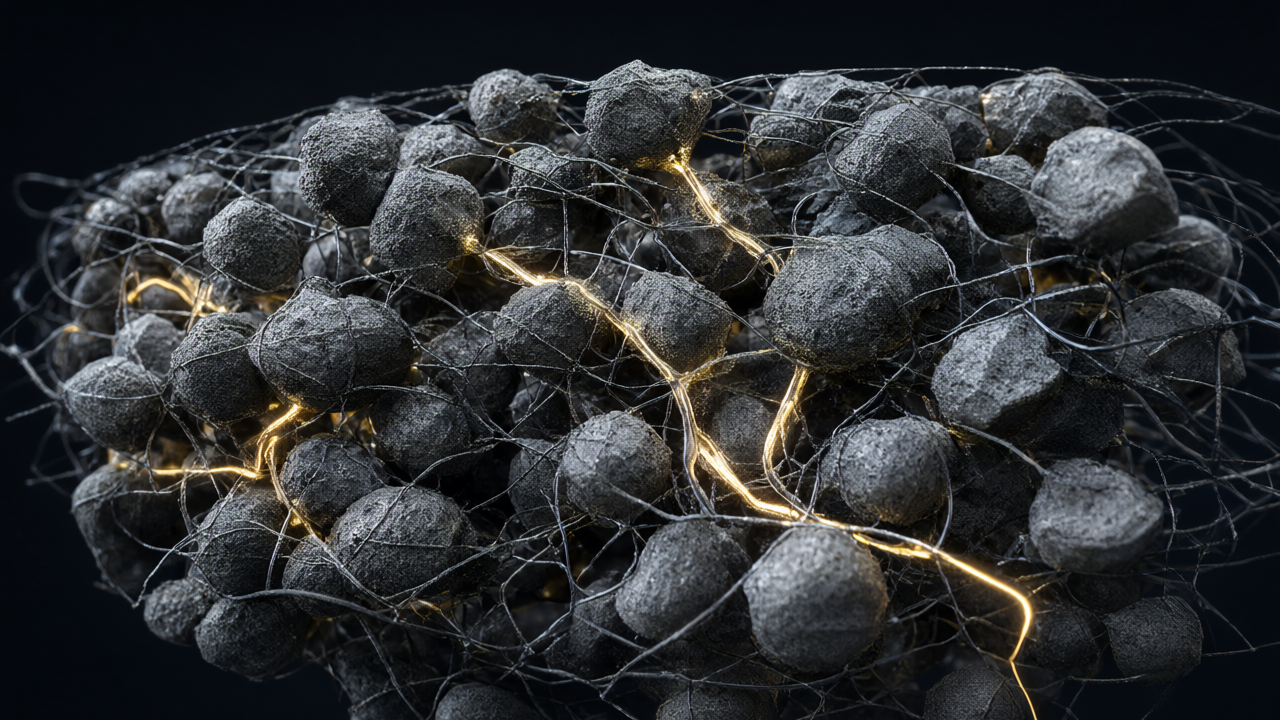
- The nanotubes reinforce the conductive network within battery electrodes, optimizing electron transfer and reducing internal resistance.
- Notably, TUBALL™ achieves equivalent or superior performance with significantly lower loading (10 to 60 times less) compared to conventional conductive additives like carbon black or multi-wall carbon nanotubes. This enables a higher active material ratio in electrodes, directly contributing to increased energy density.
- The technology also contributes to extending battery cycle life, delaying degradation and enhancing overall longevity.
Background & Context
Improving energy density and battery lifespan are paramount challenges in today’s battery technology landscape. The electric vehicle (EV) market, in particular, demands extended driving ranges and faster charging times, making high-performance battery materials indispensable. While SWCNTs have garnered attention for their exceptional conductivity and mechanical strength, their high manufacturing cost and scalability have been historical hurdles. OCSiAl’s breakthrough addresses these issues, providing SWCNTs at a market-viable price and scale.
Strategic Significance & Outlook
OCSiAl aims to contribute to the realization of next-generation batteries with energy densities exceeding 400 Wh/kg through the deployment of TUBALL™. This advancement holds potential to accelerate applications in fields requiring extreme battery performance, such as electric aircraft and high-performance EVs. With OCSiAl’s continuous expansion of mass production capabilities, nanotube-based high-performance batteries are expected to see broader adoption across various industries, driving innovation in energy storage solutions globally.
Source: https://ocsial.com/media/file/2026/09/30/BROCHURE_SWCNT_ENG_26.09.pdf
Get our weekly technology intelligence — free
Receive an infographic that lets you judge at a glance whether each field’s analysis report is worth reading.
Subscribe Free — Weekly Tech Intelligence
By subscribing, you’ll receive Troy-Technical’s weekly technology intelligence newsletter.
- Your email and selected fields are used only to deliver the newsletter.
- We never share your information with third parties.
- You can unsubscribe anytime via the link in each email.
See our Privacy Policy for details.
Takes about a minute · Unsubscribe anytime