Key Findings
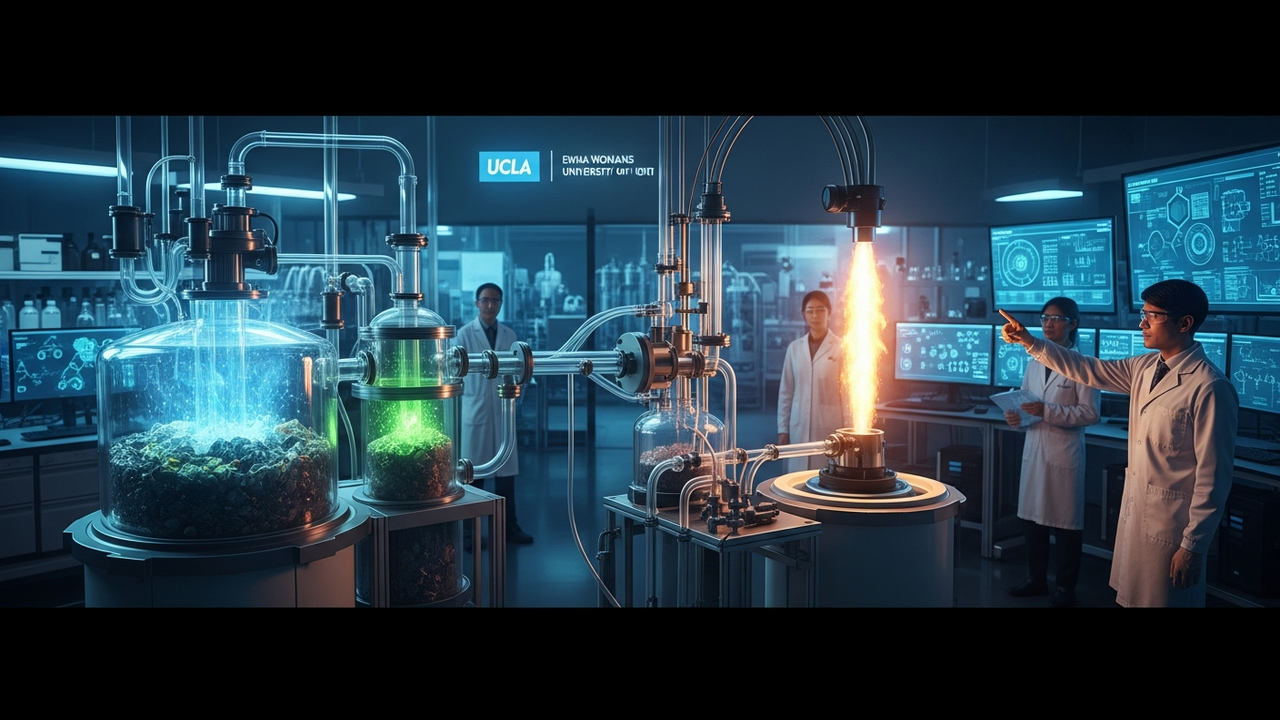
A collaborative research team from the UCLA Samueli School of Engineering and Ewha Womans University in South Korea has jointly developed a revolutionary new chemical process. This process efficiently converts unsorted mixed plastic waste directly into high-purity hydrogen fuel, opening the door to transforming the global challenge of plastic pollution into a solution for clean energy production.
Technical Details
The developed process is named ‘Alkali Thermal Treatment (ATT)’. ATT operates at significantly lower temperatures compared to conventional plastic waste treatment technologies like gasification. This low-temperature operation not only reduces energy consumption but also enhances process safety and control. Most notably, this process does not release carbon from plastics into the atmosphere as carbon dioxide; instead, it efficiently sequesters it as a solid mineral. This completely avoids greenhouse gas emissions, achieving hydrogen production with zero environmental footprint. The technology is applicable to various types of mixed plastics, including polyethylene, polypropylene, and polystyrene, and significantly reduces treatment costs and complexity by eliminating the need for sorting.
Background and Industry Context
Hundreds of millions of tons of plastic waste are generated globally each year, with much of it ending up in landfills or polluting oceans. Simultaneously, there is a growing demand for clean hydrogen energy as part of climate change mitigation efforts. However, hydrogen production still faces cost and resource constraints. This research presents a ‘two birds with one stone’ solution, addressing both the waste problem and the energy problem—two urgent global challenges. Hydrogen production from plastic waste also aligns with the principles of a circular economy, significantly contributing to the establishment of a sustainable society.
Strategic Significance and Outlook
The research by UCLA and Ewha Womans University offers an innovative means to transform plastic waste into a valuable resource. If the ATT process achieves further scale-up and commercialization, it has the potential to revolutionize both waste management and energy supply for municipalities and industries. Particularly, the advantage of directly generating hydrogen from mixed plastics bypasses the challenges of existing recycling infrastructure, promoting broader adoption. This technology is expected to play a crucial role in the future convergence of sustainable resource management and clean energy production.
Get our weekly technology intelligence — free
Receive an infographic that lets you judge at a glance whether each field’s analysis report is worth reading.
Subscribe Free — Weekly Tech Intelligence
By subscribing, you’ll receive Troy-Technical’s weekly technology intelligence newsletter.
- Your email and selected fields are used only to deliver the newsletter.
- We never share your information with third parties.
- You can unsubscribe anytime via the link in each email.
See our Privacy Policy for details.
Takes about a minute · Unsubscribe anytime





Comments