Key Findings
This guide provides a detailed explanation of ISO cleanroom classification standards, specifically emphasizing the critical importance of ISO Class 1 for nanotechnology research and advanced semiconductor fabrication. This standard is indispensable for ensuring quality and safety in cutting-edge fields that demand extremely clean environments.
Technical / Clinical Details
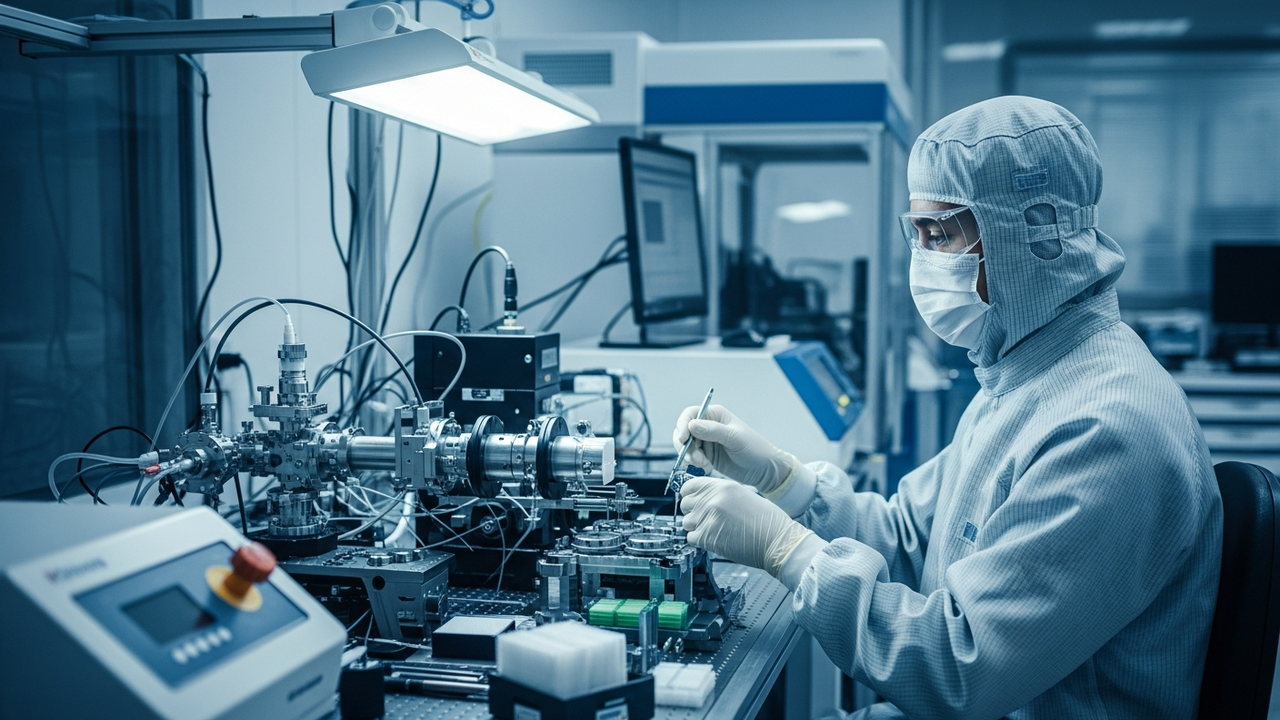
Cleanroom classification, based on ISO 14644-1 standards, defines levels of airborne particulate cleanliness, with ISO Class 1 being the most stringent. In nanotechnology, where minute nanoparticles smaller than 0.1 µm can impact research and manufacturing processes, extremely low particle concentrations like those specified for ISO Class 1 are required. The guide explicitly states that while previous cleanroom classifications focused on 0.5 µm particles, modern nanotechnology necessitates focusing on 0.1 µm particle classification. Specifically, ISO Class 1 limits the maximum permissible concentration of 0.1 µm particles to just 10 particles per cubic meter. Achieving this requires advanced air filtration via HEPA and ULPA filters, laminar airflow, and strict protocols to minimize particle generation. Furthermore, to attain ISO Class 2, rigid wall systems are noted as mandatory due to the demanding requirements for airtightness and structural rigidity.
Background & Context
In advanced technological sectors such as semiconductor manufacturing, nanotechnology, precision medical devices, and aerospace, stringent control of particulate contamination is crucial for ensuring product performance and reliability. At the nanoscale, even minute amounts of dust or microorganisms can cause critical defects in products. Therefore, international cleanroom standards form the foundation supporting the growth and innovation in these industries. Particularly, with the advancement of nanotechnology, there is an increasing need for cleanliness standards for finer particles. The revision of ISO standards and the development of associated operational guidelines address these evolving industry needs.
Strategic Significance & Outlook
This explanation of ISO cleanroom standards serves as a vital guide for engineers, researchers, and investors in the nanotechnology sector regarding cleanroom design and operation. As nano-device miniaturization and complexity continue to advance, the demand for ultra-high purity environments exceeding ISO Class 1 may increase. Furthermore, the development of smart cleanroom technologies leveraging AI and IoT for real-time monitoring systems and automated contamination response is also expected to accelerate. These advancements will significantly contribute to optimizing manufacturing processes, improving yield rates, and enhancing final product quality, thereby fostering further development of the nanotechnology industry. This marks a critical step in building a new paradigm for device manufacturing.
Source: https://www.raxpanel.com/blog/clean-room-standards-explained-iso-classification-guide/
Get our weekly technology intelligence — free
Receive an infographic that lets you judge at a glance whether each field’s analysis report is worth reading.
Subscribe Free — Weekly Tech Intelligence
By subscribing, you’ll receive Troy-Technical’s weekly technology intelligence newsletter.
- Your email and selected fields are used only to deliver the newsletter.
- We never share your information with third parties.
- You can unsubscribe anytime via the link in each email.
See our Privacy Policy for details.
Takes about a minute · Unsubscribe anytime





Comments