
Background
The relentless march of computing power and efficiency is intrinsically linked to the performance of memory devices. Yet, conventional silicon-based memories are rapidly approaching their inherent physical limits in terms of miniaturization, data density, and power consumption, creating an urgent need for novel architectures to drive the post-Moore era. Single-electron devices (SEDs) have long been considered a ‘Holy Grail’ for memory technology, promising ultimate miniaturization and ultra-low power operation due to their fundamental storage mechanism. However, achieving stable and reliable operation of single-electron devices at room temperature has remained a formidable scientific and engineering challenge, largely confining them to laboratory settings requiring cryogenic cooling. Overcoming this barrier is critical for developing foundational technologies that will underpin future advancements in artificial intelligence (AI), big data analytics, and edge computing.
Breakthrough Findings
Addressing this long-standing challenge, a research team at Fudan University has successfully developed a groundbreaking 2D single-electron quantum flash memory device. This innovative device achieves stable, nonvolatile storage of a single electron at room temperature – a feat previously deemed possible only under extremely low, cryogenic conditions. This breakthrough represents a monumental leap in memory technology, unlocking the potential to dramatically enhance computing power, increase data density, and significantly improve energy efficiency across a wide spectrum of electronic systems.
Technical Details
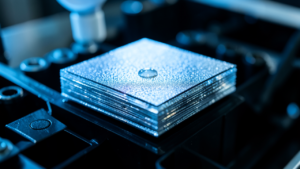
The core of Fudan’s novel memory device lies in its active layer, which leverages a sophisticated two-dimensional (2D) material mere nanometers in thickness. This ultra-thin architecture is critical for enabling precise, quantum-level control over a single electron, thereby facilitating stable information storage. In stark contrast to conventional flash memory, which relies on the accumulation of thousands of electrons to represent a bit, leading to limitations in miniaturization and energy efficiency, this new device isolates and manipulates individual electrons. By skillfully harnessing quantum tunneling effects, the Fudan team has engineered the device to stably maintain a single electron’s charge state for extended periods, even at ambient temperatures. This fundamental shift in storage mechanism translates into an exponential increase in information density and promises orders of magnitude lower power consumption compared to existing memory technologies. Furthermore, beyond its nonvolatile characteristics (retaining data without continuous power), the device achieves remarkable write/erase speeds on the nanosecond scale, significantly outperforming current commercial flash memories. The research team estimates an impressive data retention lifetime of approximately 10 years, showcasing performance parameters that far surpass the constraints of conventional silicon-based technologies.
Strategic Significance and Future Outlook
The successful development of this 2D single-electron quantum flash memory device carries profound implications for the future trajectory of the electronics industry. Looking ahead, the Fudan research team’s immediate priorities include scaling up the technology for large-scale production and ensuring its seamless compatibility with existing semiconductor manufacturing processes. Rigorous evaluation of device durability, reliability, and long-term stability under various operational conditions will also be paramount. Should this technology achieve commercialization, it is poised to dramatically elevate the performance and energy efficiency across an entire spectrum of information processing devices – from ubiquitous smartphones and wearable technologies to high-performance servers, data centers, and even emerging quantum computing platforms. This innovation has the potential to establish an entirely new paradigm for memory technology, serving as a cornerstone for the next generation of digital infrastructure and propelling society into an era of unprecedented computational capability and efficiency.
Source: https://www.chinadaily.com.cn/a/202607/24/WS6a62c03fa310986e2b467125.html
Get our weekly technology intelligence — free
Receive an infographic that lets you judge at a glance whether each field’s analysis report is worth reading.
Subscribe Free — Weekly Tech Intelligence
By subscribing, you’ll receive Troy-Technical’s weekly technology intelligence newsletter.
- Your email and selected fields are used only to deliver the newsletter.
- We never share your information with third parties.
- You can unsubscribe anytime via the link in each email.
See our Privacy Policy for details.
Takes about a minute · Unsubscribe anytime






Comments