
Key Findings
YieldWerx has released a comprehensive analysis on the key trends and challenges in photonics and optical I/O innovations for 2026. The report emphasizes that optical interconnects are undergoing their most dramatic paradigm shift, moving from inter-system communication to in-package communication, driven by the fundamental demands of AI workloads. As electrical interconnects are reaching their physical limits in terms of power density, reach, and latency determinism, in-package optical I/O is positioned as an indispensable technology for AI systems to deliver performance beyond the capabilities of traditional copper wiring.
Technical / Clinical Details
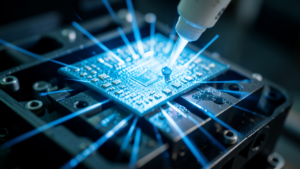
In-package optical I/O refers to the technology of directly integrating optical transceivers within the same package as high-performance processors like CPUs and GPUs. This approach drastically shortens the distance between chips, enabling data transfer via optical signals that are significantly faster and incur much lower loss than electrical signals. While traditional pluggable optical modules handled communication between server racks, in-package optical I/O aims to eliminate bottlenecks in inter-chip communication within AI clusters. This technology provides the high bandwidth, low latency, and superior power efficiency essential for demanding AI workloads. However, with this increasing integration, manufacturers face a new and complex challenge: establishing accurate correlation between electrical and photonic test data from wafer-level to the final package, which is crucial for ensuring manufacturing yield and reliability.
Background & Context
The rapid advancement of AI and the emergence of massive neural network models are placing unprecedented demands on data center computing infrastructure. Particularly in AI clusters where tens of thousands of GPUs operate in concert, the ‘memory wall’ problem, where data movement consumes more power and time than computation itself, has become prominent. Electrical signal data transfer faces increasing power consumption, signal attenuation, and physical limits in interconnect density, hindering further AI scaling. Consequently, industry leaders such as NVIDIA, Intel, and TSMC are making massive investments in optical technologies like silicon photonics and co-packaged optics (CPO) as the core of next-generation AI systems. The YieldWerx analysis highlights these urgent industry needs and technical challenges.
Strategic Significance & Outlook
The proliferation of in-package optical I/O holds the potential to fundamentally transform the performance and energy efficiency of AI computing. This technology will enable the training and inference of larger and more complex AI models to be executed faster and more economically. While the testing and verification challenges pointed out by YieldWerx are significant, overcoming them will allow photonics technology to integrate even deeper into mainstream computing applications. In the future, optical I/O is expected to become a standard feature in chip design, fostering new innovations in all fields requiring high bandwidth and low latency, such as autonomous vehicles, AR/VR, and quantum computing. This technological innovation will be an indispensable component in shaping the foundation of next-generation digital infrastructure.
Source: https://yieldwerx.com/blog/2026-photonics-optical-io-trends-challenges/
Get our weekly technology intelligence — free
Receive an infographic that lets you judge at a glance whether each field’s analysis report is worth reading.
Subscribe Free — Weekly Tech Intelligence
By subscribing, you’ll receive Troy-Technical’s weekly technology intelligence newsletter.
- Your email and selected fields are used only to deliver the newsletter.
- We never share your information with third parties.
- You can unsubscribe anytime via the link in each email.
See our Privacy Policy for details.
Takes about a minute · Unsubscribe anytime




Comments