Key Findings
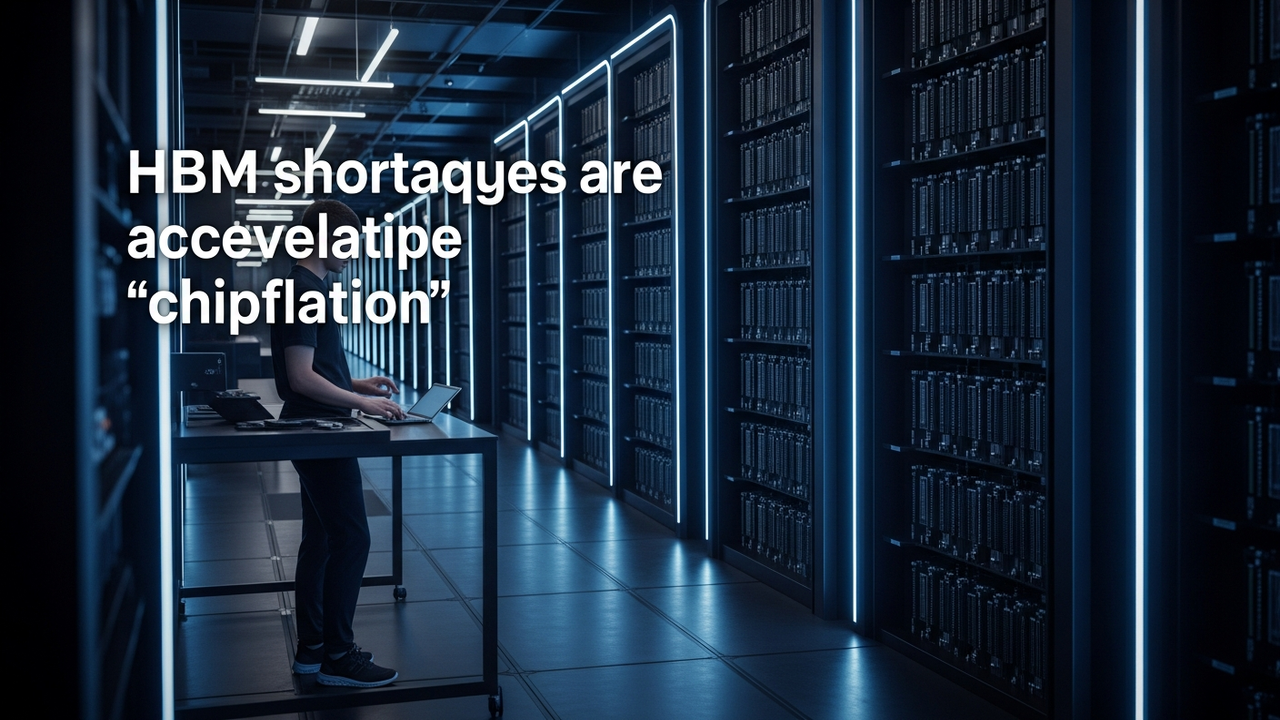
The explosive surge in AI infrastructure demand has led to a severe shortage of High-Bandwidth Memory (HBM), pushing memory chip prices into a period dubbed ‘chipflation.’ Market research firm TrendForce forecasts that this HBM shortage is not temporary but represents a ‘new normal’ that will persist as AI demand consistently outpaces available production capacity.
Market & Technical Details
The performance of AI servers depends not only on GPUs but critically on the bandwidth and capacity of the HBM connected to them. Training modern AI models requires processing vast amounts of data at high speeds, and HBM offers a significant advantage over traditional DDR5 system RAM due to its superior data transfer rates and efficiency. However, HBM manufacturing is complex and consumes up to four times more silicon wafer capacity compared to standard DDR5 memory. Consequently, as memory manufacturers prioritize HBM production, the supply of other DRAM products diminishes, leading to widespread price increases across the broader memory market.
Analysts at Morgan Stanley point to the expanding AI demand as the cause of this ‘chipflation’ phenomenon in the memory industry. This implies that not only are prices for AI hardware, including GPUs, escalating, but peripheral components, especially HBM, are also experiencing significant price hikes. Current HBM3 is already in tight supply, and TSMC’s CoWoS (Chip-on-Wafer-on-Substrate) packaging capacity is fully allocated until mid-2027. Despite efforts by major memory manufacturers like Samsung and Micron to increase HBM production, the shortage is not expected to be resolved in 2026.
- **HBM Silicon Consumption:** Consumes up to 4 times more silicon than standard DDR5, impacting the overall supply balance.
- **Chipflation:** AI demand inflates memory prices, increasing costs for cloud providers.
- **Prolonged Supply Constraints:** The HBM shortage will persist as a ‘new normal’ as long as AI demand outstrips production capacity.
Background & Context
The escalating scale and complexity of AI models have dramatically accelerated investments in AI hardware for data centers. This has led to an exponential increase in demand not only for high-performance AI chips (GPUs and AI accelerators) but also for essential HBM and the advanced packaging technologies that integrate them. Bottlenecks in advanced packaging, such as TSMC’s CoWoS, further exacerbate the HBM supply crunch. This situation exerts considerable pressure on the profit structures of cloud providers and contributes to rising costs for AI infrastructure.Strategic Significance & Outlook
The HBM shortage and ‘chipflation’ will continue to be critical challenges for the growth of the entire AI ecosystem. While memory manufacturers are undertaking massive investments to increase production capacity, catching up with demand growth will take time. In the long term, optimizing HBM production technologies, developing new packaging solutions, and strengthening the overall supply chain will be key to navigating this ‘new normal.’ Additionally, alternative HBM technologies and more efficient memory utilization through co-design of software and hardware will be explored as future solutions. Stable HBM supply is indispensable for the sustainable growth of the AI industry.
Get our weekly technology intelligence — free
Receive an infographic that lets you judge at a glance whether each field’s analysis report is worth reading.
Subscribe Free — Weekly Tech Intelligence
By subscribing, you’ll receive Troy-Technical’s weekly technology intelligence newsletter.
- Your email and selected fields are used only to deliver the newsletter.
- We never share your information with third parties.
- You can unsubscribe anytime via the link in each email.
See our Privacy Policy for details.
Takes about a minute · Unsubscribe anytime





Comments