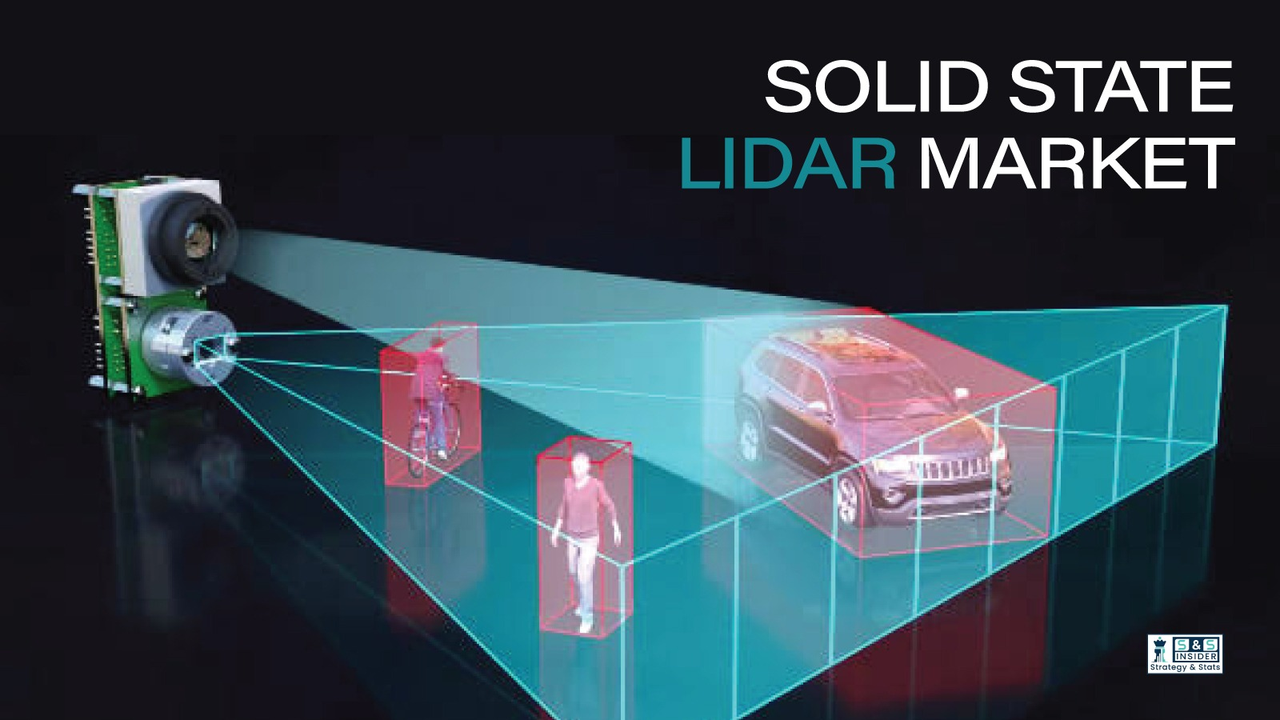
Background: The Evolution of LiDAR for Autonomous Systems
LiDAR (Light Detection and Ranging) is a crucial sensor technology for autonomous mobility, including self-driving vehicles, robotics, and industrial automation. Early LiDAR systems, relying on mechanical spinning components, faced challenges in terms of size, cost, durability, and reliability. This has driven a strong industry push towards solid-state LiDAR, which eliminates moving parts to achieve greater compactness, robustness, and mass manufacturability. The continuous innovation in underlying optical technologies is accelerating this transition.
Key Findings: Advancements in Solid-State LiDAR Technologies
The solid-state LiDAR market is being transformed by several key technological advancements and the efforts of leading companies:
- Enabling Technologies:
– Silicon Photonics: This technology allows for the fabrication of complex optical circuits on a silicon chip, significantly reducing the size and cost of LiDAR sensors while enabling high integration density. – MEMS (Micro-Electro-Mechanical Systems) LiDAR: Utilizes miniature mirrors to steer laser beams rapidly, offering a smaller and more durable alternative to fully mechanical systems. – Flash LiDAR: Illuminates an entire scene with a single flash of light, capturing 3D data instantaneously without any moving parts, ideal for high-speed applications. – 4D Sensing: Extends traditional 3D spatial data with velocity information (e.g., using Doppler effects), providing richer environmental perception crucial for predicting object movements. - Voyant Photonics’ 4D FMCW LiDAR: In April 2026, Voyant Photonics notably accelerated the commercialization of its silicon photonics-based chip-scale 4D FMCW (Frequency Modulated Continuous Wave) LiDAR solutions. FMCW LiDAR is highly valued for its superior immunity to interference and its ability to provide both distance and velocity directly, making it particularly suitable for demanding applications in robotics, industrial automation, and advanced autonomous systems.
- Contributions from Industry Leaders: Several prominent companies are driving innovation in the solid-state LiDAR space:
- Hesai Technology: A leading Chinese LiDAR company known for its high-resolution 3D sensing solutions, particularly for automotive applications.
- Luminar Technologies: Specializes in long-range, high-resolution automotive LiDAR, forming partnerships with major car manufacturers for integration into future autonomous vehicles.
- RoboSense: Another key Chinese player, offering high-performance LiDAR solutions for various applications, including autonomous driving and robotics.
These collective efforts are expected to fuel substantial growth in the solid-state LiDAR market, with forecasts predicting a multi-billion dollar valuation by 2035.
Technical Significance & Outlook: Shaping the Autonomous Future
The rapid advancements in solid-state LiDAR are technically profound, as they directly address the core challenges of autonomous mobility: safety, reliability, and cost. Improved precision, scalability, and cost-effectiveness are making LiDAR more pervasive and performant. The emergence of chip-scale LiDAR, enabled by silicon photonics, is particularly significant as it promises to miniaturize sensors, reduce manufacturing costs, and facilitate wider integration into various platforms. This evolution will allow autonomous systems to achieve higher levels of environmental perception and decision-making capabilities, accelerating the realization of a future where autonomous technologies are seamlessly integrated into daily life and industry. The projected growth of the solid-state LiDAR market is a strong indicator of this impending widespread adoption, fundamentally transforming how we interact with and navigate the physical world.
Source: https://www.snsinsider.com/blogs/solid-state-lidar-market




Comments