
Key Findings
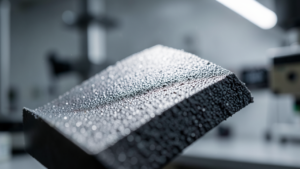
A research team at Tokyo University of Science has developed a new layered crystal, TlFe1.6Se2, characterized by atomically thin iron selenide (FeSe) layers embedded within a bulk material. This crystal successfully achieves an ideal combination of excellent thermoelectric properties: a very high thermoelectric power factor and exceptionally low thermal conductivity, positioning it as a highly promising next-generation material for waste heat recovery.
Technical / Clinical Details
TlFe1.6Se2 is distinguished by its unique layered structure, comprising alternating layers of thermoelectrically active Tl-Se and insulating-like FeSe layers. The embedding of atomically thin FeSe layers within the bulk material effectively induces phonon scattering (quantum units that carry heat) without impeding the movement of charge carriers in the highly electronically conductive Tl-Se layers. This mechanism dramatically reduces thermal conductivity. This ‘electron-crystal, phonon-glass’ characteristic provides an ideal combination for thermoelectric materials, maintaining high electrical conductivity while achieving low thermal conductivity. The developed TlFe1.6Se2 exhibits an excellent thermoelectric figure of merit (ZT value) near room temperature, with confirmed stability across a broad temperature range. This innovative material design strategy holds the potential to significantly enhance the efficiency of thermoelectric power generation.
Background & Context
Thermoelectric materials are gaining attention in fields such as waste heat recovery, solid-state cooling, and sensing, as they can directly convert temperature differences into electrical energy or use electrical energy for cooling. The vast amount of waste heat generated globally (e.g., in factories, automobiles, data centers) is currently released into the environment unused. Its recovery is crucial for improving energy efficiency and reducing CO2 emissions. However, existing thermoelectric materials have struggled to balance high performance with practical applicability, particularly facing challenges with efficiency at lower temperatures. The research from Tokyo University of Science offers a promising solution to this long-standing problem, poised to accelerate the commercial application of thermoelectric materials worldwide.
Strategic Significance & Outlook
The discovery of TlFe1.6Se2 has the potential to revolutionize various applications, including waste heat recovery systems, exhaust heat power generation in automobiles, improved energy efficiency in industrial processes, and compact power sources for wearable devices. Particularly, its excellent thermoelectric performance and the simplicity of its synthesis suggest applicability for large-scale manufacturing processes. The research team plans to continue its work on further optimizing this material, evaluating its stability, and integrating it into practical devices. This achievement is expected to significantly contribute to the development of clean energy technologies for a sustainable society, placing Japan at the forefront of this critical materials innovation.
Source: https://www.eurekalert.org/news-releases/1049511
Get our weekly technology intelligence — free
Receive an infographic that lets you judge at a glance whether each field’s analysis report is worth reading.
Subscribe Free — Weekly Tech Intelligence
By subscribing, you’ll receive Troy-Technical’s weekly technology intelligence newsletter.
- Your email and selected fields are used only to deliver the newsletter.
- We never share your information with third parties.
- You can unsubscribe anytime via the link in each email.
See our Privacy Policy for details.
Takes about a minute · Unsubscribe anytime







Comments