Key Findings
Animal-free proteins produced using precision fermentation technology hold immense potential to revolutionize the food industry. However, the transition from lab-scale to industrial production presents several formidable challenges, including maintaining strain performance, managing high media costs, and ensuring precise bioprocess control.
Technical / Clinical Details
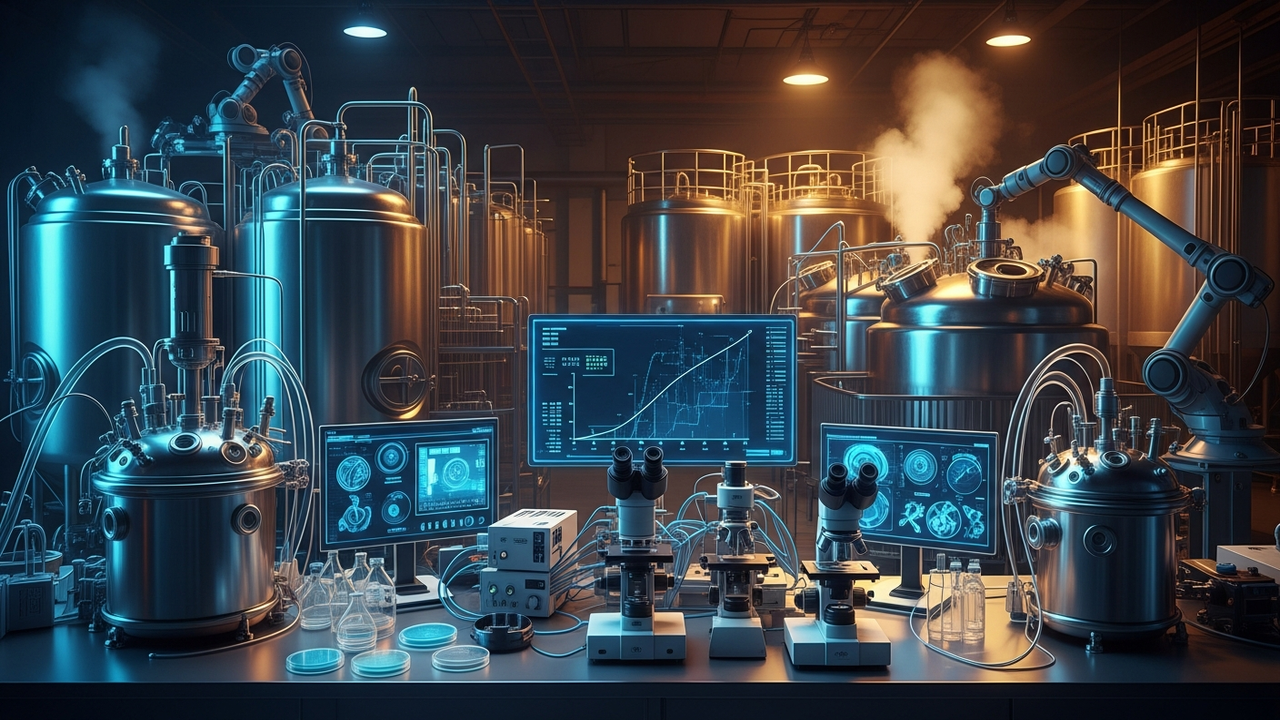
Protein production through precision fermentation involves cultivating microorganisms in large bioreactors. When scaling up from small laboratory flasks to industrial fermenters of thousands of liters, several complex technical hurdles emerge:
- Maintaining Strain Performance: As scale increases, factors such as oxygen transfer efficiency, mixing dynamics, and shear stress change. This can make it difficult for strains optimized in the lab to perform identically at industrial scale, potentially leading to reduced yield and quality of the target protein.
- Optimizing Media Costs: Precision fermentation typically uses expensive, high-purity media, including carbon sources (e.g., glucose), nitrogen sources, and micronutrients, to maximize microbial growth and target protein expression. In industrial-scale production, these media costs constitute a significant portion of the total manufacturing cost, making the development of cost-effective alternative media and process optimization essential.
- Precise Bioprocess Control: Even slight deviations in parameters such as pH, dissolved oxygen concentration, temperature, and agitation speed within the bioreactor can negatively impact microbial physiology and protein expression. In large-scale systems, uniformly and precisely controlling these parameters is technically challenging, requiring advanced sensors, control algorithms, and automation systems.
Overcoming these challenges requires deep expertise in bioprocess engineering and innovative solutions.
Background & Context
Driven by global population growth and increasing environmental awareness, the demand for sustainable alternative proteins is soaring. Precision fermentation is expected to be a key technology in meeting this demand by offering environmentally friendly and ethical alternatives to animal-derived proteins (such as dairy, eggs, and meat). However, the commercial success of this technology hinges on its ability to reduce manufacturing costs to competitive levels and ensure supply stability. Current challenges are major factors impeding the bridge from fundamental research to market availability.
Strategic Significance & Outlook
For animal-free proteins from precision fermentation to become a mainstream component of the food system, resolving the technical and economic challenges discussed above is imperative. Research and development must focus on developing more robust and efficient strains, cheaper media, and precise process control technologies for large-scale bioreactors. Companies will need to prioritize innovation across the entire manufacturing process and collaborate with partners who possess scale-up expertise. Investors see significant growth opportunities in companies that can overcome these hurdles and establish sustainable alternative protein production capabilities. Progress in this field is expected to contribute significantly to food security and environmental sustainability.
Source: https://www.mdpi.com/2076-3417/16/15/7392
Get our weekly technology intelligence — free
Receive an infographic that lets you judge at a glance whether each field’s analysis report is worth reading.
Subscribe Free — Weekly Tech Intelligence
By subscribing, you’ll receive Troy-Technical’s weekly technology intelligence newsletter.
- Your email and selected fields are used only to deliver the newsletter.
- We never share your information with third parties.
- You can unsubscribe anytime via the link in each email.
See our Privacy Policy for details.
Takes about a minute · Unsubscribe anytime









Comments