Key Findings
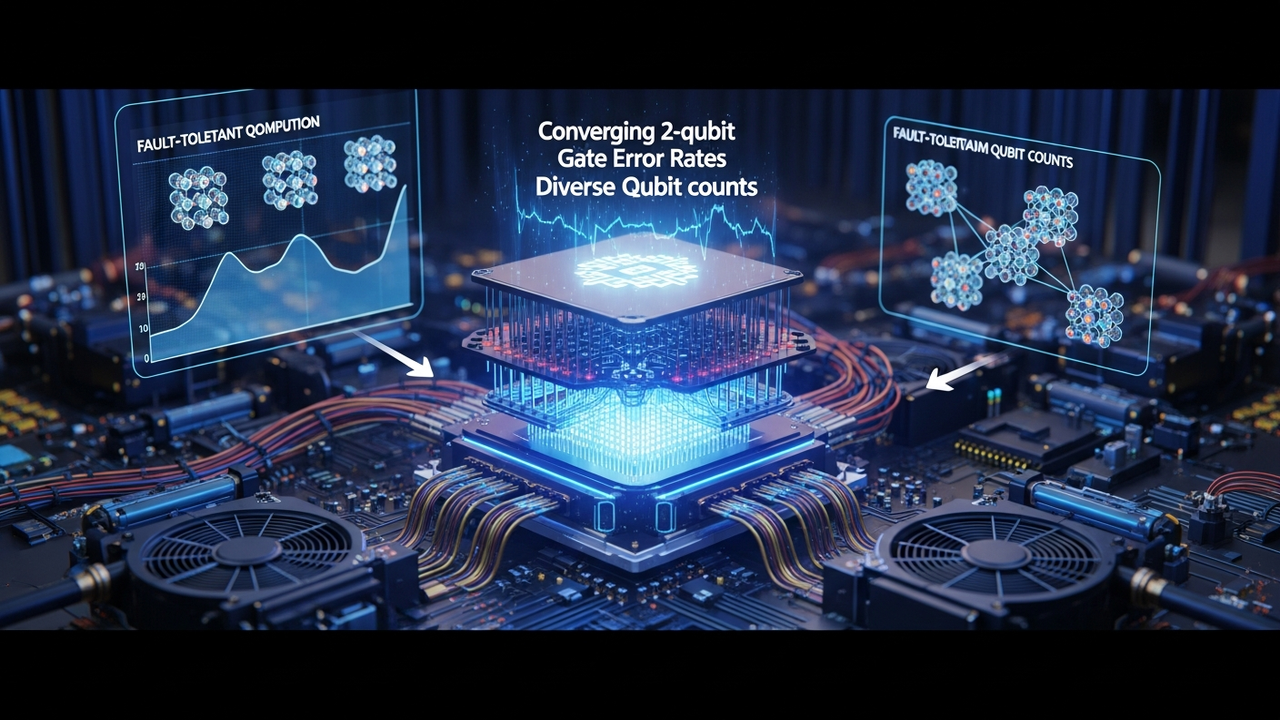
A recent paper published in MDPI’s Philosophies journal provides a comprehensive analysis of technological advancements across diverse quantum computing platforms, including trapped-ion, superconducting circuits, neutral atoms, silicon spin, photonic, and bosonic (cat qubit) systems. The study highlights a notable convergence in two-qubit gate error rates and an increasing diversity in qubit counts, signaling significant progress towards achieving quantum advantage and ultimately, fault-tolerant quantum computing.
Technical Details
- Platform Analysis: The review scrutinizes six primary quantum computing architectures, evaluating their individual progress. Despite their distinct physical foundations, all platforms demonstrate a common pursuit of reducing error rates and scaling qubit numbers.
- Error Rate Convergence: A critical observation is the consistent reduction and convergence of two-qubit gate error rates across these platforms, moving closer to the thresholds required for fault-tolerant quantum computing. This improvement is fundamental for enhancing the reliability of quantum calculations and enabling practical quantum error correction.
- Ecosystem Knowledge Accumulation: The paper emphasizes that the collective accumulation and sharing of knowledge in error correction theories, sophisticated control electronics, and advanced manufacturing methods across different platforms are accelerating the overall maturity of quantum technology. This collaborative knowledge transfer is expected to boost innovation speed and mitigate redundant investments within various technology domains.
Background & Context
The quantum computing landscape has seen rapid evolution, with numerous companies and research institutions globally pursuing development across various physical modalities. Current Noisy Intermediate-Scale Quantum (NISQ) devices are prone to errors, indicating a substantial gap before large-scale fault-tolerant quantum computing becomes a reality. However, as the paper points out, the observed improvements in error rates across leading technological platforms suggest that quantum computing is actively transitioning from a purely theoretical discipline to a more practical one. Each platform leverages its unique strengths—e.g., trapped ions for long coherence times, superconducting circuits for fast gate operations—to contribute to solving specific challenges.
Strategic Significance & Outlook
The convergence of two-qubit gate error rates and the increase in diverse qubit architectures suggest a significant boost in the practical capabilities quantum computers can achieve in the coming years. Advancements in error correction and cross-ecosystem knowledge sharing are likely to accelerate the timeline for fault-tolerant quantum computing. This will unlock capabilities for previously intractable computations in fields such as drug discovery, new materials development, financial modeling, and artificial intelligence, promising a transformative impact on industry. Researchers and investors must closely monitor these technological indicators to assess which platforms are poised to deliver the next major breakthroughs and capitalize on emerging opportunities.
Source: https://www.mdpi.com/2409-9287/11/4/127
Get our weekly technology intelligence — free
Receive an infographic that lets you judge at a glance whether each field’s analysis report is worth reading.
Subscribe Free — Weekly Tech Intelligence
By subscribing, you’ll receive Troy-Technical’s weekly technology intelligence newsletter.
- Your email and selected fields are used only to deliver the newsletter.
- We never share your information with third parties.
- You can unsubscribe anytime via the link in each email.
See our Privacy Policy for details.
Takes about a minute · Unsubscribe anytime









Comments