Key Findings
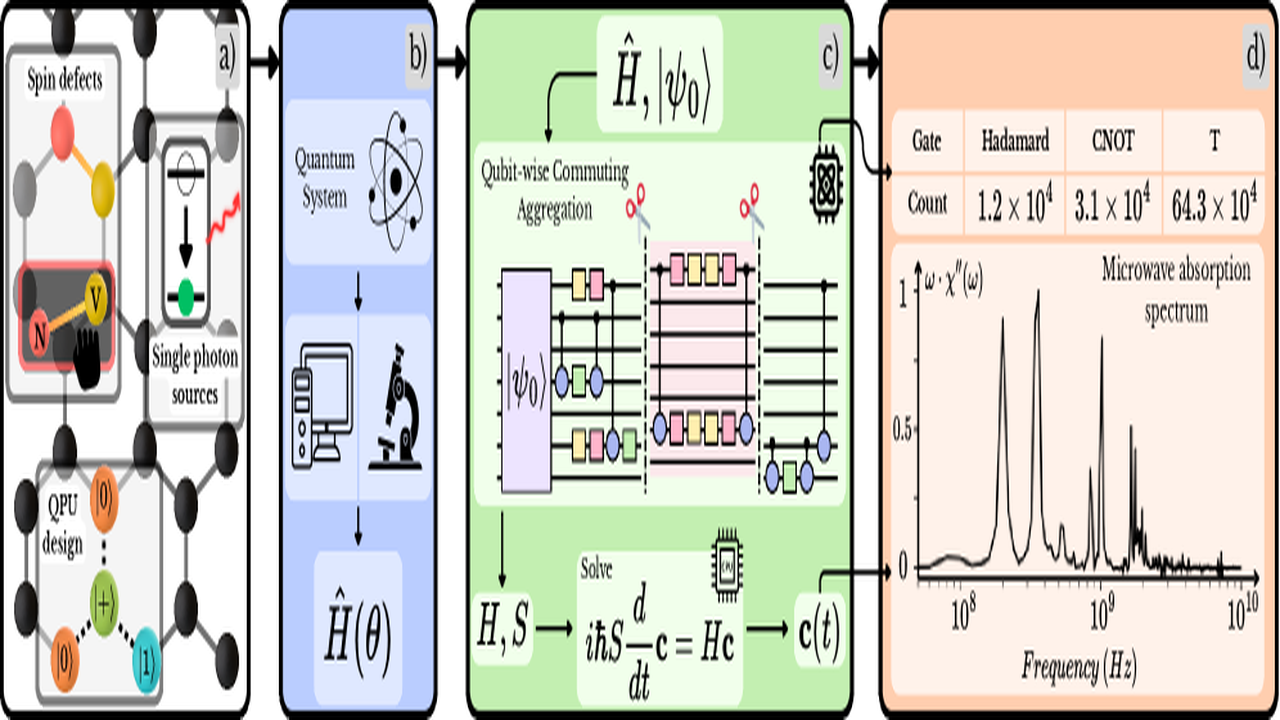
This arXiv preprint introduces a novel quantum computer-assisted framework designed for simulating interacting spin systems in solids, directly applicable to the design and optimization of various quantum technologies. This includes quantum sensors, single-photon sources, and spin-defect-based quantum registers and processors. Crucially, the framework enables access to extended time dynamics within the constraints of Noisy Intermediate-Scale Quantum (NISQ) and early fault-tolerant hardware, offering a groundbreaking approach to accelerate solid-state spin qubit technology development.
Technical Details
- Quantum-Assisted Design: The proposed framework leverages quantum computers to efficiently simulate spin systems within interacting solids. This capability allows researchers to explore more complex quantum system behaviors and design parameters that are computationally prohibitive for traditional classical simulation methods due to their exponential scaling.
- Extended Time Dynamics: A key innovation is the ability to simulate the time evolution of quantum systems over extended durations, even with the limited coherence times of NISQ devices. This is achieved through advanced circuit design and algorithmic approaches, which is critical for accurate performance prediction in quantum material science and quantum sensing applications.
- Nitrogen-Vacancy Center Testbed: As a proof-of-concept, nitrogen-vacancy (NV) centers in diamond were utilized as a testbed. NV centers are excellent candidates for solid-state spin qubits, known for their long coherence times, making them ideal for demonstrating the framework’s effectiveness. Benchmark comparisons against classical simulations confirmed the framework’s accuracy and utility.
- Flexible Blueprint: The methodology is not restricted to a single hardware type, providing a “flexible blueprint” applicable to the design, comparative analysis, and optimization of various solid-state spin qubit technologies. This facilitates rapid prototyping and iterative improvement of new quantum devices.
Background & Context
The advancement of quantum technologies heavily relies on the precise design and fabrication of high-performance qubits. However, the inherent complexity of quantum systems rapidly makes classical simulation intractable. Especially in the NISQ era, where devices are inherently noisy, efficient design and optimization tools are indispensable for performance enhancement. This research proposes a meta-approach, using quantum computers as design tools themselves, which could potentially accelerate the self-improvement cycle of quantum computing. Solid-state spin qubits are highly promising components for quantum sensing, quantum communication, and quantum computing, making their optimization directly linked to broad progress in quantum technologies.
Strategic Significance & Outlook
This new framework has the potential to fundamentally shift the paradigm of quantum technology development. By empowering quantum computers to design and refine their own “components,” it will accelerate the development of higher-performance quantum sensors, more efficient single-photon sources, and more robust quantum processors. Crucially, the ability to overcome NISQ device limitations and explore longer quantum dynamics will significantly hasten the realization of practical quantum applications. Investors and technologists should pay close attention to the impact this self-optimization approach could have on the growth and maturity of the entire quantum ecosystem, potentially leading to faster commercialization and broader industrial adoption.
Source: https://arxiv.org/html/2601.22091v2
Get our weekly technology intelligence — free
Receive an infographic that lets you judge at a glance whether each field’s analysis report is worth reading.
Subscribe Free — Weekly Tech Intelligence
By subscribing, you’ll receive Troy-Technical’s weekly technology intelligence newsletter.
- Your email and selected fields are used only to deliver the newsletter.
- We never share your information with third parties.
- You can unsubscribe anytime via the link in each email.
See our Privacy Policy for details.
Takes about a minute · Unsubscribe anytime









Comments