Key Findings
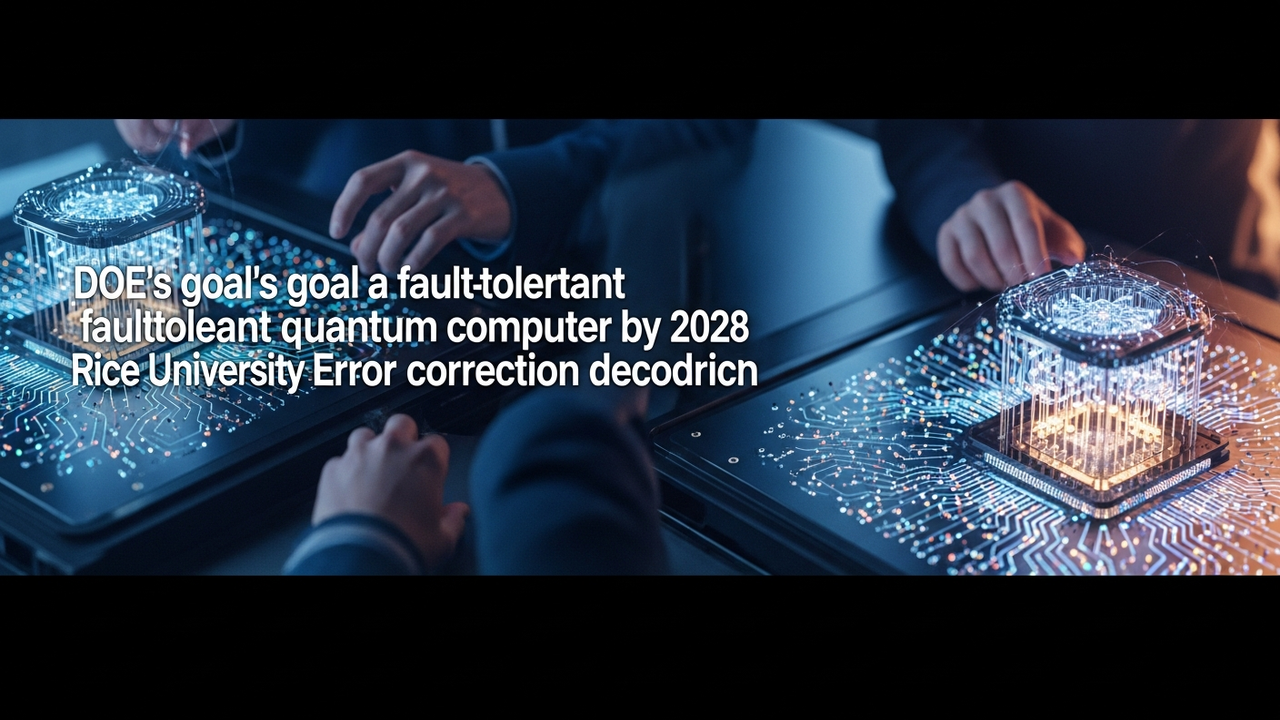
The U.S. Department of Energy (DOE) has set an exceptionally ambitious target to deliver a fault-tolerant quantum computer by 2028. To advance this goal, Rice University has joined the DOE’s Quantum Science Center (QSC), focusing its research on scaling quantum error correction decoding. Rice has been awarded a $900K grant over five years for this critical work. The QSC, led by Oak Ridge National Laboratory (ORNL) with partners including industry giants like IBM and Quantinuum, is pursuing this aggressive timeline, which is significantly ahead of many commercial roadmaps. Rice University’s specialized expertise will directly address the bottleneck of classical high-performance computing within the quantum error correction process.
Technical Details
- Fault-Tolerant Quantum Computing Goal: A fault-tolerant quantum computer is designed to automatically correct errors that occur in individual qubits due to noise and environmental interference, enabling large-scale and highly reliable computations. The 2028 target implies rapid advancement not just in increasing qubit counts, but crucially in technologies that dramatically reduce error rates.
- Scaling Quantum Error Correction Decoding: Quantum error correction protects logical qubits by utilizing redundancy across many physical qubits. However, the process of detecting and correcting these errors (decoding) demands substantial classical computational resources, which can become a major bottleneck for scaling quantum systems. Rice University’s research will focus on developing novel algorithms and hardware architectures to efficiently scale this decoding process.
- QSC Structure and Role: The QSC is a broad academic-industrial partnership program led by ORNL, aiming to drive quantum technology from foundational research to applied development. Corporate partners like IBM and Quantinuum contribute hardware and software expertise, while academic institutions like Rice focus on specific technical challenges, such as error correction breakthroughs.
Background & Context
Quantum computing holds the promise of revolutionizing fields from pharmaceuticals and materials science to finance and AI, but current noisy intermediate-scale quantum (NISQ) devices are limited by high error rates. Achieving a fault-tolerant quantum computer is the indispensable step to overcome these limitations and unlock true quantum advantage. Large-scale investments by government agencies like the DOE, coupled with robust collaboration between academia and industry, are part of a national strategy to tackle this complex challenge.
Strategic Significance & Outlook
Rice University’s participation in the QSC, specifically addressing the quantum error correction decoding bottleneck, significantly enhances the likelihood of achieving the ambitious 2028 goal. This research is also crucial for enabling optimal collaboration between classical and quantum computers (hybrid computing). If a fault-tolerant quantum computer is demonstrated by 2028, it would have an immeasurable impact on scientific research and industrial applications, accelerating a new wave of technological revolution. Future research outcomes will serve as critical indicators for shaping the practical timeline of quantum computing.
Source: https://thedailyquantum.com/articles/rice-doe-quantum-science-center-fault-tolerant-2028
Get our weekly technology intelligence — free
Receive an infographic that lets you judge at a glance whether each field’s analysis report is worth reading.
Subscribe Free — Weekly Tech Intelligence
By subscribing, you’ll receive Troy-Technical’s weekly technology intelligence newsletter.
- Your email and selected fields are used only to deliver the newsletter.
- We never share your information with third parties.
- You can unsubscribe anytime via the link in each email.
See our Privacy Policy for details.
Takes about a minute · Unsubscribe anytime






Comments