Key Findings
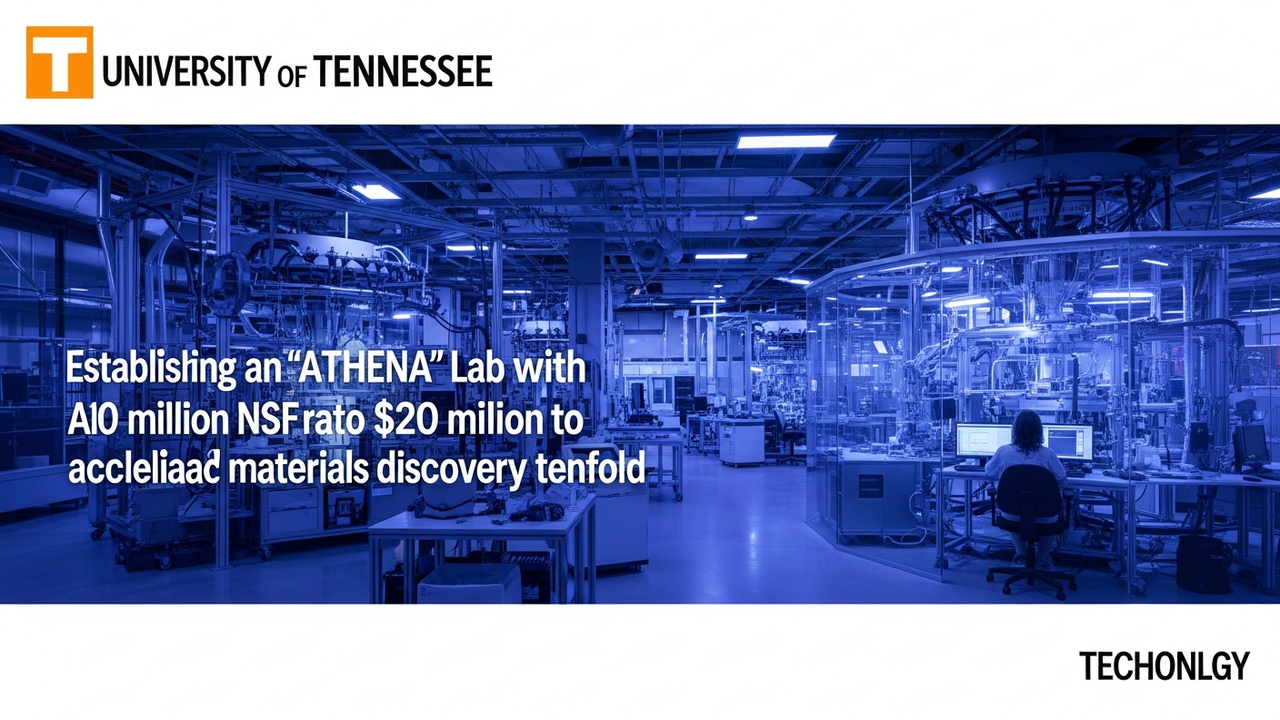
The University of Tennessee, Knoxville, has been awarded a substantial $20 million grant from the U.S. National Science Foundation (NSF) to launch the ‘ATHENA’ initiative. This initiative will serve as one of 20 research hubs in a national network of AI-driven laboratories, aiming to pioneer breakthroughs in automated materials discovery. ATHENA’s primary objective is to dramatically accelerate the design, synthesis, characterization, and autonomous optimization of advanced materials, enabling rapid identification of those with the highest potential for real-world applications. Initial projections anticipate an improvement in the speed of some material characterization experiments by 10 to 30 times.
Technical Details
The ATHENA initiative will establish an AI-driven laboratory environment integrating the following advanced technologies:
- AI-Driven Material Design: Machine learning algorithms will learn material structure-property relationships from vast datasets to generate design candidates for new materials with desired functionalities. This approach complements and enhances traditional human-led design processes that rely on intuition and experience.
- Automated Synthesis and Characterization: Robotic systems and automated instruments will autonomously perform material synthesis, processing, and various characterization experiments. This includes advanced analytical tools like X-ray diffraction, electron microscopy, and spectroscopy, enabling high-precision and high-throughput data collection.
- Autonomous Optimization: AI agents will analyze data from synthesis and characterization in real-time, autonomously recommending the next experimental steps or modifications to material composition. This closed-loop feedback system will exponentially accelerate the material development optimization cycle.
- Cloud-Accessible Lab Workflows and Digital Tools: The initiative will provide a cloud-based platform allowing researchers to remotely access laboratory equipment and design/execute experiments regardless of geographical constraints. This democratizes access to advanced research infrastructure, enabling broader participation in cutting-edge science.
Through this integrated approach, ATHENA aims to accelerate material discovery across diverse fields, including clean energy, advanced semiconductors, and biomedical materials. For instance, it will enable efficient screening of new battery materials and rapid optimization of catalysts with specific functionalities, significantly shortening time-to-market for new products.
Background and Industry Context
Rapidly translating new scientific discoveries into societal applications is a pressing challenge in materials science. Conventional material development processes often serve as time-consuming and costly bottlenecks, particularly for exploring complex, multifunctional materials that demand immense resources. Recognizing the criticality of AI and automation in material development, the U.S. National Science Foundation (NSF) has made a substantial investment in establishing a nationwide network of AI-driven laboratories. The ATHENA initiative is a cornerstone of this national strategy, intended to strengthen U.S. scientific and technological competitiveness and foster the next generation of innovators. This effort aligns with a global trend where countries are actively integrating AI into materials science to enhance research and development efficiency.
Future Outlook
The ATHENA initiative also emphasizes cultivating the next generation of scientists and engineers working at the intersection of AI and experimental science. Through the development and sharing of open software standards, it aims to foster collaboration across the materials science community and accelerate knowledge dissemination. In the future, this national network is expected to expand further, accommodating a wider array of material systems and application areas. This will pave the way for groundbreaking materials to be discovered and commercialized at unprecedented speeds, contributing to solutions for global challenges such such as climate change, energy security, and healthcare.
Get our weekly technology intelligence — free
Receive an infographic that lets you judge at a glance whether each field’s analysis report is worth reading.
Subscribe Free — Weekly Tech Intelligence
By subscribing, you’ll receive Troy-Technical’s weekly technology intelligence newsletter.
- Your email and selected fields are used only to deliver the newsletter.
- We never share your information with third parties.
- You can unsubscribe anytime via the link in each email.
See our Privacy Policy for details.
Takes about a minute · Unsubscribe anytime