Key Findings: Energy-Constrained MLIP Embedding Significantly Boosts Prediction Accuracy for Hydrogen Evolution Electrocatalysts
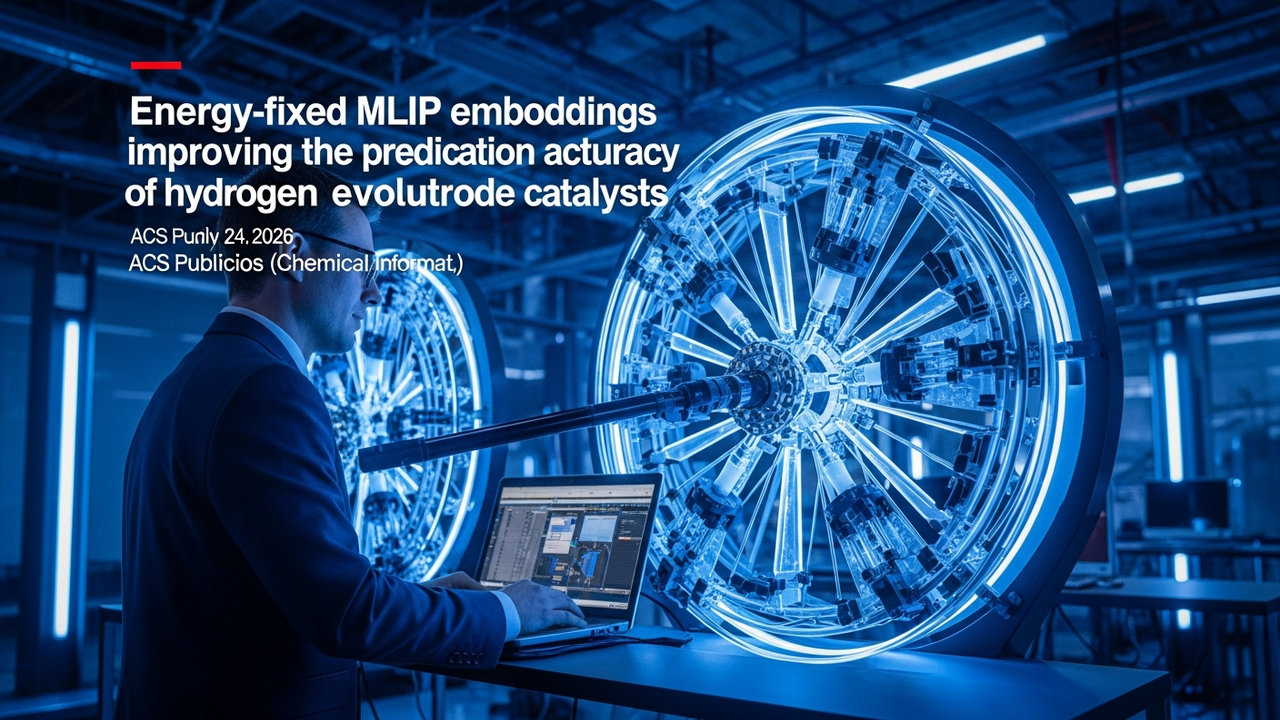
A team of researchers has developed a groundbreaking machine learning framework to more accurately predict hydrogen adsorption energies on diverse catalytic surfaces. This “energy-constrained” framework integrates energy descriptors extracted from machine learning interatomic potentials (MLIPs) with pre-trained latent embeddings from a Crystal Hamiltonian Graph Neural Network (CHGNet). This approach significantly enhances predictive accuracy without the need to retrain existing interatomic potential models, providing a robust tool for accelerating the efficient screening and discovery of materials such as hydrogen evolution reaction (HER) catalysts.
Technical & Clinical Details: High-Precision Prediction via Hybrid MLIP and GNN Approach
This new framework leverages the local energy description capabilities of MLIPs and the insights into the overall electronic structure of materials from GNNs to model complex adsorption phenomena on catalytic surfaces with high precision. Specifically, MLIPs capture detailed energy contributions at individual atoms and their local environments, while CHGNet provides latent embeddings that comprehensively represent the electronic state of a material through Hamiltonian-based learning across the entire crystal structure. The framework integrates MLIP-calculated energy descriptors by “constraining” them within the latent space of CHGNet, thereby utilizing the strengths of both models while compensating for their respective limitations. As a result, prediction errors for hydrogen adsorption energies are substantially reduced across diverse catalytic materials with various surface sites and compositions, enabling high-precision screening previously difficult with conventional methods. This improvement in accuracy directly translates to reducing the number of costly first-principles calculations, thereby cutting development time and costs.
Background & Context: Importance of Clean Hydrogen Production and Catalyst Development
In the transition to clean energy, hydrogen production via water electrolysis is a critical technology. The development of efficient hydrogen evolution electrocatalysts is crucial for the performance and cost-effectiveness of this process. However, discovering ideal catalysts requires exploring an enormous number of material candidates and surface structures, which has been inefficient using only traditional experimental methods or first-principles calculations. The application of materials informatics, particularly AI technologies like MLIPs and GNNs, is expected to be a powerful means to overcome this bottleneck in catalyst discovery. The results of this study enhance the reliability of computational catalyst design and contribute to the realization of a sustainable hydrogen energy society.
Strategic Significance & Outlook: Applications in Multifunctional Catalyst Design and Industrial Deployment
This energy-constrained MLIP embedding framework holds potential for application beyond hydrogen evolution catalysts, extending to the design of catalysts for other important electrochemical reactions such as oxygen evolution reaction (OER), carbon dioxide reduction reaction (CO2RR), and fuel cells. The widespread adoption of this technology is expected to accelerate R&D cycles, leading to the rapid commercialization of higher-performance, durable, and lower-cost catalyst materials. In the future, it is anticipated to evolve as a foundational technology for AI-driven catalyst screening platforms, significantly propelling the commercialization of clean energy technologies.
Source: https://pubs.acs.org/doi/10.1021/acs.jcim.6c01720
Get our weekly technology intelligence — free
Receive an infographic that lets you judge at a glance whether each field’s analysis report is worth reading.
Subscribe Free — Weekly Tech Intelligence
By subscribing, you’ll receive Troy-Technical’s weekly technology intelligence newsletter.
- Your email and selected fields are used only to deliver the newsletter.
- We never share your information with third parties.
- You can unsubscribe anytime via the link in each email.
See our Privacy Policy for details.
Takes about a minute · Unsubscribe anytime