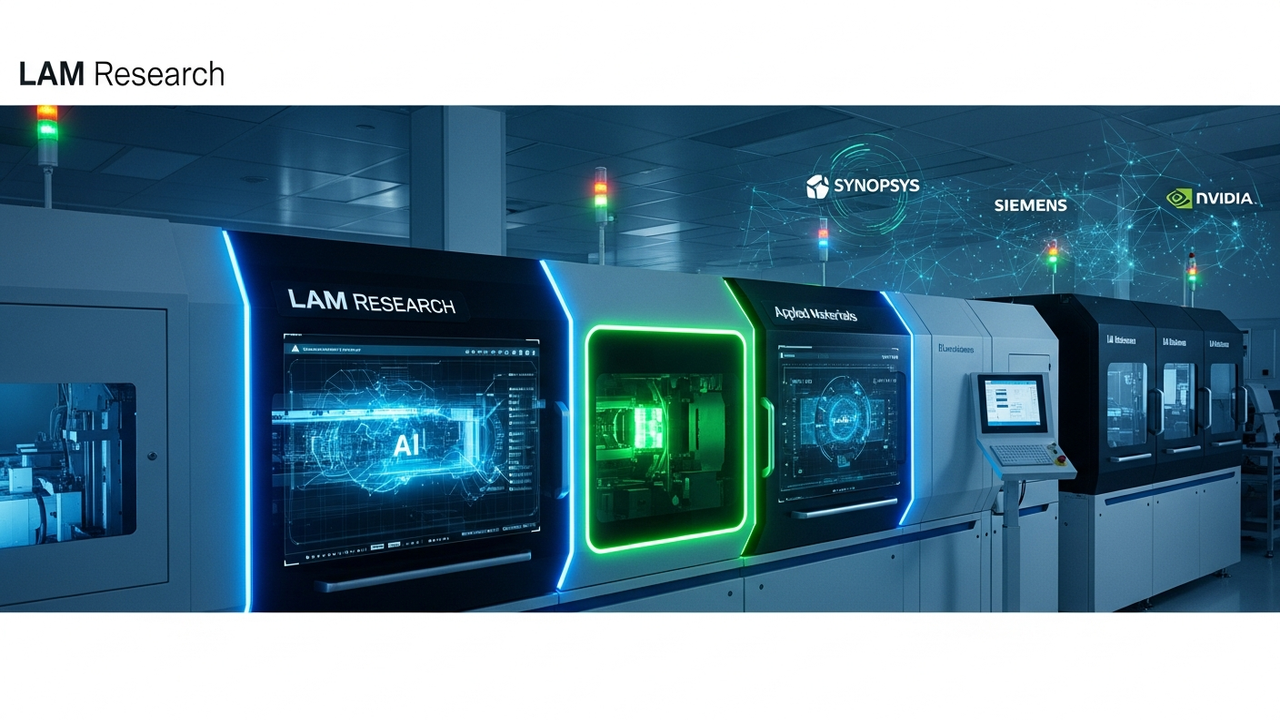
Key Findings: LAM Research, Applied Materials, Synopsys, Siemens, and NVIDIA Dramatically Boost Semiconductor Manufacturing Productivity with AI Integration
According to a Forbes article, leading players in the semiconductor industry, LAM Research and Applied Materials, are achieving remarkable results by deeply integrating artificial intelligence (AI) to enhance design and manufacturing productivity. Specifically, Applied Materials’ “Ai^x” platform reports dramatic efficiency improvements, such as accelerating manufacturing chamber simulation times by up to 35x through the use of AI and GPU-accelerated simulations. Furthermore, Electronic Design Automation (EDA) software giants Synopsys and Siemens have strategically partnered with NVIDIA to develop autonomous engineering workflows and self-validating AI agents for EDA. This has led to accelerated chip verification and the optimization of thousands of process variables, thereby significantly speeding up the innovation cycle across the entire semiconductor industry.
Technical & Clinical Details: Integration of Digital Twins, Autonomous AI Agents, and GPU-Accelerated Simulations
LAM Research’s “Semiverse” concept and Applied Materials’ “Ai^x” platform create digital twins of semiconductor manufacturing processes, allowing AI to optimize processes in a virtual environment. This significantly reduces the number of physical prototypes and experimental costs. For example, in complex manufacturing steps like etching and deposition, AI learns optimal process parameters from vast simulation data and feeds those results back into actual production lines. In partnership with NVIDIA, Synopsys and Siemens are maximizing the capabilities of AI agents in EDA workflows by leveraging GPU-accelerated computing resources. These autonomous AI agents identify bottlenecks and propose solutions throughout the entire process, from early chip design to verification and final manufacturing. Particularly in chip verification, AI has accelerated processes that traditionally took weeks of human effort to a matter of hours, and by simultaneously optimizing thousands of process variables, it contributes to yield improvement and performance maximization.
Background & Context: Slowing Moore’s Law and AI as a New Growth Driver for the Semiconductor Industry
The semiconductor industry faces the significant challenge of slowing Moore’s Law due to physical limits in miniaturization. To maintain the historical pace of performance improvement, fundamental innovations in materials science, process technology, and design automation are essential. AI has emerged as a powerful driver to address this challenge, with the potential to dramatically enhance productivity and efficiency in the semiconductor industry through data analysis, pattern recognition, optimization, and autonomous decision-making. The large-scale investments and collaborations in AI by leading companies indicate a shared understanding that AI is a central technology shaping the future of the semiconductor industry.
Strategic Significance & Outlook: AI-Driven Transformation of the Entire Semiconductor Ecosystem and Enhanced Competitiveness
The integration of AI into semiconductor manufacturing will accelerate the transformation of not just individual chip performance but the entire semiconductor ecosystem. From design cycles to manufacturing processes, quality control, and supply chain optimization, AI will create value at every stage. This movement will enable the rapid development of next-generation AI accelerators, quantum computing chips, and edge AI devices, strengthening the competitiveness of individual companies and nations. The collaborative efforts of industry leaders such as NVIDIA, Applied Materials, LAM Research, Synopsys, and Siemens suggest a future where AI ushers in a new era of innovation in the semiconductor industry, reinforcing the foundation of our digital society.
Get our weekly technology intelligence — free
Receive an infographic that lets you judge at a glance whether each field’s analysis report is worth reading.
Subscribe Free — Weekly Tech Intelligence
By subscribing, you’ll receive Troy-Technical’s weekly technology intelligence newsletter.
- Your email and selected fields are used only to deliver the newsletter.
- We never share your information with third parties.
- You can unsubscribe anytime via the link in each email.
See our Privacy Policy for details.
Takes about a minute · Unsubscribe anytime